 India GO
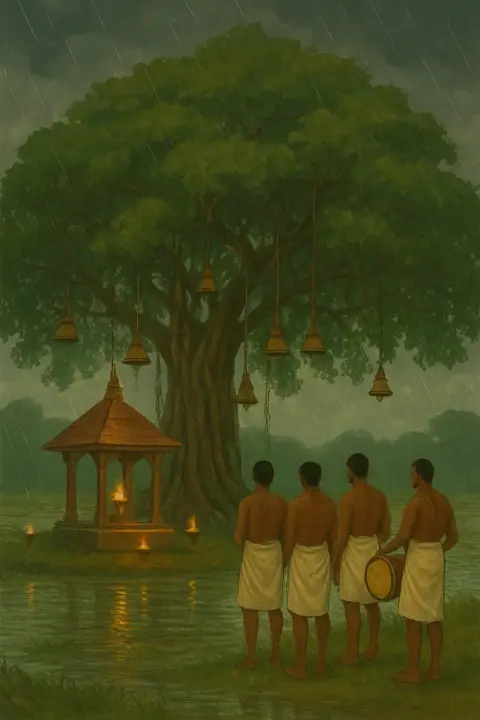
Ochira Kali and the Panthrandu Vilakku at Oachira
A mock battle fought knee-deep in a flooded monsoon field
Ochira Kali is a mock battle fought in a waterlogged paddy field beside the Oachira Parabrahma temple in Kollam district, Kerala, on the first two days of the Malayalam month of Mithunam, in mid-June. The temple is one of the most unusual in Kerala: it has no idol and no covered shrine, and people worship the formless Parabrahmam under trees. The same temple holds the Panthrandu Vilakku, twelve days of lamps and prayer in Vrischikam, and a festival of giant bull effigies 28 days after Onam.
The dates follow the Malayalam solar calendar; the temple committee runs the festival.
The legend

The Parabrahma temple at Oachira is unlike other Kerala temples: it has no sanctum and no idol. Shiva and Vishnu are worshipped at two banyan platforms.
The field by the temple recalls the wars between the kings of Kayamkulam and Venad. Oachira Kali is held there on the 1st and 2nd of Mithunam in their memory.

Fighters from the 52 communities of Onattukara keep a vow and train in kalari first. Real weapons were banned long ago; swords and shields are mock ones.
Customs
Battle in the water
In the waterlogged field by the temple, fighters led by their kalari masters stage the battle, shouting the cry 'thee thee theai'.
Twelve lamps
The separate Panthrandu Vilakku runs from 1 to 12 Vrischikam: pilgrims build huts by the temple, sing hymns and feed the needy.
A temple without an idol
Kerala Tourism describes the Oachira temple as dedicated to Parabrahmam, also called Omkaram, the universal consciousness. It practises worship without an idol and has no covered structure: devotees pray under the trees of the temple ground. Shiva and Vishnu are worshipped at two platforms built around banyan trees. Wikipedia puts the temple ground at about 36 acres and notes that it is known as Dakshina Kashi, the Kashi of the south. The town lies on National Highway 66 on the border of Kollam and Alappuzha districts.
The battle in the water
Ochira Kali takes place in the padanilam, the battlefield, a paddy field next to the temple that is flooded in the monsoon. Boys and men, divided into two groups and led by their kalari (martial arts school) masters, fight a playful but vigorous battle, knee-deep in water, splashing mud at each other to the beat of drums and shouting the cry 'thee thee theai'. Real weapons were banned long ago; the participants use sticks, and the swords and shields are mock ones.
The fighters come from the 52 karas (communities) of Onattukara, the surrounding region, and keep a vow and train in kalari beforehand. The field recalls old wars of the Kayamkulam kingdom. Wikipedia says the soldiers of the Kayamkulam Raja met at Oachira every year for war exercises, and that the region had about 108 kalaris in 52 karas until the early 20th century.
Three festivals at one temple
The temple's year has three festivals that draw crowds. The dates-by-year list above shows both the June battle and the November lamps.
Ochira Kali (Mithunam 1–2, mid-June)
The mock battle in the flooded field, during the monsoon.
Panthrandu Vilakku (Vrischikam 1–12)
Twelve days of lamps, from mid-November in the Gregorian calendar. Pilgrims build huts by the temple and stay there, sing hymns and feed the needy.
Irupathettam Onam (28 days after Onam)
Giant bull effigies of cloth and hay, the eduppu kala, are pulled to the temple on wheeled platforms. Kerala Tourism calls it one of the biggest festivals of the region.
Getting there
Oachira is on National Highway 66, about 32 km from Kollam, and is served by KSRTC buses and by Oachira railway station on the Southern Railway. Kerala Tourism notes that its festival dates are calculated from the Malayalam calendar and can change with local custom, so confirm the days with the temple before travelling.
If you are on the coast between Kollam and Alappuzha, two other temple festivals of the area have pages here: Mannarasala Ayilyam at the serpent temple near Haripad and the Chettikulangara Kumbha Bharani.
Watching safely and respectfully
Ochira Kali is open to all and free to watch, but it is a ritual kept under a vow.
- Stay out of the field — Watch from the edge of the padanilam. Fighters move fast, and mud and water fly.
- Protect your gear — It is the monsoon and you will get splashed: keep your phone and camera in a waterproof bag.
- Crowds — The FCDO notes that stampedes have occurred at some events with large crowds, including religious gatherings. Agree a meeting point and keep away from crushes at the field's edge.
FAQ
When is Ochira Kali?
On the first two days of the Malayalam month of Mithunam, in mid-June. The date tag for this temple covers two festivals and shows whichever comes first, Ochira Kali in June or the Panthrandu Vilakku in November and December: 17–28 November 2026 (expected).
Is Oachira in Kollam or Alappuzha?
The temple is in Kollam district, on National Highway 66 right on the border with Alappuzha district.
What is the Panthrandu Vilakku?
Twelve days of lamps, Vrischikam 1 to 12, from mid-November, when pilgrims live in huts by the temple, sing hymns and feed the needy.
What is Ochira Kalakettu?
The festival of Irupathettam Onam, 28 days after Onam, when giant bull effigies of cloth and hay are pulled to the temple on wheeled platforms.
Why is there no idol at the Oachira temple?
The temple is dedicated to Parabrahmam, the formless universal consciousness, so it has no idol and no covered shrine; worship takes place under trees.
What does Ochira Kali commemorate?
Old wars of the Kayamkulam kingdom. Kerala Tourism links it to the battle between Marthanda Varma of Travancore and the Raja of Kayamkulam.
Sources (6)
Facts checked: 21 October 2026. Prices and hours are approximate; check locally.