 India GO
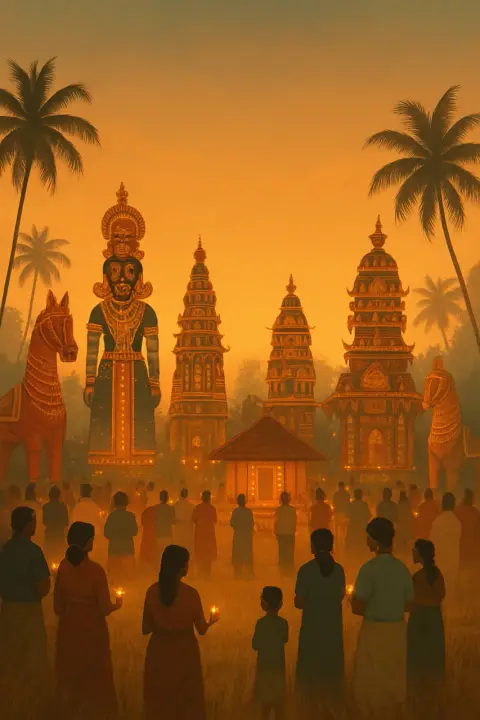
Chettikulangara Kumbha Bharani: the towers in the paddy field
Towers of bamboo and cloth rise over a paddy field at dusk
Kumbha Bharani is the great festival of the Chettikulangara Devi temple near Mavelikkara, in Kerala’s Alappuzha district. On the day of the Bharani star in the Malayalam month of Kumbham, the 13 karas (village divisions) around the temple haul their kettukazhcha, towering structures of wood, cloth and ornament, to the paddy field beside it and leave them standing through the night. Next date: 13 March 2027 (expected), usually in February or March.
The day follows the Malayalam almanac; the Alappuzha collector's local-holiday order, about a week ahead, is the formal confirmation.
The legend
Legend says a boatman on the Karippuzha stream ferried an old woman bound for Chettikulangara; by morning she had vanished. So the goddess came.

Another legend: villagers held for months digging a canal near Kollam vowed to build kettukazhcha for the goddess every year if they were allowed home.
Historians date the kettukazhcha in its present form to the early 19th century; since then the village's 13 karas have built it together.
Customs
Kettukazhcha
Each kara hauls its tower to the temple: six kuthira temple cars, five theru chariots and figures of Bhima and Hanuman.
A night in the paddy
After darshan the towers stand in the paddy field east of the temple; at night the goddess's image is carried out to them, and next day they go home.
Bharani Chanda
A big bazaar, the Bharani Chanda, runs alongside the festival.
Where to celebrate
Mavelikkara
On Kumbha Bharani the thirteen karas of Chettikulangara haul their kettukazhcha, towers about 25 m tall, into the paddy field by the Devi temple and leave them standing through the night.
The kettukazhcha
The festival’s offering is 13 structures, one tradition for each kara, built by the people of each kara. They come in three kinds:
- Six kuthiras, the tallest temple cars. Kerala Tourism puts the largest kettukazhcha at 90 to 100 feet; other counts give the kuthiras about 80 to 85 feet (around 25 metres). One section of a kuthira’s frame, the kathirukal, is about 35 feet tall on its own.
- Five therus, smaller chariot towers that look like pagodas.
- Three figures: Bhima, brought by Mattom North, which weighs about three and a half tonnes and shows him riding a bullock cart to kill the demon Bakasura; and Hanuman and Panchali (Draupadi), both from Mattom South.
In the afternoon the towers are hauled along the roads from the karas and reach the field east of the temple between about 16:00 and 19:00. After darshan they stand in the paddy, and at night the goddess’s image is carried out to them in procession. By the next morning they are taken back to the karas, and a large bazaar, the Bharani Chanda, runs alongside.
Kuthiyottam, the boys’ offering
The most important vow offering of the festival is kuthiyottam, a ritual dance made by families as a vow to the goddess. A sponsoring household takes in boys from Shivaratri onwards, and the boys, aged about 8 to 14, are taught the ritual dance. On Bharani day they are taken to the temple in procession with drums, ornamental umbrellas and decorated elephants, and dance before the shrine. The rite ends with the removal of a thread or fine wire from the skin, which draws a few drops of blood that are offered to the goddess. It is thought to descend from an older blood offering, softened over the centuries.
Legends of the goddess and the towers
The temple’s goddess, Chettikulangara Bhagavathy, is said to have arrived as an old woman. A boatman on the Karippuzha stream ferried her across on her way to Chettikulangara, and by morning she had vanished: the goddess had come to the village.
The towers have their own legend. Villagers held for months digging a canal near Kollam vowed that if they were allowed to go home they would build kettukazhcha for the goddess every year. They were released the next day and kept the vow. Historians date the kettukazhcha in its present form to the early 19th century, and since then the 13 karas have built it together.
How to plan the day
No tickets are needed for the field. There is little to stay in near the temple, so most visitors come for the afternoon and night from a nearby town.
- Where to stay
Alappuzha or Kollam, or Mavelikkara itself. Book about a month ahead, together with trains to Mavelikkara or Kayamkulam.
- Getting there
The temple is on the Kayamkulam–Thiruvalla road, about 4 km west of Mavelikkara and 7 km north of Kayamkulam, both on the railway.
- Arrive by early afternoon
Roads around the temple close as the towers are hauled in. Be there before that and watch them come along the roads, then move to the field for dusk.
- Confirm the date
The day follows the Malayalam almanac. When Bharani falls twice in Kumbham, the later one is kept. The Alappuzha district collector’s local-holiday order, about a week ahead, is the formal confirmation.
Etiquette and safety
Kerala Tourism says the festival draws lakhs of visitors, and the towers move through narrow roads.
- Keep clear of moving towers — Stay well away from structures being hauled and from the overhead lines they pass under.
- The temple admits Hindus only — Non-Hindus can watch everything in the field and on the roads, but not enter the temple itself.
- Respect the kuthiyottam — The boys’ procession and dance are a family’s vow. Give them room and ask before photographing close up.
- Crowds — The UK government notes that stampedes have occurred at large religious gatherings in India. Agree a meeting point away from the field.
FAQ
When is Chettikulangara Kumbha Bharani?
On the day of the Bharani star in the Malayalam month of Kumbham, usually in February or March: 13 March 2027 (expected). The Alappuzha collector’s holiday order about a week ahead confirms it.
What is Kumbha Bharani?
The festival of Bharani, a nakshatra or lunar mansion, in the month of Kumbham. At Chettikulangara it is the temple’s great day, with the kettukazhcha procession and the kuthiyottam offering.
In which district is Chettikulangara?
Alappuzha district, Kerala. The temple is about 4 km west of Mavelikkara and 7 km north of Kayamkulam.
What is kettukazhcha?
The giant decorated structures that the 13 karas build and haul to the temple: six tall kuthira cars, five theru chariots and figures of Bhima, Hanuman and Panchali.
Can non-Hindus attend Chettikulangara Bharani?
Yes, the field and the roads are open to everyone and no ticket is needed. Only the temple itself admits Hindus only.
Sources (4)
Facts checked: 21 October 2026. Prices and hours are approximate; check locally.