 India GO
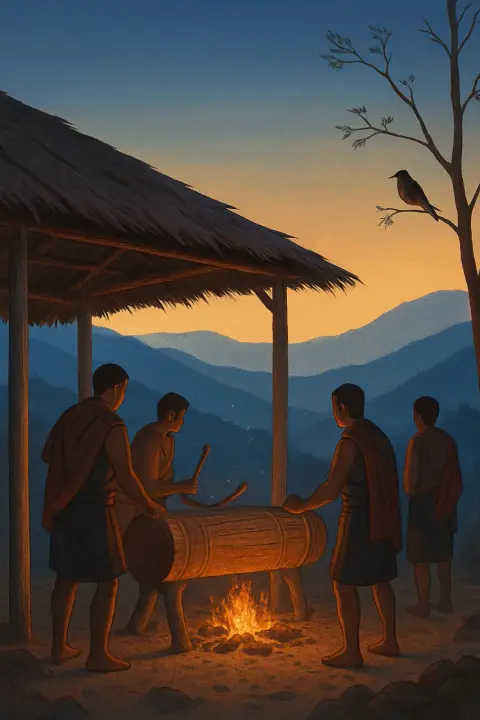
Naknyulüm: the Chang festival of light after darkness
Log drums beaten in the dark before dawn until the first bird sings
Naknyulüm is the most important festival of the Chang Naga tribe of Tuensang in eastern Nagaland. It remembers a time when the world fell into darkness and celebrates the return of daylight, with three days of rites that end with log drums at dawn and the elders listening for the first bird. Next dates: 31 July – 1 August 2027 (expected).
The dates are fixed by custom; the Chang community bodies and the Tuensang district administration publish local programmes in July.
The legend
'Naknyu' means 'mother of darkness' and 'lum' means 'festival'. Chang lore tells of a time when the world sank into utter darkness for three days and nights.
When the darkness suddenly gave way to daylight, the Chang ancestors founded a festival of light's victory over darkness and prayed that it would never return.
An elder of the Oungh clan announces the festival, which runs for three days and nights in the last week of July, on the moonless nights.
Customs
Tops and kongkin
On the second day, the rest day, men spin yan tops, women play the bamboo kongkin, and relatives exchange food and gifts.
Drums till dawn
On the third day young men beat log drums until morning, while the elders wait in silence for the first bird: its call foretells the year.
A quiet festival
During these days the Chang do not sing or perform folk dances, and guests are not received at home: it is a strict festival with many taboos.
What people eat
Millet biscuits
Steamed biscuits made from sticky rice and fresh millet flour.
The legend of the darkness
Naknyu means "mother of darkness" and lüm means "festival". Chang tradition tells of a time when the whole world was covered in darkness for days and nights on end, so that people could not go out to farm, gather firewood, fetch water or work their jhum (shifting-cultivation) fields. In one telling, the darkness ended when a man killed a two-tailed tiger and the daylight came back. When it did, the Chang ancestors founded a festival of light's victory over darkness and prayed that the darkness would never return.
The festival is kept during Daomao, the Chang term for the time when the moon is fully hidden. According to the Tuensang district administration, calculating the moon calendar and setting the date, time and length of Naknyulüm is one of the duties of the Oungh clan.
The three days
- Day 1: Wenshi
Women grind pearl millet into flour and steam it into biscuits wrapped in leaves; the Utsav portal mentions rice as well. Men collect a scented plant, ngounam, and plant it around the house, at the gates and in the door frames to keep away evil and sickness. Pigs and mithun (a semi-domesticated bovine) are slaughtered for the feast, and the priest and elder men make yan (spinning tops) and the kongkin, a bamboo mouth instrument.
- Day 2: Youjem
Friends and families go round the village sharing cooked meat and the steamed biscuits. Men play at spinning yan tops, women display wii (box beans) and play the kongkin, and there is a meat-eating competition. The Utsav portal adds that one wei and one yan are left at each house entrance at night for the gods.
- Day 3: Nakseng
From dawn until sunrise the men beat the log drums, a sound of victory over the darkness. The elders sit in silence and wait for the first bird: if the first to sing is the aoumeishou, a small bird with blue spots, it is a good omen. Nagaland Tourism adds that on this day the village paths and the paths to the fields are cleared.
A quiet festival with taboos
Naknyulüm is not a show. During these days the Chang do not sing or perform folk dances, and households do not receive guests: it is a strict festival with many taboos. By the custom recorded on the Ministry of Tourism's Utsav portal, a guest who happens to visit a home during the festival is expected to come back the following year to avert ill omen. So do not call on families uninvited; the village rites are best seen only if a local host invites you, and the public side of the festival is the celebration in Tuensang town.
Permits and getting there
- Inner Line Permit — Everyone who is not an indigenous inhabitant of Nagaland, Indian or foreign, needs an Inner Line Permit to enter. The tourist ILP is issued online on the Nagaland ILP portal; the fee is about ₹200 for Indian and about ₹500 for foreign tourists, for 30 days.
- Foreigners: other permits — Foreign visitors: some parts of India are protected or restricted areas that need a special permit, and the FCDO notes that the rules can change at any time and advises applying 3 months before arrival. Whether such a permit applies to Nagaland at the time of your trip is set by India's Ministry of Home Affairs: check its website or the Bureau of Immigration before booking.
- Getting to Tuensang — The Ministry of Tourism gives Dimapur as the nearest airport, about 278 km away, and the nearest railway station, about 290 km; Kohima is about 240 km away.
- No alcohol — Nagaland is a dry state: the FCDO warns that drinking or carrying alcohol there can lead to arrest.
- Other Naga festivals — Tuluni of the Sumi Nagas comes in July, and the state's Hornbill Festival near Kohima in December.
FAQ
When is Naknyulüm celebrated?
Next dates: 31 July – 1 August 2027 (expected). The Tuensang district administration gives 31 July to 1 August every year; by tradition the festival falls on the moonless nights at the end of July.
Which tribe celebrates Naknyulüm?
The Chang Nagas, whose homeland is Tuensang district in eastern Nagaland.
What does Naknyulüm mean?
Naknyu means "mother of darkness" and lüm means "festival": it marks the end of a legendary darkness and the victory of light.
Can tourists attend Naknyulüm?
Partly. Households keep taboos and do not receive guests, so village rites are for invited visitors only; the public celebration is in Tuensang town. An Inner Line Permit is needed to enter Nagaland.
Sources (6)
Facts checked: 22 October 2026. Prices and hours are approximate; check locally.