 India GO
Nabakalebara: the renewal of the Puri images
The year the gods of Puri are carved anew from sacred neem
Nabakalebara, Odia for “new body”, is the rite in which the wooden images of Jagannath, Balabhadra and Subhadra in Puri’s Jagannath temple are not repaired but replaced: new images are carved from sacred neem trees found in the forest, and the old ones are buried inside the temple. It happens only in a year with an extra lunar month of Ashadha, so the gap between renewals has ranged from 8 to 19 years. The rites themselves are closed; what the public sees is that year’s Rath Yatra, the new images’ first ride, which draws far larger crowds than usual.
The extra month is known from the almanac years ahead; the Shree Jagannatha Temple Administration and the Odisha government announce a Nabakalebara well in advance.
The legend
The gods of Puri are carved from neem, and wood ages just as people do. So from time to time they are given a new body, a naba kalebara.
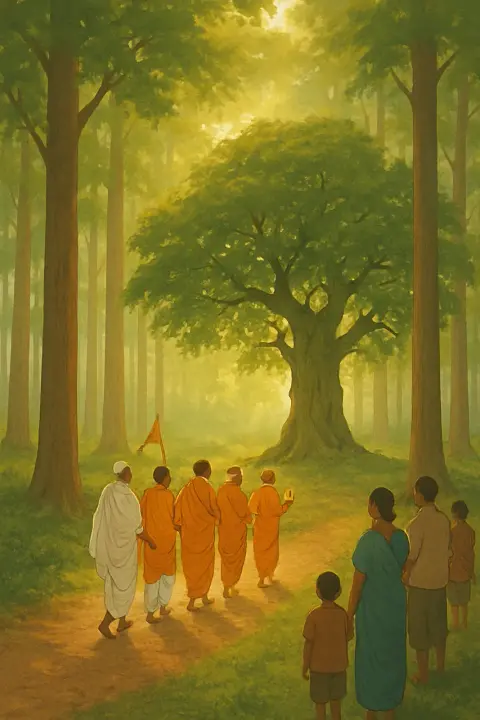
About a hundred daita servitors led by the dalapati ask the king of Puri for leave to begin the search, and he grants it with an offering of betel nut.
Barefoot, they walk to the goddess Mangala's temple at Kakatpur. Four elders sleep before the goddess, seeking a sign of where the trees grow.

The right neem is known by its signs: Jagannath's tree has dark bark and four main branches, like the four arms of Narayana.
The logs are carved into new gods, and at that year's Rath Yatra they ride out to the people for the first time.
Meaning
Daitapatis
To them Jagannath is the head of the family: they mourn the old images for ten days, as for a relative, and hold a feast on the twelfth.
The Kondh
One scholarly view traces Nabakalebara to a rite of the Kondh people, who still practise similar ceremonies.
Customs
Carving in secret
For 21 days the carvers work behind strong doors. Not even the head priest may enter, and the carvers do not leave the temple.
Hymns at the enclosure
While the carving goes on, hymns with temple music are sung outside the Koili Baikuntha, and Brahmin priests chant Vedic verses.
Seven coverings
The new images are wrapped in seven layers, sandalwood paste and resin among them, then painted in natural colours.
Opening the eyes
Last of all, Brahmin priests 'open' the gods' eyes in the netrotsava, and the next day the new gods are first shown to devotees.
What people eat
Mahaprasad
consecrated temple food, the carvers' fare for all 21 days
Words of the festival
ନବକଳେବର
Nabakalebara
'new body', from the Odia naba, new, and kalebara, body
ଦାରୁବ୍ରହ୍ମ
daru brahma
'the divine in wood', a name for Puri's wooden images
ବନଯାଗ ଯାତ୍ରା
Banajaga Yatra
the servitors' journey into the forests to find trees for the new images
ଘଟ ପରିବର୍ତ୍ତନ
Ghata Parivartana
the night-time transfer of the 'brahma', the sacred essence, into the new images
କୋଇଲି ବୈକୁଣ୍ଠ
Koili Baikuntha
the temple enclosure where new images are carved and old ones buried
True or myth
❌ Myth. It needs a year with an extra month of Ashadha, so the gap ranges from 8 to 19 years: 2015 came 19 years after 1996.
✅ True. The rite takes place at midnight in total secrecy, the servitors are blindfolded, and the whole town is blacked out.
✅ True. The other deities have separate graves at Koili Baikuntha, but Jagannath's earlier images lie one above the other.
Where to celebrate
Puri
Worth the trip
In a Nabakalebara year the Puri deities are carved anew from sacred neem; the renewal itself is hidden, but the Rath Yatra that follows, the new images' first ride, draws the biggest crowd.
Why the gods get a new body
The images of Puri are daru brahma, “the divine in wood”. They are carved from neem, and wood ages just as people do, so from time to time the gods are given a new body. The year is set by the lunar calendar: Nabakalebara needs an extra month of Ashadha, which the almanac shows years ahead. The belief that it comes round every 12 years is a myth. The interval has been as short as eight years and as long as nineteen: the renewal of 2015 came 19 years after 1996. Earlier renewals fell in 1912, 1931, 1950, 1969 and 1977.
One scholarly view traces the rite to the Kondh people of Odisha, who still practise similar ceremonies. More on the deity is on the Jagannath page.
How the renewal unfolds
The sequence below follows published accounts of the tradition and encyclopedias. It runs from late March to July of a Nabakalebara year.
- Leave from the king
About a hundred daita servitors, led by the dalapati, ask the king of Puri for leave to begin the search; he grants it with an offering of betel nut.
- Banajaga Yatra: the search for the trees
On the tenth lunar day of the bright half of Chaitra the party sets out for the forests. Barefoot, they walk to the temple of the goddess Mangala at Kakatpur, where four elders sleep before the goddess to receive a sign of where the trees grow.
- Choosing the neem
Each tree must show its signs. Jagannath’s has dark bark and four main branches, like the four arms of Narayana, with marks of a conch and a discus; Balabhadra’s has seven branches, Subhadra’s five.
- Carving in secret
In the Koili Baikuntha enclosure the carvers work for 21 days behind closed doors. Not even the head priest may enter, and the carvers do not leave the temple; they eat mahaprasad, the consecrated temple food. Outside, hymns are sung and Brahmin priests chant Vedic verses.
- Ghata Parivartana: the transfer at midnight
At midnight the brahma, the sacred essence, is moved from the old images into the new ones. The servitors are blindfolded, the rite is done in total secrecy, and the whole town’s lights go out.
- Burial and mourning
The old images are buried at Koili Baikuntha: the other deities in separate graves, Jagannath’s earlier images one above another. For the daitapatis Jagannath is the head of the family; they mourn for ten days, as for a relative, and hold a feast on the twelfth.
- Seven coverings and the eyes
The new images are wrapped in seven coverings, the saptavarana, sandalwood paste and resin among them, and painted in natural colours. Last of all, Brahmin priests open the gods’ eyes in the netrotsava, and the next day the new gods are first shown to devotees.
- Rath Yatra
In that year’s chariot festival the new images ride out to the people for the first time.
What a visitor can actually see
Almost nothing of the renewal itself. The rites take place inside the Jagannath temple and are closed to everyone except the servitors, and the temple admits only Hindus. Koili Baikuntha, where the images are carved and buried, is not open during the rites.
The public part is the Rath Yatra. The new images ride on the chariots down the Bada Danda, the avenue of about 3 km from the Jagannath temple to the Gundicha temple, and anyone can watch from the roadside behind the barricades. For 2015 about five million people were expected. How the chariot festival runs, with its dates for the coming years, is on the Rath Yatra page.
If a Nabakalebara year is announced
The extra month is known years ahead, and the Shree Jagannatha Temple Administration and the Odisha government announce a Nabakalebara well in advance. Treat it as the Puri Rath Yatra plan with a far longer lead time.
- Rooms first — Book as soon as the year is announced, at least six months ahead: in a Nabakalebara year Puri’s rooms are effectively gone without a very early booking.
- Trains on the first day — Indian Railways opens ticket sales 60 days before travel; take them on the first day.
- Arrive two days early — Plan on at least three nights, four if you can, and arrive two days before Rath Yatra.
- Crowds — The FCDO notes that stampedes have occurred at some events with large crowds, including religious gatherings. Keep to the barricaded viewing areas and follow police instructions. General advice: Is India safe.
FAQ
What is Nabakalebara?
The renewal of the wooden images of Jagannath, Balabhadra and Subhadra at Puri: new images are carved from sacred neem, the sacred essence is moved into them at midnight, and the old ones are buried in the temple.
When is the next Nabakalebara?
It needs a year with an extra month of Ashadha. The temple administration and the Odisha government announce it well in advance; until then no date is fixed for travel.
Does Nabakalebara happen every 12 years?
No. The gap depends on the extra month and has ranged from 8 to 19 years; the 2015 renewal came 19 years after 1996.
Which state is Nabakalebara associated with?
Odisha. It is the rite of the Jagannath temple in Puri.
What happens to the old images?
They are buried at Koili Baikuntha inside the temple grounds; Jagannath’s earlier images lie one above another, and the daitapati servitors mourn them for ten days.
Can non-Hindus see Nabakalebara?
The rites are closed to everyone but the servitors, and the temple admits only Hindus. Anyone can watch the Rath Yatra of that year from the roadside on the Bada Danda.
Sources (5)
Facts checked: 21 October 2026. Prices and hours are approximate; check locally.