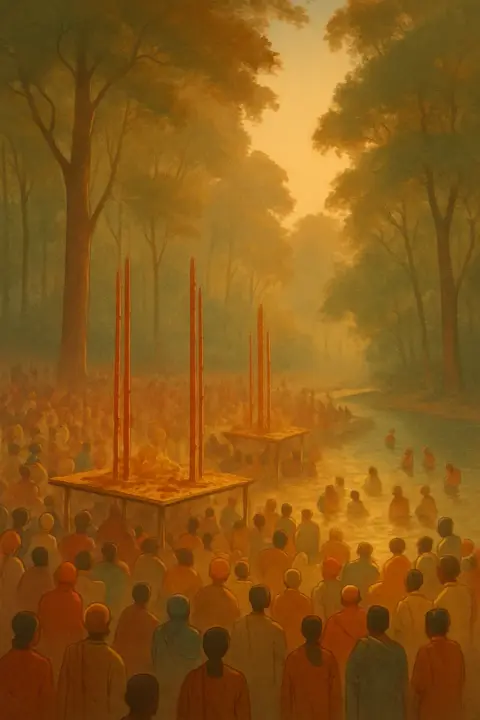
Medaram Jatara: Sammakka and Saralamma come out of the forest
Pilgrims weigh themselves in jaggery for goddesses carried out of the forest
The Sammakka Saralamma Jatara at Medaram, in the forests of Telangana's Mulugu district, is a festival of the Koya people that has grown into one of the largest gatherings in India: the Mulugu district places it second only to the Kumbh Mela. For four days Koya priests bring the goddesses Sammakka and Saralamma out of the forest to open platforms, with no temple and no idol. The great jatara is held every two years, in even years; in odd years a smaller jatara keeps the same four days of rites. Nearest dates, of either the great or the smaller jatara: 17–20 February 2027.
Countdown17–20 February 2027
When17–20 February 2027
The Sammakka-Saralamma priests' association announces the four days seven to nine months ahead; the Telangana government then plans the arrangements.
The legend
🐅
Legend says the chief Medaraju, out hunting, found a baby girl on an anthill guarded by tigers and named her Sammakka. Her herbs, it is said, cured any illness.
💍
Sammakka married Pagididda Raju, the Koya ruler of Medaram. Their children were Saralamma, Nagulamma and Jampanna.
⚔️
In a drought Medaram could not pay its tribute, and the Kakatiya king Prataparudra marched on it at the Magha full moon. Sammakka's family stood against his army.
Saralamma and Pagididda Raju fell in battle, and Jampanna died in the Sampenga stream, known ever since as Jampanna Vagu.
🔴
Wounded, Sammakka headed for Chilakalagutta hill and vanished. By an anthill lay a casket of turmeric and vermilion: it is revered as her, with a jatara every two years.
Meaning
The Koya
Every rite of the jatara is performed by Koya priests by Koya custom, with no Brahmins. Until 1955 about two thousand people came, most of them Koya.
State festival
Undivided Andhra Pradesh declared the jatara a state festival in 1996, and Telangana did the same in 2014, the year it was formed.
Customs
Bangaram by weight
The goddesses are offered jaggery, called bangaram, "gold". Usually one to five kilos; those whose vow was answered give their own weight in it.
Out of the forest
On the first day priests bring Saralamma from Kannepalli, with Pagididda Raju and Govinda Raju. On the second evening Sammakka comes down from Chilakalagutta hill.
The gaddelu
There is no temple and no idol: the goddesses are set on the gaddelu, open platforms, where priests also place bamboo poles from the forest.
Bath in the stream
Before darshan pilgrims bathe in the Jampanna Vagu. When the goddess is carried across the stream, people in the water greet her with both hands raised.
Back to the forest
On the fourth evening the priests carry the goddesses back into the forest. This rite, the Vanapravesam, closes the jatara until the next one two years on.
Words of the festival
గద్దెలు
gaddelu
the open platforms where the goddesses sit for the days of the jatara
బంగారం
bangaram
"gold": Medaram's name for the jaggery offered to the goddesses
కుంకుమ భరిణె
kumkuma bharine
a vermilion casket, the form in which Sammakka is brought from the hill
వడ్డెలు
vaddelu
Koya priests of the goddesses' lineage, who bring them in and carry them back
జంపన్న వాగు
Jampanna Vagu
the stream at Medaram named after Sammakka's son, where pilgrims bathe before darshan
True or myth
The great Medaram jatara is held every two years.
✅ True. Tradition traces it to Sammakka's disappearance: once every two years, at the full moon of Magha.
The jatara's rites are led by Brahmin priests.
❌ Myth. Every rite is performed by Koya priests, and the right is hereditary.
Sammakka is worshipped as a stone idol.
❌ Myth. She is brought from the hill as a vermilion casket and set on an open platform, with no temple and no statue.
Where to celebrate
Medaram
Every two years, around the Magha full moon, Koya priests carry the goddesses Sammakka and Saralamma out of the forest to open platforms at Medaram, and over a crore of pilgrims follow.
The four days of the jatara
The jatara runs from a Wednesday to a Saturday, around the full moon of Magha (usually late January or February). Every rite is performed by Koya priests, the vaddelu, by Koya custom; the right is hereditary, and no Brahmin priest takes part.
Day 1: Saralamma arrives
Priests bring Saralamma from the village of Kannepally to the gaddelu, the open platforms at Medaram, with Pagididda Raju and Govinda Raju.
Day 2: Sammakka comes down the hill
In the evening Sammakka is brought down from Chilakalagutta, a forested hill, as a casket of vermilion (kumkuma bharine). This is the moment most pilgrims wait for.
Day 3: darshan and offerings
The peak day. Pilgrims queue for darshan (seeing the deity) at the gaddelu and offer jaggery, which Medaram calls bangaram, "gold": usually one to five kilos, and those whose vow was answered give their own weight in it.
Day 4: back to the forest
In the afternoon the priests carry the goddesses back into the forest. This rite, the Vanapravesam, closes the jatara.
The story of Sammakka and Saralamma
In the tribal story, hunters found a baby girl glowing on an anthill among tigers and named her Sammakka. She grew up a healer and married Pagididda Raju, the Koya chief of Medaram and a feudatory of the Kakatiya kings; their children were Saralamma (also called Sarakka), Nagulamma and Jampanna. When drought left Medaram unable to pay its tribute, the Kakatiya king Prataparudra sent an army, and the family fought it, in the district's words, against an unjust law. Pagididda Raju and Saralamma fell, and Jampanna died in the stream that has carried his name ever since, the Jampanna Vagu. Its water runs red; the district notes that devotees link the colour to his blood, while the reason is the soil. Wounded, Sammakka went up Chilakalagutta hill and vanished, and by an anthill was found a casket of turmeric and vermilion, revered as her.
For a long time this was a local festival: until 1955 about 2,000 people came, most of them Koya. Today the Koya are a small minority among the pilgrims. It was declared a state festival in 1998, by the official jatara website's account, and Telangana confirmed the status in 2014, the year the state was formed.
Getting to Medaram and where to stay
Medaram is a village in Tadvai mandal, inside the Eturnagaram Wildlife Sanctuary, and is reached by road only. There is almost nowhere to stay in the village itself.
By train to Warangal or Kazipet
These are the nearest stations. Medaram is about 93 km from Warangal by road. Trains go on sale 60 days before departure, and they fill early for the jatara.
By bus from Hyderabad
Medaram is about 240 km from Hyderabad, up to six hours by road. TGSRTC, the state bus company, runs special buses from across Telangana for the four days.
Expect to walk the last stretch
The final road into Medaram is the bottleneck, and on the busiest days the last part is on foot. Being there by Day 1 makes the rest easier.
Stay in Warangal or Hanamkonda
Most visitors stay there and come and go, or camp. A few forest tents are put up at Medaram for the jatara and are listed on the official website. Book two to three months ahead and plan two or three nights.
Etiquette and crowds
This is a living Koya rite before it is a spectacle, and the scale is enormous: press reports put nearly 80 lakh (8 million) people on a single day of a recent great jatara, and the district counted about a crore (10 million) over the 2012 jatara. The state builds temporary roads, water, sanitation and medical camps for each edition, and the UK Foreign Office (FCDO) notes that stampedes have occurred at large religious gatherings in India.
Ask before photographing — Ask the Koya priests before photographing them or their rites, and keep back when the goddesses are carried past.
Go with the queues — Darshan at the gaddelu runs through long queues. Go early in the day, keep water with you and agree a meeting point in case you are separated.
At the stream — Pilgrims bathe in the Jampanna Vagu before darshan, and when the goddess is carried across, people in the water greet her with both hands raised. Watch your footing and your belongings.
Medical help — For the jatara a main medical camp and peripheral camps around Medaram are set up. India's emergency number is 112; see also is India safe.
FAQ
Is there a Medaram Jatara every year?
The great jatara is held every two years, in even years. In odd years there is a smaller jatara with the same four days of rites. Nearest dates, great or smaller jatara: 17–20 February 2027.
Which district is Medaram in?
Mulugu district, Telangana, in Tadvai mandal and inside the Eturnagaram Wildlife Sanctuary, about 93 km from Warangal.
Which tribe celebrates the Medaram Jatara?
The Koya. All the rites are performed by hereditary Koya priests, although today most pilgrims come from outside the community.
Why do people celebrate the Medaram Jatara?
To honour Sammakka and her daughter Saralamma, who in the story fought the Kakatiya army; Sammakka vanished on Chilakalagutta hill and left a casket of vermilion revered as her. Pilgrims come to fulfil vows.
What is offered at Medaram?
Jaggery, called bangaram (gold). Pilgrims whose vow has been answered often give their own body weight in it.
 India GO