 India GO
Me-Dam-Me-Phi: the Ahom festival of the ancestors
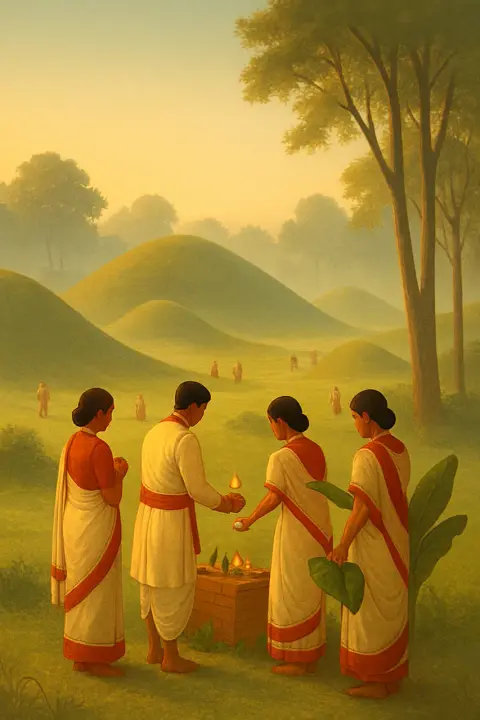
Offerings to the ancestors among the grassy burial mounds of Ahom kings
Me-Dam-Me-Phi is the ancestor festival of the Ahoms, the Tai people whose kings ruled Assam for about six centuries. It falls on 31 January every year, a holiday in Assam, and is kept with prayers and offerings to the dead and to the gods, publicly at Sivasagar and at Charaideo, the first Ahom capital, among the grass-covered burial mounds of the Ahom kings. Next: 31 January 2027.
The date is fixed and appears in the Assam holiday list, issued in November or December of the previous year.
The legend
The name is made of Tai-Ahom words: mae is an offering, dam the dead ancestors and phi the gods.

In the Ahom chronicle, Lengdon, god of heaven, sent his two grandsons Khunlung and Khunlai to earth, and they were told to keep this rite.
As a large public festival on a fixed date, 31 January, it has been kept since 1991.
Customs
The ho-phi shrine
Priests raise an eight-cornered shrine and a bamboo stand for the gods, then sing hymns of welcome, blessing and farewell.
By the moidams
It is kept at Charaideo, the first Ahom capital, founded by Sukaphaa in 1253, among the royal burial mounds, the moidams.
What the name means
The name is three Tai-Ahom words: me (mae), an offering; dam, the dead ancestors; and phi, the gods. Ahom belief holds that a person who dies remains a dam, an ancestor, only for a short while and then becomes a phi, a god, so honouring the ancestors and the gods is one act.
Ancestor worship has two forms in Ahom tradition. At home it is the Dam-phi: many Ahom families keep a pillar, the damkhuta, for offerings to their dead. Me-Dam-Me-Phi is the public, communal form. It was once held in the Tai month of Duin-Ha, around March to April, and has been kept as a large public festival on a fixed date, 31 January, since 1991.
The Ahom chronicle gives the rite a divine origin: Lengdon, the god of heaven, sent his two grandsons Khunlung and Khunlai down to earth, and they were told to keep Me-Dam-Me-Phi among the worships of the year. Today the festival is observed well beyond the Tai-Ahom community, across Assam.
How the rite is kept
The public worship is led by Ahom priests, the Deodhai and Bailung, who chant in the Tai language. They raise an eight-cornered shrine, the ho-phi, and a bamboo stand, the pang, for the gods. The hymns follow a set order: first the praise of the creator, then a song of welcome, the offerings, a blessing and finally a farewell to the gods and ancestors who have been called.
It is a religious ceremony, not a show, so watch from the edge, do not walk between the priests and the shrine, and ask before photographing them.
Charaideo and its moidams
Charaideo, about 30 km from Sivasagar in Upper Assam, was founded as the first Ahom capital by Sukaphaa, the first Ahom king, in 1253 by the conventional chronology. Its moidams are the royal burial mounds of the dynasty, rising from the landscape as grass-covered hills. The protected property covers about 95 hectares with 90 moidams of different shapes and sizes, looked after by the Archaeological Survey of India and the Assam Directorate of Archaeology.
The Moidams, the mound-burial system of the Ahom dynasty, were inscribed on the UNESCO World Heritage List as India's 43rd World Heritage property, Assam's third and the first cultural site from Northeast India. On 31 January the festival gives these mounds back their original meaning, as places where the ancestors are honoured.
If you are in Upper Assam at the end of January, it is a good day to visit Charaideo; the festival is kept publicly in Sivasagar as well.
FAQ
When is Me-Dam-Me-Phi celebrated?
On 31 January every year; it is on the Assam government holiday list. Next: 31 January 2027.
Me-Dam-Me-Phi is celebrated in which state?
Assam. It is the ancestor festival of the Tai-Ahom people, kept publicly at Sivasagar and Charaideo and now observed across the state.
What does Me-Dam-Me-Phi mean?
In Tai-Ahom, me is an offering, dam the dead ancestors and phi the gods: offerings to the ancestors and the gods.
Which community celebrates Me-Dam-Me-Phi?
The Tai-Ahom, descendants of the people of the Ahom kingdom. Their priests, the Deodhai and Bailung, lead the public worship.
Sources (4)
Facts checked: 21 October 2026. Prices and hours are approximate; check locally.