 India GO
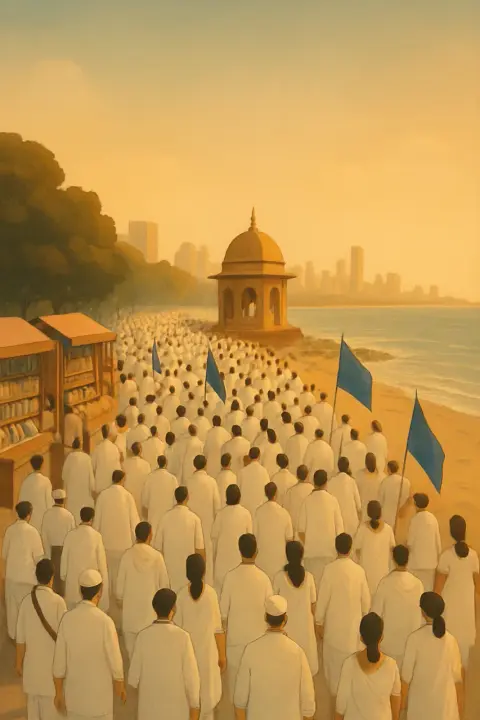
Mahaparinirvan Din at Chaitya Bhoomi, Mumbai
A queue through the night by the sea, and books spread along the pavement
Mahaparinirvan Din is the anniversary of the death of Dr Bhimrao Ramji Ambedkar, "Babasaheb", who died on 6 December 1956. Millions of his followers come to Chaitya Bhoomi, the memorial on his cremation site beside the beach at Dadar in Mumbai, to pay homage: 6 December 2026 (expected), with crowds gathering from the day before. It is a day of remembrance rather than celebration, and the road to the memorial becomes a book fair.
The date is fixed; the Mumbai municipal corporation issues the crowd and traffic arrangements in late November.
The legend
Bhimrao Ambedkar chaired the committee that drafted India's constitution, and in 1956 embraced Buddhism with hundreds of thousands of followers.
Three days after finishing the manuscript of The Buddha and His Dhamma, Ambedkar died in his sleep at his Delhi home on 6 December 1956.

His body was brought to Bombay, and on Dadar Chowpatty beach a Buddhist cremation was held on 7 December, attended by half a million people.
Buddhists revere him as a bodhisattva, so his death is called mahaparinirvana, the word used for the Buddha's passing.

Since 1971 the Chaitya Bhoomi memorial has stood at the cremation site, and every 6 December millions come here to honour Babasaheb.
Meaning
Across India
Far from Mumbai he is honoured too: his portrait is set up in Buddhist viharas, homes, schools and offices.
Delhi
In Delhi his last home, at 26 Alipur Road where he died, is now a memorial.
Customs
The queue to the urn
People arrive from across India from 1 December and queue for hours to bow before the urn of his ashes and his image in the stupa.
Books at Shivaji Park
Hundreds of book stalls in many languages fill neighbouring Shivaji Park: almost everyone leaves with a book.
State tribute
The Chief Minister and the Governor of Maharashtra come to Chaitya Bhoomi every year to pay tribute.
Bhim Jyot
An eternal flame, the Bhim Jyot, burns at the memorial in Ambedkar's memory.
Words of the festival
महापरिनिर्वाण
mahaparinirvana
in Buddhism, the passing of one who reached nirvana; the word used for Ambedkar's death
चैत्यभूमी
Chaitya Bhoomi
"ground of the chaitya": the memorial on the cremation site by the Dadar beach
बाबासाहेब
Babasaheb
"respected father", the honorific his followers use for Ambedkar
अभिवादन
abhivadan
a respectful salute, the Marathi word for the homage paid to Ambedkar on the day
How to greet
जय भीम
Jai Bhim!
"Victory to Bhim": the greeting of Ambedkar's followers, heard everywhere on the day.
True or myth
❌ Myth. He died in Delhi; his body was brought to Mumbai for cremation on Dadar Chowpatty beach.
✅ True. Around 1970 Dalit Panther founders Raja Dhale and J. V. Pawar laid out books and magazines on the sand and talked booksellers into joining.
✅ True. The journalist John Gunther noted it in Inside Asia (1939). The books sold on the day are a tribute to his love of reading.
Whom the day remembers
B. R. Ambedkar was a jurist, economist and social reformer who chaired the committee that drafted India's Constitution and became the country's first law minister. Born into a caste treated as untouchable, he spent his life fighting caste discrimination. On 14 October 1956, in Nagpur, he embraced Buddhism and administered the vows to hundreds of thousands of followers.
Three days after finishing the manuscript of The Buddha and His Dhamma, Ambedkar died in his sleep at his home at 26 Alipur Road in Delhi on 6 December 1956; the house is now a memorial. His body was brought to Bombay, and on 7 December a Buddhist cremation was held on Dadar Chowpatty beach, attended by about half a million people.
The name of the day comes from Buddhism. Mahaparinirvana is the word for the passing of the Buddha, nirvana after death, and Buddhists revere Ambedkar as a bodhisattva, so his death is called by the same word. More about his life: B. R. Ambedkar.
Chaitya Bhoomi, the memorial
Chaitya Bhoomi, "the ground of the chaitya", stands on the cremation site beside Dadar Chowpatty. It was inaugurated on 5 December 1971 by Meerabai Yashwant Ambedkar, his daughter-in-law. The main gate copies the gateway of the Sanchi stupa, and inside stands a replica of an Ashoka pillar. The memorial is a square building with a small dome over a ground floor and a mezzanine: below, a circular wall encloses a bust of Ambedkar and a statue of the Buddha; above is a stupa, where his relics are enshrined, and a resting place for bhikkhus (Buddhist monks). An eternal flame, the Bhim Jyot, burns at the memorial in his memory. The Dadar and Shivaji Park area around it is described on the Dadar and Shivaji Park page.
How the day is kept
People arrive from across India from the first days of December and queue for hours to bow before the urn of his ashes and his image in the stupa. The greeting heard everywhere is "Jai Bhim", "Victory to Bhim". The Chief Minister and the Governor of Maharashtra come to pay tribute, and the ceremonies are shown on large screens and on the Mumbai municipal corporation's social media.
The neighbouring Shivaji Park (Chhatrapati Shivaji Maharaj Maidan) turns into a camp and a book fair. Hundreds of stalls sell books in many languages, and almost everyone leaves with one: a tribute to a reader whose library already held some 8,000 books in 1939, as the journalist John Gunther noted. The fair began around 1970, when Dalit Panther founders Raja Dhale and J. V. Pawar laid out books and magazines on the sand and talked booksellers into joining. The state administration sets up a large waterproof shelter on the maidan with screens, toilets, bathing units, drinking water, ambulances and health check-up counters; in recent years more than 8,000 staff have been deployed.
Away from Mumbai the day is kept too: his portrait is set up in Buddhist viharas, homes, schools and offices, and in Delhi the Dr Ambedkar Foundation, under the Ministry of Social Justice and Empowerment, holds a tribute at Prerna Sthal in the Parliament complex.
Visiting respectfully
The book-fair road is worth walking respectfully if you are in Mumbai that day; a few things matter.
- A day of homage — For millions this is a day of mourning and gratitude, not a festival or a spectacle. The Marathi word for what people come to do is abhivadan, a respectful salute.
- Join the queue, do not cut it — People wait for hours to reach the urn; if you want to enter the memorial, take your place in the line.
- Ask before photographing — Ask before photographing people in prayer or at the memorial.
- Buy a book — The book fair is the day's own way of remembering him, and buying a book is the most fitting souvenir.
Planning the visit
The date never moves, and the city plans around it.
- Roads close
In recent years Mumbai traffic police have closed roads around Chaitya Bhoomi and Shivaji Park from the morning before the day until the night after it. The municipal corporation and the police announce the arrangements in late November.
- Come by train and on foot
In recent years Central Railway has run extra unreserved trains into Mumbai around the day; inside the city, plan to walk the last stretch to Dadar beach.
- Other places
In Delhi his last home at 26 Alipur Road is a memorial. In Nagpur, Deekshabhoomi, where he took up Buddhism, draws its own crowds on Dhammachakra Pravartan Din in October.
FAQ
What is Mahaparinirvana Day?
The anniversary of the death of Dr B. R. Ambedkar, who chaired the committee that drafted India's Constitution, marked above all at Chaitya Bhoomi in Mumbai. Next: 6 December 2026 (expected).
What happened on 6 December 1956?
Ambedkar died in his sleep at his home in Delhi, three days after finishing the manuscript of The Buddha and His Dhamma. He was cremated in Buddhist rites on Dadar Chowpatty in Bombay on 7 December.
Why is it called Mahaparinirvan Din?
Mahaparinirvana is the Buddhist word for the Buddha's passing. Buddhists revere Ambedkar as a bodhisattva, so his death is called by the same word.
Did Ambedkar die in Mumbai?
No. He died in Delhi; his body was brought to Mumbai for cremation on Dadar Chowpatty, where Chaitya Bhoomi now stands.
Can visitors go to Chaitya Bhoomi on the day?
Yes, the memorial and the book fair at Shivaji Park are open to all. Expect queues of many hours, closed roads, and come in a spirit of respect.
Sources (4)
Facts checked: 21 October 2026. Prices and hours are approximate; check locally.