 India GO
Magh Bihu (Bhogali Bihu): Assam's harvest feast
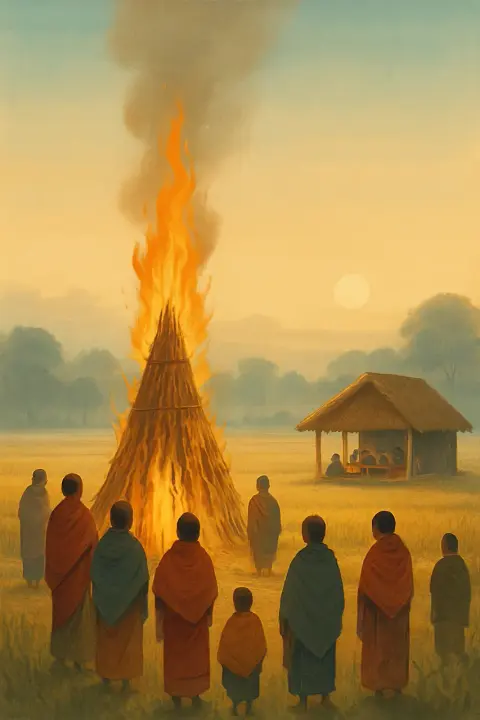
Towers of bamboo and thatch set alight in the harvested fields at dawn
Magh Bihu, also called Bhogali Bihu, is Assam's festival for the end of the rice harvest, held in mid-January when the Sun enters Capricorn. Dates: 14–15 January 2027 (expected). The eve, Uruka, is a night of feasting in huts built in the fields; at first light the bonfires called meji and the huts themselves are burned with prayers to the ancestors. Its other name comes from bhog, feasting and enjoyment, and food is the heart of it.
The Assam holiday list, issued between mid-November and early December of the previous year, fixes the Magh Bihu holidays; village committees build the bonfire huts (meji) in the week before.
The legend
Magh Bihu marks the end of the harvest in Assam. Its other name, Bhogali Bihu, comes from bhog: feasting and enjoyment.
The eve is called Uruka, traced to the Deori-Chutia urukuwa, "to end": the harvest and the month of Pausha are over.
In a Deori tradition the meji fire recalls the beginning of creation, and it is burned as the sun turns north.
Customs
Night in the bhelaghar
On Uruka young people put up bhelaghar huts of bamboo, leaves and thatch in the fields and feast by the fire till morning.
Meji at dawn
Early in the morning meji bonfires are lit in the fields with prayers to the ancestral gods. At the end the bhelaghar burns too.
What people eat
Til pitha
Rice cakes called pitha, like til pitha with sesame, in every home.
Words of the festival
মেজি
meji
The Magh Bihu bonfire, burned in the fields at dawn.
What Magh Bihu is
Assam keeps three Bihus, each tied to the farming year: Rongali (Bohag) Bihu in April, the spring new year and the most important of the three; Kongali (Kati) Bihu in October or November; and Bhogali (Magh) Bihu in January, when the harvest is in and the granaries are full. Magh Bihu is also called Maghar Domahi.
The word Uruka, the name of the eve, is traced to the Deori-Chutia urukuwa, "to end": the harvest and the month are over. Today the Bihus are kept by Assamese people of every religion and community, and several communities have their own names for the feast night.
The day is fixed by the sun, not the moon: Magh Bihu falls on the day the Sun enters Capricorn if that happens in the morning, otherwise on the next day, so it lands on 14 or 15 January. The Assam government's holiday list, issued between mid-November and early December of the previous year, fixes the holidays.
How the festival runs
Magh Bihu is less a show than a village's own night and morning, and its architecture is the point.
- The week before: building
Village committees and young people put up the meji, a tower of bamboo, wood and thatch, and the bhelaghar, a hut of bamboo, leaves and straw, in the harvested fields.
- Uruka: the feast night
On the eve families and friends cook together and eat by the fire; women prepare chira (flattened rice), pitha, laru and curd for the next day. Village youth often spend the night in the bhelaghar, feasting till morning.
- Dawn: the meji burns
Early in the morning, after bathing, the eldest member of the family sets the meji alight, and prayers are offered to the ancestral gods with rice cakes and other offerings. The bhelaghar burns too, and ashes from the fires are spread on trees and fields for a good crop.
- The day: food and games
The rest of the day is visits, food and village games such as tekeli bhonga, pot-breaking.
What is eaten
Bhogali means feasting, and every home makes pitha, rice cakes such as til pitha with sesame and sunga pitha, and laru, coconut sweets. Chira (flattened rice), akhoi (puffed rice), pitha and curd are also among the offerings at the fire, and the morning after, people eat mah-karai, a roasted mix of rice and black gram. Fish is part of the Uruka feast, with duck, chicken or mutton curries in many homes, and some communities serve rice beer.
Where to see Magh Bihu
The festival is all over Assam; it is best seen in a village, with a host.
Guwahati
The state capital and the easiest place to arrive; the festival dates on this page are given for Guwahati. For a night in a bhelaghar and the meji at dawn, go out to a village with a host.
Morigaon and Nagaon
Rural districts east of Guwahati where the old field customs are strong. Buffalo fights (moh juj) at Ahotguri and bulbul (songbird) fights at Hajo near Guwahati are old Magh Bihu customs, and contested ones: animal welfare groups call them cruel, the Gauhati High Court in December 2024 set aside the state rules that had allowed them, and the state assembly then passed an amendment to exempt buffalo fights, which needs the President's assent. In Morigaon district the Jonbeel Mela, a barter fair of the Tiwa community, is held on the weekend after Magh Bihu.
Jorhat
A town in Upper Assam, named in the database among the places where the festival is kept in the villages around it.
Tips for visitors
Magh Bihu is a family and village festival, open to guests who come with someone local.
- Find a host — The night in the bhelaghar and the dawn fire belong to the village; a homestay or a local contact is the way in.
- Be up before dawn — The meji is lit early, after the morning bath; if you sleep in, you miss the fire.
- Ask before photos — The prayers at the fire are a family rite: ask before photographing people.
- Watch the holiday list — Assam's holiday list, out between mid-November and early December, fixes the Magh Bihu days; plan trains and rooms once it is out.
FAQ
When is Magh Bihu?
14–15 January 2027 (expected). It falls on 14 or 15 January, depending on the hour the Sun enters Capricorn, and the feast night of Uruka is the eve.
Which Bihu comes in January?
Magh Bihu, also called Bhogali Bihu, the harvest Bihu. Rongali (Bohag) Bihu comes in April and Kongali (Kati) Bihu in October or November.
Which Bihu is the biggest in Assam?
Rongali (Bohag) Bihu in April, the spring new year, is the most important of the three. Magh Bihu is the feast of the three.
Can Muslims celebrate Bihu?
Yes. Today the Bihus are celebrated by Assamese people of every religion, caste and community.
What is Uruka?
The eve of Magh Bihu: a night of cooking and feasting by the fire, often in bhelaghar huts built in the fields. The name is traced to a Deori-Chutia word meaning "to end".
What food is made for Magh Bihu?
Pitha rice cakes such as til pitha with sesame, laru sweets, chira and curd, and fish on Uruka night.
Sources (8)
- Magh Bihu
- Bihu
- MyGov Assam: My Magh Bihu celebration
- Government of Assam: holiday list
- Al Jazeera: bird and buffalo fights return to India's northeast
- PTI via The Week: Gauhati HC quashes Assam govt SOP allowing buffalo, bulbul fights
- The Pioneer: Assam to exclude buffalo fight from animal cruelty law
- Jonbeel Mela
Facts checked: 21 October 2026. Prices and hours are approximate; check locally.