 India GO
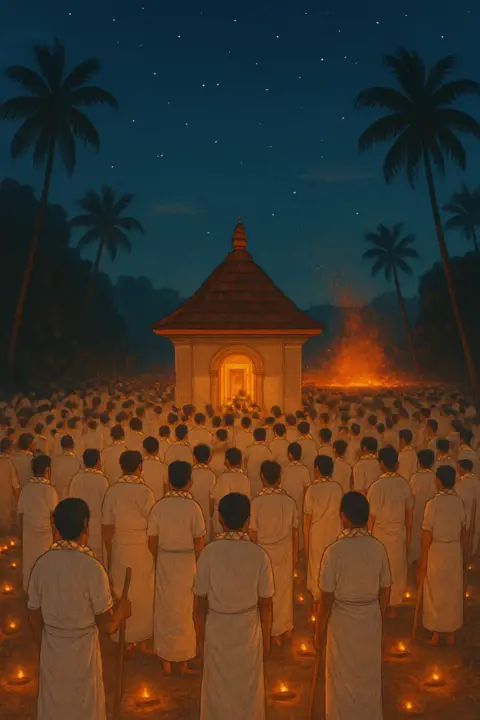
Lairai Zatra in Shirgao: the night the dhonds cross the fire
Devotees in white crossing glowing coals beneath a banyan tree at night
Lairai Zatra is the annual festival of the goddess Lairai at her temple in Shirgao, Bicholim taluka, North Goa. On Vaishakha Shukla Panchami, the fifth day of the bright half of Vaishakha, her devotees, the dhonds, walk barefoot across the coals of a bonfire through the night. Dates: 10–11 May 2027 (expected). Tens of thousands come, and since the fatal crush of 2025 the North Goa district administration and the temple committee prepare a crowd plan in advance.
The day follows the lunar calendar; the temple committee and the North Goa district administration announce the arrangements and crowd rules in April.
The legend
According to legend, a band of goddess sisters came to Goa and parted ways, each settling in a village of her own.

Lairai stayed in Shirgao, Mahamaya in Mayem, Morjai in Morjim and Kelbai in Mulgao.
Lairai's sister is also said to be Mirabai, the name given to the Virgin of Miracles, Milagres Saibinn, of Mapusa.
Every year, on the fifth day of the bright half of Vaishakha, her devotees, the dhonds, walk across glowing coals behind the goddess at night.
Meaning
Catholics
Catholics come to the zatra to honour Milagres Saibinn, Lairai's sister, and the communities exchange garlands at each other's feasts.
Customs
A month of vows
For about a month the dhonds keep a strict vegetarian diet, and five days before the zatra they take a vrata, a vow.
Jasmine buds
The dhonds offer the goddess garlands of mogra buds, the jasmine she is said to love.
Bathing in the pond
The dhonds bathe in the Dhondacho Tali, the temple pond.
The homkund
At midnight the priest lights the homkund, a pyramid of firewood under a banyan, and the dhonds dance around it until it burns down to coals.
Across the coals
In the small hours the dhonds, staffs (bett) in hand, walk barefoot over the coals behind the goddess.
Words of the festival
लईराई
Lairai
the Shakti goddess of Shirgao, worshipped in the form of a kalasha, a sacred pitcher
dhond
a devotee of Lairai under a vow to walk the coals
homkund
the fire under the banyan whose coals the dhonds cross; also called homarvan
bett
a dhond's staff, decorated with ribbons and woollen threads
mogra
Indian jasmine; garlands of its buds are offered to Lairai
True or myth
❌ Myth. The zatra draws people of many castes and communities from across Goa and beyond, Catholics among them.
✅ True. Her form is a kalasha; the main idol is an unshaped stone, and the festival idol has four arms.
❌ Myth. They keep a vegetarian diet for about a month and observe a vow for the last five days.
How the night runs
The rituals and pujas go on through the day; the fire is the night. The customs themselves are described above; this is the order in which you see them.
- Night: drums and dance
Dhonds, in white, holding their staffs (bett), dance to drums in front of the goddess and clash the staffs together.
- Midnight: the homkund is lit
A bonfire is lit under a banyan at midnight and the dhonds dance around it until it burns down to coals.
- Small hours to morning: across the coals
The dhonds run across the coals behind the goddess, calling her name. The fire-walk goes on into the next morning.
- The following days: Kaulotsav
The zatra is followed by several days of Kaulotsav at the temple.
Crowds and the 2025 crush
In the early hours of 3 May 2025 a crush on a slope near the temple killed six people and injured more than seventy, according to press reports. The Chief Minister ordered a magisterial inquiry, and a fact-finding committee submitted its report to the state government.
For the following zatra the North Goa district administration reviewed its preparations with the temple committee, citing the risk of congestion on the approach roads. The measures announced included:
- entry in staggered time slots, announced over public address systems;
- one-way traffic and the removal of stalls and encroachments from the main corridors;
- holding areas for devotees, CCTV and a joint command and control room;
- police at critical points, medical aid posts, clear ambulance corridors and round-the-clock fire safety;
- a Do's and Don'ts guide in the local language, and training of devotees and volunteers in queue discipline.
In practice: come knowing the slot system, follow the police and volunteers, and do not stop on the approach roads. The UK Foreign Office (FCDO) notes that stampedes have occurred in India at events with large crowds, religious gatherings among them. More: Is India safe? and emergency numbers.
Getting there and parking
Shirgao is a village in Bicholim taluka, inland in North Goa. On zatra days traffic is diverted and parking is outside the village. In the last published plan:
- From the Thivim side: cars and two-wheelers were sent to park along the new bypass road at Assnora; buses went via the Assnora bus stand to the Irrigation Department ground at Mulgao.
- From the Bicholim, Sankhali and Valpoi side: all vehicles were diverted at Poira to parking behind the temple and at the Salgaonkar and Chowgule mining sites.
The Goa information department publishes the diversion notice a few days before the zatra; check it for the current plan. Where to base yourself in Goa: Goa; other Goan festivals: festivals of Goa.
As a visitor
The zatra is open to all who come with respect: people of many castes and communities attend, Catholics among them, who honour Milagres Saibinn of Mapusa as Lairai's sister.
- Watch, do not join the walk — The fire-walk is for dhonds, who prepare for about a month with a vegetarian diet and take a vow for the last five days.
- Keep the paths clear — Give way to the dhonds and the goddess's procession, and stay out of the ambulance corridors.
- Plan for a long night — The fire is lit at midnight and the walk lasts into the morning; transport and parking are some distance from the temple.
FAQ
When is Lairai Zatra?
Next: 10–11 May 2027 (expected). It falls on Vaishakha Shukla Panchami, usually between late April and mid-May; the fire-walk goes through the night into the next morning.
What is the story of Lairai Devi?
By legend, a band of goddess sisters came to Goa and each settled in a village of her own; Lairai stayed in Shirgao. She is worshipped in the form of a kalasha, a sacred pitcher.
Who are the sisters of Lairai Devi?
Traditionally she is one of seven sisters. Among those named are Mahamaya of Mayem, Morjai of Morjim and Kelbai of Mulgao; Milagres Saibinn of Mapusa is also called her sister.
Where is the Lairai Devi temple?
In the village of Shirgao, Bicholim taluka, North Goa.
Is Lairai Zatra safe to attend?
After the 2025 crush, the district administration has planned the zatra with staggered entry slots, one-way traffic, holding areas, CCTV and medical posts. Follow the announced slots and the police instructions.
Sources (8)
- GTDC: The Lairai Mandir
- Goa DIP: preparedness review
- Goa DIP: diversion of vehicles
- Lairai
- The Week (PTI): magisterial inquiry into the Shirgao stampede
- Goa CM announces inquiry into temple stampede (Deccan Herald)
- Shirgao stampede report submitted to govt, under review (The Goan)
- FCDO: India, safety and security
Facts checked: 22 October 2026. Prices and hours are approximate; check locally.