 India GO
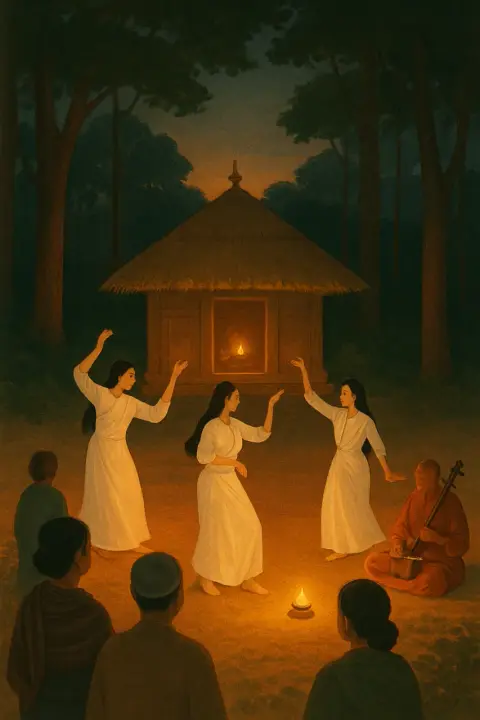
Lai Haraoba: the pleasing of the gods in Manipur
Priestesses' hands retelling how the gods shaped the first human body
Lai Haraoba, "the pleasing of the gods", is the Meitei festival of Manipur held for the Umang Lai, the forest deities and deified ancestors kept at neighbourhood and village shrines, more than three hundred of them. There is no single date: each shrine holds its own Haraoba, from about February to June, and one shrine's festival lasts from three days to over a month. Before planning a visit, note that the UK Foreign, Commonwealth & Development Office (FCDO) advises against all but essential travel to Manipur, and that foreign nationals should check permit rules first: press reports say a Protected Area Permit is required.
Each shrine's Haraoba committee sets its own dates and announces them locally in the weeks before; there is no state notice.
The legend

Lai Haraoba means "the pleasing of the gods". The Meitei festival honours the Umang Lai, forest deities and deified ancestors numbering over three hundred.

It is a ritual enactment of the creation myth. Practitioners say the name comes from the cry of "hoi" at the moment the universe was revealed.

There are four forms: Kanglei around Imphal, Moirang in the south of the valley, Kakching in the east, and Chakpa in villages such as Andro and Phayeng.
Customs
Called from the water
It opens with Lai Ikouba: maiba priests and maibi priestesses call the deity up from water into the shrine to the sound of the pena fiddle.
The maibi's dance
The maibis tell with their hands how the gods made the human body and how the year's work goes: building a house, cotton, weaving.
Lullaby for the gods
Each day ends with naosumba, as the pena player sings the deities to rest for the night.
Where to celebrate
Imphal
Shrines across the Imphal valley each keep their own Haraoba between February and June: priestesses dance the making of the body and the year's work in the courtyard, and quiet onlookers are welcome.
What Lai Haraoba is
Lai Haraoba belongs to the oldest layer of Meitei religion, older than the Vaishnava tradition that later shaped Manipuri Sankirtana (inscribed by UNESCO in 2013) and Manipuri classical dance.
The festival is a ritual enactment of the Meitei creation myth. The rites are led by the maibi, priestesses, together with maiba priests, while the pena player (asheiba) accompanies them on the pena, a bowed string instrument. Only women can be maibi; the maiba and the pena player are men. At the centre of the ritual stand a male and a female deity of the shrine, Lainingthou and Lairembi.
How a Haraoba unfolds
Every shrine follows the same outline, and the stage is the shrine courtyard (laibung), with no tickets or seats.
- Lai Ikouba: called from the water
The festival opens when the maiba and maibi call the deity up from water into the shrine, to the sound of the pena.
- Laibou: the story told with hands
On the Haraoba days the maibi tell with their hands how the gods made the human body, and then how the year's work goes: building a house, growing cotton, weaving.
- Naosumba: a lullaby for the gods
Each day ends with naosumba, when the pena player sings the deities to rest for the night.
- Lairoi: the closing
The last part closes the festival at the shrine.
The four forms of Lai Haraoba
Lai Haraoba is kept in four regional forms, each with its own deity, rites and calendar.
Kanglei Haraoba, Imphal
The form of the neighbourhood shrines in and around Imphal, addressed to Pakhangba. It includes the Khoriphaba rite, the search for a bride for the deity Khoriphaba.
Moirang Haraoba
At the Ebudhou Thangjing temple in Moirang, about 45 km south of Imphal near Loktak lake, from about mid-May into June. It is linked to the story of Khamba and Thoibi. The hill pilgrimage to Thangjing that belongs to it has been stopped in recent years by security restrictions, so plan for the temple only.
Chakpa Haraoba
Village forms in Chakpa villages such as Andro, Phayeng and Sekmai, each on its own dates.
Kakching Haraoba
In Kakching, in the east of the valley, ending with the Ngaprum Tanba eel-hunting rite on the last day.
Travel advice and permits
FCDO advice. The UK Foreign, Commonwealth & Development Office advises against all but essential travel to the state of Manipur, including Imphal, because of ethnic violence since May 2023. It notes that curfews and other restrictions, transport disruption and the suspension of internet services can happen at short notice in parts of the state, and that some insurgent groups are active in north-east India, including Manipur. Its advice there is to avoid protests and large gatherings, follow the local authorities and your travel company, monitor local media and follow any curfew. FCDO also notes that travel insurance can be invalidated by travelling against its advice. Read the current FCDO page and your own government's advice before booking.
Foreign nationals. Press reports say the Ministry of Home Affairs reimposed the Protected Area regime on Manipur and foreigners need a Protected Area Permit; we found no official notice of the current rules. Check with an Indian mission, the Bureau of Immigration or your tour operator before booking. FCDO's general rule for protected areas is to apply about three months before arrival, through an Indian High Commission or consulate abroad, or in India through the state's liaison office or the Foreigners Regional Registration Office. Regulations can change at any time. See also our India visa guide.
Indian nationals. Indian citizens from outside Manipur need an Inner Line Permit. The temporary permit for visitors is valid for 30 days, is not renewable and costs about ₹100. It is issued on the official ILP portal and at self-service kiosks at Imphal airport, Mao Gate and Jiribam.
In an emergency anywhere in India, call 112. More in Is India safe?
Etiquette at the shrine
A Haraoba is worship, and quiet onlookers are welcome.
- Shoes off — Take your shoes off before entering the shrine courtyard.
- Sit at the edge — Sit at the side of the courtyard, never between the maibi and the shrine.
- Ask before photographing — Ask the shrine committee before taking any photographs, and above all before photographing a maibi in trance.
Planning around a shrine
With no state-wide date, a trip is built around one shrine.
- Choose the shrine first
Each shrine's committee sets its own dates and announces them locally, in the local papers, in the weeks before. Book once the opening day (Ekouba) is known.
- Where to stay
Imphal for the Kanglei shrines; Moirang for the Moirang form. A month ahead is usually enough for a room.
- Getting there
Imphal is reached by air; the railway ends at Jiribam, about 220 km away. Arrive the day before the opening.
FAQ
What is the meaning of Lai Haraoba?
It is usually translated as "the pleasing of the gods" or "the merrymaking of the gods". The festival honours the Umang Lai, the forest deities and deified ancestors of the Meitei.
In which state is Lai Haraoba celebrated?
In Manipur, by the Meitei, mainly at shrines across the Imphal valley, including Imphal, Moirang, Kakching and Chakpa villages such as Andro and Phayeng.
What are the four types of Lai Haraoba?
Kanglei Haraoba around Imphal, Moirang Haraoba in the south of the valley, Chakpa Haraoba in villages such as Andro, Phayeng and Sekmai, and Kakching Haraoba in the east.
When is Lai Haraoba?
There is no single date. Each shrine holds its own Haraoba between about February and June, from three days to over a month, and announces the dates locally a few weeks ahead.
Can foreigners attend Lai Haraoba?
Shrine Haraobas are free and quiet onlookers are welcome, but FCDO advises against all but essential travel to Manipur, and foreign nationals should check permit rules with the Indian authorities or a tour operator: press reports say a Protected Area Permit is required.
Sources (10)
- FCDO foreign travel advice: India
- Manipur Inner Line Permit, official portal
- Lai Haraoba
- Lai Haraoba, Sahapedia
- UNESCO: Sankirtana of Manipur
- Meitei pilgrims barred from sacred Thangjing hill, The Assam Tribune
- FCDO: India, regional risks (Manipur)
- FCDO: India, entry requirements (access permits)
- Curbs on foreigners back in Manipur, The Tribune
- Scroll: Protected Area Regime reimposed in Manipur, Nagaland and Mizoram
Facts checked: 21 October 2026. Prices and hours are approximate; check locally.