 India GO
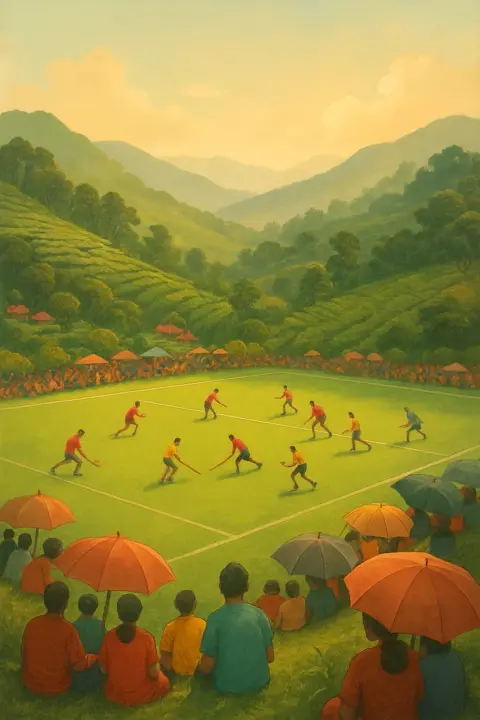
Kodava Hockey Namme: a month of hockey where every team is a family
A month of matches in the coffee hills, where every side shares one surname
Kodava Hockey Namme is a hockey tournament that works like a family reunion. For about a month, usually from early April into early May, Kodava families of Kodagu (Coorg) in Karnataka field teams in a knockout tournament, and every player on a side shares one surname. It started in 1997 with about 60 families; the 26th edition drew 383 teams. There is no fixed date: each year a different family hosts and announces the dates and venue several months ahead. At the final of the 26th edition the flag was handed to the Ajjikuttira family as the next host.
The next host family is named at each final and announces the dates and venue several months ahead (the 2026 dates were public by late August 2025).
The legend
Kodagu is called the cradle of Indian hockey: more than 50 Kodavas have played for India, seven of them at the Olympics.
The tournament was started in 1997 by former referee Pandanda Kuttappa and his brother Kashi Ponnappa to bring Kodava families together.
The first Pandanda Cup drew about 60 families. Since then a different family hosts each year, and the cup carries its name.
Customs
One surname
Every player in a team shares one surname. A woman chooses for herself whether to play for her father's family or her husband's.
Opening day
The opening and closing ceremonies show Kodava dances and martial arts, and a guest makes the first pass with a silver stick.
How the tournament works
The rules are simple and strict. All members of a team must belong to the same family, meaning the same Kodava surname, and play in full hockey kit. Women can play too, and a married woman decides for herself whether to turn out for her father's family or her husband's.
Each year one family takes on the festival: it raises the money, prepares the ground and gives its name to the cup, so the tournament is known as the Pandanda Cup, the Kaliyanda Cup, the Chenanda Cup and so on. Sponsors, raffle tickets and contributions from the playing families cover the cost, and the Kodava Hockey Academy, set up after the first tournament, has the last word on the rules. At each final the flag passes to the next host family.
The matches run as a knockout over about a month, with the final at the end. That final weekend is the peak: the final of the 26th edition was played in front of a crowd of more than 25,000.
Why Kodagu plays hockey
Kodagu is called the cradle of Indian hockey: more than 50 Kodavas have played for India, seven of them at the Olympics. The family tournament was the idea of Pandanda Kuttappa, a former first-division hockey referee, who started it in 1997 with his brother Pandanda Kashi Ponnappa. They paid for the first tournament themselves; it was played at Karada and drew about 60 families.
From there it grew. By 2003 the field had reached 280 teams, and the 26th edition, hosted by the Chenanda family near Napoklu, had 383. The festival is in the Limca Book of Records, and Guinness World Records lists the 2024 edition (Kundyolanda Cup, Napoklu) as the largest field hockey tournament by number of players; by team count it is described as one of the largest field-hockey tournaments in the world.
What you see as a spectator
Watching is free. Opening and closing days are the most colourful: the ceremonies show Kodava dances and martial arts, and a guest opens the tournament by making the first pass with a silver hockey stick. Between those days it is simply hockey, match after match, with families on the sidelines cheering their surname and food and other stalls around the ground doing good business.
This is a community sports festival rather than a show put on for visitors: a pleasant afternoon if you are staying in Kodagu in April, but not a reason on its own to plan a trip. If you can only go once, choose the final, which draws the biggest crowd.
When and where it is held
- When: about a month, usually starting in late March or early April and ending in late April or early May. The exact dates are set by the host family.
- Where: the venue moves with the host. Recent tournaments have been played at Napoklu and Madikeri; earlier ones at Ponnampet, Ammathi, Virajpet and other towns of Kodagu.
- How to find the dates: the next host is named at each final and announces the dates and venue several months ahead. Karnataka newspapers such as Star of Mysore and Deccan Herald report the announcement and the fixtures.
- Next host: at the final of the 26th edition the flag passed to the Ajjikuttira family. Venue and dates are announced by the host family.
More of Kodava culture
Kodagu's own festivals are a better window into Kodava life than the hockey alone. Kail Podh, the festival of arms, is the day the guns come out of the prayer room for a village shooting match. Tula Sankramana at Talakaveri gathers people on the ridge where the Kaveri rises, and Puttari (Huthari) is the Kodava harvest festival.
FAQ
What is the Kodava hockey festival?
A month-long knockout hockey tournament of Kodava families in Kodagu (Coorg), Karnataka, held since 1997 (with a break from 2019 to 2022). Every player on a team shares one surname, and a different family hosts each year.
When is the Kodava Hockey festival held?
Usually for about a month from late March or early April to late April or early May. The host family announces the exact dates several months ahead.
Who hosts the next Kodava hockey festival?
At the final of the 26th edition the flag was handed to the Ajjikuttira family as the next host. Venue and dates are announced by the host family; check Kodagu newspapers.
Who can play in Kodava family hockey?
Members of one Kodava family, sharing one surname, in full hockey kit. Women play too and choose whether to represent their father's or their husband's family.
Do I need a ticket to watch?
No. Watching the matches is free; the final draws the biggest crowd, more than 25,000 at the 26th edition.
How many teams play in the Kodava hockey festival?
The 26th edition had 383 family teams; the first, in 1997, about 60.
Sources (4)
Facts checked: 21 October 2026. Prices and hours are approximate; check locally.