 India GO
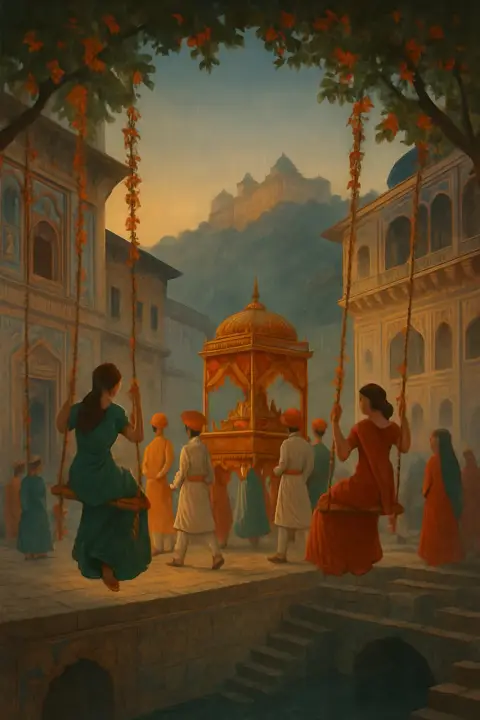
Kajli Teej in Bundi
A goddess carried past stepwells and painted havelis under a monsoon sky
Kajli Teej, also called Kajari Teej or Badi Teej, is the late-monsoon festival of the goddess Parvati, and Bundi in Rajasthan celebrates it in its own way: two evenings on which the image of Teej Mata is carried in a palanquin through the old bazaars, and a town fair that runs for about two weeks. Dates of the processions: 20–21 August 2027. Rajasthan Tourism publishes the dates in its official festival calendar.
Rajasthan Tourism publishes the dates years ahead (its current list runs to 2030) and can revise them; the Bundi town administration announces the fair a few weeks before.
The legend
Teej means third: it names three festivals for Parvati and Shiva. Kajari Teej falls on the third day of the dark half of Bhadrapada.

In Rajasthan it is called Badi Teej, and Bundi keeps its own version, with the Kajali Teej fair.
The procession with Parvati recalls her leaving her parents' home for her husband's; she is honoured by those who seek a happy marriage.
Customs
Goddess in a palanquin
Parvati's image is carried in a palanquin through Bundi's main bazaars, with music.
Henna and bangles
Women dress in bright traditional clothes, put on new bangles and paint their hands with henna.
Rural fair
Nearby runs a fair loved by the surrounding villages, with kataar daggers, paintings, bangles, crafts and snacks.
Words of the festival
तीज
Teej
Third: a festival of the third lunar day.
What Kajli Teej is
Teej means "third", and the name covers three festivals for Parvati and Shiva, each on a third lunar day and kept mainly by married women and girls:
- Hariyali Teej in the month of Shravan, called Chhoti (small) Teej in Rajasthan; in Jaipur it is the big Teej procession.
- Kajli (Kajari) Teej, the third day of the dark half after the Shravan full moon, about two weeks later. Because it follows Chhoti Teej, Rajasthan calls it Badi (big) Teej.
- Hartalika Teej, on the third day of the bright half of Bhadrapada, about two weeks after that.
On Kajli Teej women who keep the fast go without food and water and break it with sattu, roasted gram flour. The day includes prayers to the neem tree and to the moon. Women sing kajri, folk songs of the rainy season whose themes are separation from a loved one and waiting at the parental home to be fetched for the festival.
The procession and the fair in Bundi
In Bundi Kajli Teej is a town event. The fair is organised by the municipal council, and its main event is the shahi sawari, the royal procession of Teej Mata, on the two evenings of the festival. A local press report from one year describes it setting out in the early evening from Ramprakash Talkies and winding through the old bazaars, past Tilak Chowk and Chaumukha Bazaar, to Kumbha Stadium, the fair ground; that year rural algoza (double flute) groups played along the route and competed for prizes. The council announces the time and route before each fair.
The fair at Kumbha Stadium then runs for about 15 days, with stalls, swings and carousels, and an evening stage programme: devotional bhajan evenings, Rajasthani and all-India poetry gatherings (kavi sammelan), a cultural evening by the Tourism Department and music nights. Rajasthan Tourism notes that the fair is very popular with villagers from around Bundi.
Bundi around the festival
Bundi is worth a stay beyond the procession. Rajasthan Tourism lists Raniji ki Baori, a stepwell built in 1699 by Rani Nathavati and known for its carved elephants; Taragarh fort, built in 1354; the Chitrashala, the painted hall of the palace whose murals have kept their colours; Sukh Mahal, a small two-storeyed summer palace where Rudyard Kipling is said to have written part of Kim; and the cenotaph on 84 pillars built for a ruler's wet nurse.
Teej comes in the late monsoon, so expect rain on some evenings. Bundi also holds the Bundi Festival in October or November, three days after Kartik Purnima, and Teej in Jaipur falls about two weeks before Kajli Teej.
Tips for the procession
The procession is a religious event and a local one; a few habits make it easier for everyone.
- Find a spot early — The route runs through the old bazaars. Take a place along it well before the procession is due, and do not step into the path of the palanquin.
- Ask before photographing — Ask women and families before taking close-up photographs.
- Crowds — The UK Foreign Office advises extra care at large religious gatherings. Agree a meeting point; the emergency number is 112, more in emergency numbers in India.
How to get to Bundi
Rajasthan Tourism gives Jaipur airport, about 206 km away, as the nearest. Bundi railway station is about 4 km south of the old city, and regular buses run from Ajmer, Jaipur, Kota, Udaipur and other cities. The municipal council announces the fair programme before it opens.
FAQ
When is Kajli Teej in Bundi?
Next: 20–21 August 2027, the two evenings of the procession. The fair around them lasts about two weeks.
What is the meaning of Kajli Teej?
Teej means "third": the festival falls on the third lunar day of the dark half after the Shravan full moon. On this day women sing kajri, the folk songs of the rainy season.
What are the three types of Teej?
Hariyali Teej in Shravan, Kajli (Kajari) Teej about two weeks later, and Hartalika Teej about two weeks after that, in the bright half of Bhadrapada.
Why is it called Badi Teej?
In Rajasthan, Hariyali Teej is called Chhoti (small) Teej, and Kajli Teej, which follows it, is Badi (big) Teej.
Which goddess is worshipped on Kajli Teej?
Parvati, whom Rajasthan Tourism names as Uma; in Bundi her image, Teej Mata, is carried in the procession.
How do I reach Bundi?
By train to Bundi station, about 4 km from the old city, or by bus from Kota, Ajmer, Jaipur or Udaipur. The nearest airport given by Rajasthan Tourism is Jaipur, about 206 km away.
Sources (5)
Facts checked: 21 October 2026. Prices and hours are approximate; check locally.