 India GO
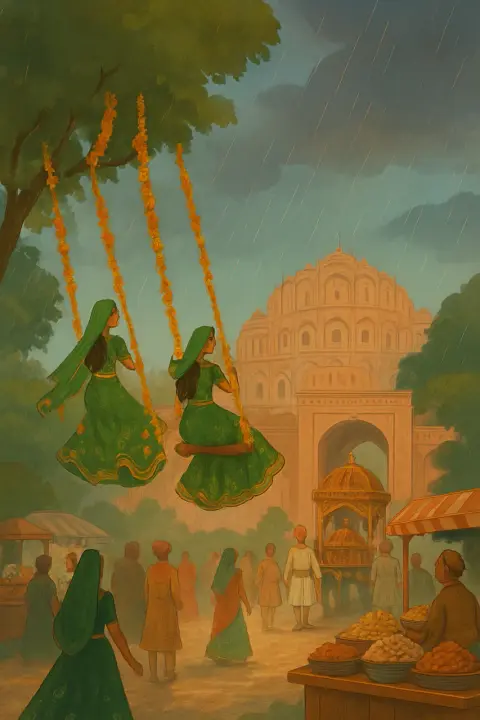
Teej in Jaipur: the goddess leaves the City Palace at the start of the monsoon
Swings in the courtyards, green bangles and a goddess leaving the palace in the rain
Teej is a monsoon festival of north and west India dedicated to the goddess Parvati, called Teej Mata, and kept above all by women. Hariyali Teej, the "green Teej", falls on the third lunar day of the bright half of the month of Shravana, usually between late July and mid-August. In Jaipur it is marked by a royal procession: Teej Mata is carried in a palanquin out of the City Palace and through the old city's bazaars on two evenings. In Jaipur: 4–5 August 2027.
Rajasthan Tourism publishes the dates years ahead (its current list runs to 2030) and can revise them, as in 2026, when the procession moved a day later; check a few weeks before.
The legend

Legend says Parvati fasted and prayed for many years to become Shiva's wife.
Shiva accepts her only in her 108th birth, and Hariyali Teej remembers the day they were joined.

It falls in the month of Shravana, when the monsoon rains turn everything green, hence the name: Green Teej.
Here Parvati is called Teej Mata. In Jaipur she is carried in a palanquin through the bazaars on two days, recalling her journey to her husband's home.
Customs
Swings
Swings go up under trees and in courtyards, and women and girls swing, sing and dance.
Sindhara
A mother sends her married daughter gifts: clothes, bangles, a bindi, henna and ghevar.
Sinjara
On the eve of Hariyali Teej women paint their hands and feet with henna.
Home to parents
Married women go back to their parents for Teej when they can, and brothers put up swings for their sisters.
Songs of parting
Teej songs often speak of separation: from a husband away for work, or from the parental home.
What people eat
Ghevar
a honeycomb disc of ghee batter in syrup, the sweet of Shravana
Words of the festival
तीज
teej
"third": the third lunar day after the new moon
Hariyali Teej
the "green Teej" of Shravana, also called the Small Teej
झूला
jhula
a swing, the one thing no Teej is without
sindhara
a mother's gifts to her married daughter, from the Sanskrit for adornment
Teej Mata
"Mother Teej", Parvati's name at this festival
True or myth
✅ True. There are Hariyali Teej, Kajari Teej and Hartalika Teej, kept in different parts of India and Nepal.
❌ Myth. Kajari Teej comes later, in Bhadrapada; in Rajasthan it is the Big Teej, and Hariyali the Small one.
❌ Myth. There it is called Teeyan and runs about 13 days, from the third day of the bright half of Sawan to the full moon.
Where to celebrate
Jaipur
On Hariyali Teej the goddess's palanquin leaves Jaipur's City Palace in the late afternoon with folk troupes from across Rajasthan; a second procession, Budhi Teej, follows the next day.
What Teej is
The word teej means "third": the third lunar day after the new moon. There are three Teej festivals in the year. Hariyali Teej comes in Shravana, when the monsoon turns everything green; in Rajasthan it is the Small Teej. Kajari Teej, the Big Teej, follows in Bhadrapada; in Rajasthan it is kept above all in Bundi. Hartalika Teej, about a month after Hariyali Teej, is observed with a strict fast in Bihar, eastern Uttar Pradesh, Jharkhand, Nepal and elsewhere.
Behind Hariyali Teej is a legend: Parvati fasted and prayed for many years to become the wife of Shiva, and he accepted her only in her 108th birth. Teej remembers the day they were joined, and women pray to the goddess for the well-being of their husbands. Married women go back to their parents' home when they can, and a mother sends her daughter the sindhara: clothes, bangles, a bindi, henna and ghevar, a honeycomb disc of fried batter in syrup that is the sweet of the season. On the eve, called Sinjara in Rajasthan, women paint their hands and feet with henna. Swings go up under trees and in courtyards, women wear green and lehariya saris and sing Teej songs, many of them about separation from a husband away for work or from the parental home. More on the goddess: Parvati.
The Teej Mata procession
Jaipur's royal procession of Teej Mata sets out from the Zenana Deodhi, the women's quarters of the City Palace, at about 5:30 pm. It recalls Parvati's journey from her parents' home to her husband's. The goddess rides in a palanquin under a canopy, with camels, folk dancers and musicians, chariots and bullock carts, and troupes from across Rajasthan; Rajasthan's tourism department organises it.
The route is short. The procession passes through Tripolia Gate into Tripolia Bazaar, stops at Chhoti Chaupar for a maha-aarti, a great lamp offering, and continues along Gangauri Bazaar towards the Chaugan Stadium and Talkatora side of the old city, where it ends after dark. The next evening a second procession, Budhi Teej, follows the same way. Monsoon showers are likely on both days, and the procession goes ahead in the rain.
Where to watch
The whole route is free. Come an hour early to stand at the front.
Tripolia Gate
The first stretch of the route. Rajasthan Tourism has in some years set up seating for foreign nationals on the terrace of the Hind Hotel opposite Tripolia Gate and in the verandas below it.
Tripolia Bazaar
Shops and upper floors along the bazaar look straight down on the procession; a balcony here is worth arranging in advance.
Chhoti Chaupar
The square where the procession stops for the maha-aarti.
Gangauri Bazaar
The last stretch towards the Chaugan Stadium, usually after dusk.
Practical tips for Teej in Jaipur
Teej falls in the monsoon, outside Jaipur's main season.
- Book about a month ahead — A month is enough for trains, flights and a room; hotel prices rise moderately. Stay in the old city or in a hotel with a Tripolia Bazaar frontage, and arrive the day before. See the Jaipur guide.
- See the eve too — On Sinjara, the day before, the bazaars sell lehariya cloth, bangles and ghevar, and women have henna applied.
- Rain and flooding — Carry rain cover for your phone and camera. The UK Foreign Office warns that monsoon rains can cause flash flooding with little warning.
- In the crowd — Keep valuables in a front pocket, agree a meeting point off the route, and leave space for the procession.
FAQ
When is Teej in Jaipur?
Next: 4–5 August 2027, with the Teej Mata procession on both evenings. Rajasthan Tourism publishes the dates years ahead and can revise them, so check a few weeks before.
In which month is the Teej festival celebrated?
Hariyali Teej falls in the Hindu month of Shravana (Sawan), usually between late July and mid-August. Kajari Teej and Hartalika Teej follow in Bhadrapada.
What is Kajari Teej?
The second Teej of the monsoon, kept in Bhadrapada and called the Big Teej in Rajasthan, where Bundi holds a fair for it. It is not another name for Hariyali Teej.
What is Hartalika Teej?
A Teej about a month after Hariyali Teej, on the third day of the bright half of Bhadrapada, when married women keep a waterless fast. It is widely observed in Nepal and eastern India.
Where does the Teej procession start in Jaipur?
From the Zenana Deodhi of the City Palace, at about 5:30 pm, through Tripolia Gate, Tripolia Bazaar and Chhoti Chaupar to Gangauri Bazaar.
Is it free to watch the Teej procession?
Yes. The whole route is free; come about an hour early for a place at the front.
Sources (6)
Facts checked: 21 October 2026. Prices and hours are approximate; check locally.