 India GO
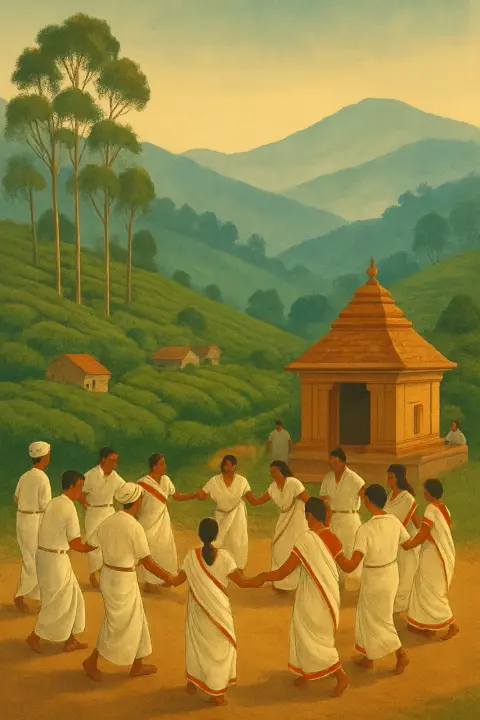
Hethai Habba: the Badaga festival of the Nilgiri hills
White turbans on the hill roads as Badaga villages honour their ancestress
Hethai Habba is the biggest festival of the Badagas, the hill farming community of the Nilgiris in Tamil Nadu. It honours Hethai Amma, revered as the community's foremother and protector, and gives thanks for the harvest, the cattle and the dairy year. There is no single date for the whole district: the day follows the lunar calendar and each village keeps its own, so the festival moves from village to village between late December and January.
The Badagas are the largest of the hill communities of the Nilgiris, farming the slopes around Kotagiri, Ketti, Hubbathalai and dozens of other hattis, or villages. Hethai Habba honours Hethai Amma and gives thanks for the harvest, the cattle and the dairy year. It falls on the first Monday after the full moon of the Tamil month of Margazhi, after eight days of kolu, and different villages keep their own days, so the season spreads across December and January rather than falling on one date everywhere.
The Nilgiris collector declares the local holiday for the Hethaiyamman festival in December; each village keeps its own days.
The legend
The Badagas are a Nilgiri hill community living in nearly 400 villages, hattis; their name, from an Old Kannada word, means "northerners".
Their tradition traces the Badagas to seven siblings who came to these hills, and the founders are honoured under the name Hethappa, or Hetha.
Hethai Amman, the story goes, herded buffaloes. She is revered as a deified foremother and the community's protector.
Her staff, the dhadi, is kept in every house in the hagottu, the butter-churning room by the kitchen, a room cleansed each Monday with spring water.
And once a year, on the first Monday after the full moon of Margazhi, Badagas dressed in white go to her temples at Beragani and Pedduva.
Customs
All in white
Men wear the white mandare turban, a mundu and the seele wrap and carry the family staff; women drape a white mundu over their shoulders. The road becomes a white stream.
Five coins
Before the festival every household in the village gives five hana coins. They are tied in white cloth and carried to the temple as an offering.
The send-off
For those setting off, women spread white sheets on the path, and those staying behind bow down to be blessed. A shared cry rings out: "Ye ha ho".
Eight days of kolu
The eight days before the festival are kolu: Badagas keep strictly vegetarian, avoid alcohol, and everyone is to visit Hethai's temple.
A few seconds
Hethai's image is shown to people only on the festival day, and only for a few seconds. Photographing it is strictly forbidden.
Food for all
When the pilgrims return, villages hold anna dhana, "food for all": people sit down in rows and eat together.
Words of the festival
எத்தை அம்மன்
Hethai Amman
the Badagas' ancestral goddess; this is her name in Tamil script
hatti
a Badaga village; there are nearly four hundred in the Nilgiris
kolu
the eight days of strict observance before the festival
mandare
the white turban of Badaga men
dhadi
a herder's staff; Hethai's staff is kept at home as a sacred object
athikkodu
the Badagas' shared cry, "Ye ha ho"
True or myth
✅ True. It is revealed only on the festival day, for a few seconds, and may not be photographed.
❌ Myth. Its day is the first Monday after the full moon of Margazhi, so the date moves, usually between late December and early January.
✅ True. Badagas hold Monday, sovara, as their most sacred day, which is why Hethai's festival falls on a Monday.
Who the Badagas are
The Badagas live in nearly 400 villages, called hattis, across the Nilgiris district. Their language, Badaga, is close to Kannada, and the name comes from an Old Kannada word meaning "northerners"; by oral tradition their ancestors were Vokkaliga farmers from the plains of Mysore. Hethai means grandmother, and Hethai Amma is honoured as the ancestress of the community.
Are the Badagas a Scheduled Tribe? They were on the tribes list in the 1931 census and on the Scheduled Tribe list in the 1951 census, but were later removed; the community has long asked for the status back.
How the festival unfolds
The festival day closes eight days of kolu, a period of strict observance. On the Friday before, men from the hattis walk to the principal temple of Hethai at Beragani, in Kotagiri taluk, keeping to vegetarian food and no alcohol; Pedduva is the goddess's other main temple.
The most detailed published account of a village festival comes from Ketti, a cluster of 14 Badaga hamlets between Coonoor and Ooty. On the evening before the main day, men carry the goddess in a wooden palanquin from her house to a small Ganesha temple uphill, and the night passes in prayer, music and dance, with an oracle through whom the goddess is said to speak. In the morning about 30 men from Achanakal hamlet walk roughly two kilometres to Ketti with the staffs that stand for Hethai, which are washed and decorated with vermilion, turmeric and flowers.
Then comes anna dhana, the free meal for everyone. At Ketti, rice, ghee, beans, sambar and rasam are cooked in large cauldrons over wood fires and served on banana leaves, about 500 people at a sitting; for one recent festival the hosts expected some 30,000 people. Guests are welcomed with a white cotton cloth draped over the shoulders.
When Hethai Habba falls
Community sources give the rule as the first Monday after the full moon of the Tamil month of Margazhi, after the eight days of kolu; Monday, sovara, is the Badagas' holiest day. In practice dates differ from place to place. The Nilgiris district declares a local holiday for the Hethaiyamman festival at Beragani, which in recent years has fallen in the first week of January, while villages such as Ketti keep their own day, which can come later in January.
No calendar lists every village's day. To see a particular village festival, ask a Badaga contact or your host in the Nilgiris in December, when the district holiday is announced.
Visiting as a guest
Hethai Habba is a community religious festival, not a staged event. Guests are welcome; a community source says thousands of non-Badaga devotees come to the main temples.
- No photos of the goddess — The image of Hethai is shown only for a few seconds on the festival day and may not be photographed. At Ketti, cameras and phones are not allowed near the spot where the goddess spends the night.
- Ask before photographing people — Ask before taking pictures of families and of the procession of men in white.
- No meat or alcohol — Those taking part keep to vegetarian food and no alcohol; do not bring either with you.
- Accept the meal — Anna dhana is free and open to all. Sit in the row and eat what is served.
- Crowds on the main day — Expect large crowds at Beragani and Ketti. The UK Foreign Office advises extra care at large religious gatherings. The national emergency number is 112: see emergency numbers in India.
Getting there and where to stay
Base yourself in Ooty or Coonoor. Beragani lies in Kotagiri taluk, and Ketti has its own small station on the Coonoor–Ooty section of the Nilgiri Mountain Railway. Routes into the hills are in how to get to Ooty & Coonoor, and areas to stay in are in where to stay in Ooty & Coonoor. Bring warm layers if you plan to stay for the evening rituals.
FAQ
When is Hethai Habba?
The rule is the first Monday after the full moon of the Tamil month of Margazhi, after eight days of kolu, but each village keeps its own day. The district holiday for the Beragani festival has recently fallen in the first week of January.
Is Hethai Habba a holiday in the Nilgiris?
Yes, a local one. The Nilgiris district administration declares a local holiday for the Hethaiyamman festival; it does not apply elsewhere in Tamil Nadu.
Who are the Badagas?
A hill community of the Nilgiris living in nearly 400 villages, or hattis. They speak Badaga, a language close to Kannada, and their name means "northerners".
Can tourists attend Hethai Habba?
Yes. Guests are welcomed and fed at anna dhana, the free meal. Do not photograph the image of the goddess, and keep the village rules on meat and alcohol.
What does Hethai mean?
Grandmother. Hethai Amma is honoured as the ancestress of the Badagas.
Are the Badagas a Scheduled Tribe?
Not at present. They were on the Scheduled Tribe list in the 1951 census but were later removed, and the community has long asked for the status to be restored.
Sources (6)
Facts checked: 21 October 2026. Prices and hours are approximate; check locally.