 India GO
Ganga Dussehra: the day the Ganga came down, kept on Haridwar’s ghats
Ghats full before first light, for the day the river came down from heaven
Ganga Dussehra marks the day the Ganga is believed to have come down from heaven to earth. It falls on Dashami, the tenth lunar day of the bright half of Jyeshtha, in late May or June, and closes ten days of bathing in the river. Haridwar keeps it on the largest scale: the ghats fill before first light and the evening aarti at Har ki Pauri is the biggest of the year. In Haridwar: 4–13 June 2027 (expected).
The day follows the lunar calendar; the Haridwar district administration and the Ganga Sabha publish the bathing arrangements a few weeks ahead.
The legend
Legend says the sixty thousand sons of King Sagara insulted the sage Kapila and were burned to ash by the fire of his anger.

Their descendant, King Bhagiratha, goes to the Himalayas and through long penance begs the heavenly Ganga to come down to earth.

The earth could not bear her fall, so Shiva catches the river in his matted hair and lets only a single drop down onto the plain.
The river reaches the ashes of the ancestors and frees them; in memory of the king's labour its upper course is still called the Bhagirathi.

The descent is marked on the tenth day of the bright half of Jyeshtha: bathing in these ten days is believed to wash away ten sins.
Meaning
Mathura
The Yamuna is honoured the same day: in Mathura and Vrindavan people bathe in it, offer watermelon and cucumber, and fly kites.
Patna
In Patna a grand evening aarti is held at Gandhi Ghat, and an 1,100-metre garland is offered to the river at Adalat Ghat.
Customs
Bathing at dawn
Haridwar's ghats fill before first light as people step into the water to bathe on the day the river came down.
Aarti at Har ki Pauri
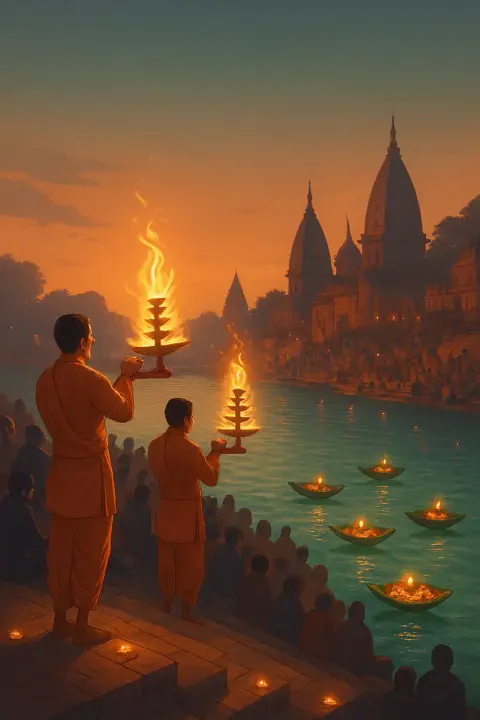
At sunset the priests raise large fire bowls, temple bells ring and people on both banks sing praises to the Ganga.
Lamps in leaf boats
Flowers and lit lamps in little leaf cups are set on the water to drift downstream, each with a wish.
Chains by the steps
The current at Har ki Pauri is strong, so people bathe by the chains strung along the steps and hold on to them.
What people eat
Lassi
in Mathura lassi, sharbat and shikanji are handed out that day
Shikanji
spiced lemonade, also handed out that day
Words of the festival
दशहरा
Dussehra
"destroyer of ten": from Sanskrit dasha, ten, and hara, to destroy
हर की पौड़ी
Har ki Pauri
"the feet of Hari", Vishnu: Haridwar's main ghat, where the river meets the plains
ब्रह्म कुण्ड
Brahmakund
the holiest spot at Har ki Pauri, where drops of amrit are said to have fallen
गंगाजल
gangajal
Ganga water, collected on the festival and carried home
आरती
aarti
a ritual of light: a lamp is circled before the sacred while hymns are sung
True or myth
❌ Myth. Ganga Dussehra falls in the month of Jyeshtha, in early summer, and its name means "destroyer of ten" sins.
✅ True. Har ki Pauri is on the west bank of the Ganga canal, into which the river is diverted just upstream.
✅ True. It went up in 1938, when the ghat was extended, while tradition dates the ghat itself to the 1st century BC.
Where to celebrate
Why it is kept
The name explains the festival. In Sanskrit dasha means ten and hara to destroy, so bathing in the river during these ten days is believed to wash away ten sins, or, in another reading, the sins of ten lifetimes. The legend behind it is told above: King Bhagiratha’s penance, Shiva catching the falling river in his matted hair, and the Ganga reaching the ashes of King Sagara’s sons. Despite the name, it is not the autumn Dussehra of Rama’s victory over Ravana.
The date follows the lunar calendar. In a year with an extra month of Jyeshtha, Haridwar keeps the festival in the extra month, which can bring it almost a month earlier than a simple count suggests. The Haridwar district administration and the Shri Ganga Sabha publish the bathing arrangements a few weeks ahead.
Haridwar on the day
Bathing starts in the dark. From before dawn people step into the water along the whole riverfront, most densely at Har ki Pauri and its Brahmakund, the spot where drops of amrit are said to have fallen. Har ki Pauri stands on the Ganga canal, into which the river is diverted just upstream, and the current there is strong: people bathe within the sections marked by chains along the steps and hold on to them. The ghats a few minutes downstream are calmer. Many people fill containers with gangajal, river water, to take home.
At sunset the Shri Ganga Sabha performs the Ganga aarti: priests raise large fire bowls, bells ring, people on both banks sing to the river, and leaf cups with flowers and lamps are set on the water. On Ganga Dussehra this is the largest aarti of the year. Watch from the ghat steps, from the island opposite with the clock tower (put up in 1938) or from the footbridges, and take your place at least an hour early. Press reports have counted bathers in the tens of lakhs, that is several million, over the main days.
Beyond Haridwar
The festival is kept mainly along the river, in Uttar Pradesh, Uttarakhand, Bihar and West Bengal. Varanasi holds a maha aarti and floats lamps at Dashashwamedh Ghat; Patna has an evening aarti at Gandhi Ghat; Garhmukteshwar, Rishikesh and Prayagraj draw bathers too. In Mathura and Vrindavan the Yamuna is honoured the same day: people bathe in it, offer watermelon and cucumber, fly kites and hand out lassi, sharbat and shikanji. More about the river goddess: Ganga.
Planning a Haridwar visit
The main day is the last day of the dates above. Two nights are the minimum: the night before the dawn bathing and the night of the festival itself.
- About six weeks ahead: the room
Pay for location: a room within walking distance of Har ki Pauri matters more than a better room further out, because vehicles are kept away from the ghats on the main day. See where to stay in Haridwar.
- 60 days ahead: the train
Trains go on sale 60 days before departure and fill early in June, when Char Dham pilgrims pass through as well. Haridwar Junction is about a twenty-minute walk from Har ki Pauri.
- Two days before: arrive
Haridwar fills up, and on the main day traffic jams reach back into the city and onto the highway. Rishikesh, about 25 km away, is quieter, but you would have to come in by that road.
- The day itself: on foot
Bathe at dawn, rest through the heat and walk back for the aarti. Haridwar averages highs of about 38°C in May and 37°C in June.
Water and crowds
The FCDO warns that rivers in India have strong currents and that people drown every year. At Har ki Pauri bathe only within the chained sections, hold children by the hand and do not swim out. The FCDO also notes that stampedes have occurred at large religious gatherings: follow police directions at the barricades, keep to the side of a moving crowd and agree a meeting point with your group. Keep phones and cash in a front pocket. More: taking a holy dip and safety in Haridwar.
FAQ
When is Ganga Dussehra?
On Dashami of the bright half of Jyeshtha, in late May or June; the nine days before it count as part of the festival. In Haridwar: 4–13 June 2027 (expected).
Why is Ganga Dussehra celebrated?
It marks the descent of the Ganga from heaven to earth. Bathing in the river during the ten days is believed to wash away ten sins.
Which states celebrate Ganga Dussehra?
Mainly Uttarakhand, Uttar Pradesh, Bihar and West Bengal, along the Ganga. Haridwar, Varanasi, Rishikesh, Garhmukteshwar, Prayagraj and Patna are the main places.
Is Ganga Dussehra the same as Dussehra?
No. Ganga Dussehra falls in Jyeshtha, in early summer, and honours the river; the autumn Dussehra celebrates Rama’s victory over Ravana.
When is the aarti at Har ki Pauri?
Every evening at sunset. On Ganga Dussehra it is the biggest of the year, so take your place at least an hour early. More: Ganga aarti in Haridwar.
Sources (4)
Facts checked: 21 October 2026. Prices and hours are approximate; check locally.