 India GO
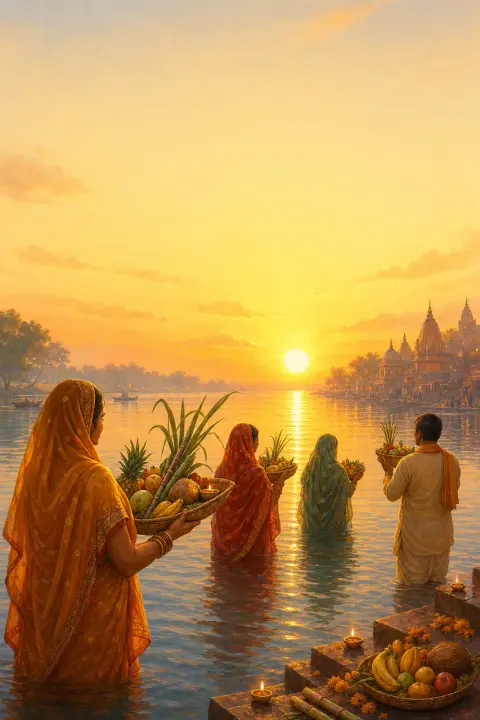
Chhath Puja in Kolkata: the Hooghly ghats and the neighbourhood ponds
Standing in the river to greet the rising sun
In Kolkata, Chhath Puja is kept mostly by families with roots in Bihar, Jharkhand and eastern Uttar Pradesh, and it is spread across the city rather than gathered in one place: along the Hooghly ghats, with Babughat the best known, and at dozens of purpose-built ponds in the neighbourhoods. Next Chhath: 13–16 November 2026 (the main festival is in Kartik, October–November; a smaller Chaiti Chhath falls in spring). The two lakes of south Kolkata, Rabindra Sarobar and Subhas Sarobar, are closed to the festival under court and tribunal orders.
Kolkata's Chhath is spread thin on purpose: a court-backed order keeps it off the city's two big lakes, so it runs instead along the Hooghly ghats and across dozens of purpose-built artificial ponds in the neighbourhoods.
Where to watch
Babughat (Baje Kadamtala Ghat): the most consistently named Chhath site in Kolkata, on the Hooghly at Strand Road near B.B.D. Bagh, with a wide colonnaded frontage and an open approach. Free, no ticket. Walkable from B.B.D. Bagh and Esplanade; Strand Road is restricted for traffic on the offering days.
Takta Ghat: a Hooghly ghat used for Chhath, beside the Indian Navy's INS Netaji Subhas; the Kolkata Municipal Corporation has had to ask for the Navy's cooperation to open it for the festival. Free, but access depends on the yearly arrangement with the naval establishment; confirm in the days before.
Doi Ghat: named by the Kolkata Municipal Corporation among the ghats used for Chhath. Free, on the Hooghly.
Bagbazar Ghat: a north Kolkata Hooghly ghat that is prepared and lit for river rituals and immersions. Free; Bagbazar is the nearest landmark.
Nimtala Ghat: a north Kolkata ghat, mainly a caution: a section has been barricaded and declared off-limits because of river erosion. Free, but part of the ghat is fenced off; stay outside the barricade.
Rabindra Sarobar and Subhas Sarobar: not venues. Both lakes are closed to Chhath under a National Green Tribunal order upheld by the Calcutta High Court and the Supreme Court; the gates are locked and policed (in recent years from late morning on the Sandhya Arghya day to late morning the next day, with police and the Railway Protection Force on duty). Do not plan around either lake.
Neighbourhood artificial ponds: the city's answer to the lake closure. Purpose-built tanks with new ghats, bio-toilets, drinking water, lifeguards and buses to reach them. Free. Recent years' sites include Kidderpore, the EM Bypass, Golf Gardens, Kasba, Patuli, Tollygunge, Ballygunge and Beliaghata; the Kolkata Municipal Corporation and KMDA publish the list shortly before the festival.
Free viewing
- Babughat (Baje Kadamtala Ghat), Strand Road: the widest and most-named Hooghly frontage
- Bagbazar Ghat, north Kolkata
- Doi Ghat
- Takta Ghat (subject to the yearly arrangement with the neighbouring naval establishment)
- Any neighbourhood artificial pond: quieter, and closer to how most of the city keeps the festival; the Kolkata Municipal Corporation publishes the year's list shortly beforehand
Programme
Nahay Khay (Kartika Shukla Chaturthi)
Households that keep the vrat bathe in the river or a clean water body, put on fresh clothes and cook one sattvik meal, usually lauki (bottle gourd) with rice and chana dal. The house and the path down to the water are cleaned. This is the last ordinary meal before the fast.
 The Hooghly ghats and neighbourhood water bodies
Kharna (Kartika Shukla Panchami)
A day-long fast is broken after sunset with gur ki kheer (rice cooked in jaggery) and roti, eaten in silence. The moment that plate is finished the nirjala fast starts: roughly 36 hours with neither food nor water, ending only after the dawn offering on day 4.
Homes and neighbourhood courtyards across the city
Sandhya Arghya (Kartika Shukla Shashthi), main day
Families converge on the Hooghly ghats and on the artificial ponds by bus, on foot and in hired vehicles, carrying sugarcane and the loaded soop. Civic arrangements (changing rooms, lighting, temporary toilets, lifeguards) go live.
The Hooghly ghats and the artificial ponds
Sandhya Arghya (Kartika Shukla Shashthi), main day
The offering to the setting sun, made standing in the Hooghly or in a pond, facing west.
Babughat (Baje Kadamtala Ghat) on Strand Road; Takta, Doi and Bagbazar ghats
Usha Arghya (Kartika Shukla Saptami)
Reaching the ghat or pond before the crowd sets. Dawn comes earlier in Kolkata than in Varanasi or Delhi.
Same ghat or pond as the evening before
Usha Arghya (Kartika Shukla Saptami)
The dawn offering to the rising sun, ending the roughly 36-hour nirjala fast with paran.
Babughat and the Hooghly ghats; the artificial ponds run the same sequence
A Bihari festival in a Bengali city
Chhath is the sun festival of Bihar, Jharkhand and eastern Uttar Pradesh, and in Kolkata it is kept by the families of that region who live in the city. It is not a Bengali festival in the way Durga Puja or Kali Puja are, but West Bengal lists Chhath among its state holidays. It also does not move the hotel market: most of those keeping the vow are residents, not visitors.
The rite itself is the same as on the Ganga in Bihar. There are no idols or temples: on the third day of the festival, Kartik Shukla Shashthi, those keeping the fast stand in the water and offer fruit, sugarcane and thekua to the setting sun, and before dawn the next morning to the rising sun. A smaller Chaiti Chhath is kept in spring, in the month of Chaitra. For the full four-day sequence, see Chhath Puja; for the festival at river scale, Chhath on the Patna ghats.
Why not at the lakes
Rabindra Sarobar and Subhas Sarobar were long used for Chhath. In 2018 the National Green Tribunal banned Chhath rituals at Rabindra Sarobar to protect the lake, and the Calcutta High Court later held that the same ban applies to Subhas Sarobar. In recent years the gates have been locked and policed from the evening-offering day to the next morning.
The city's answer is a network of artificial ponds with new ghats, toilets, drinking water and lifeguards. Recent sites have included Kidderpore, the EM Bypass, Golf Gardens, Kasba, Patuli, Tollygunge, Ballygunge and Beliaghata; the Kolkata Municipal Corporation and KMDA publish the year's list only in the days before the festival. A pond is quieter than the river and closer to how most of the city keeps Chhath.
Etiquette and safety
- Dawn is the stronger moment — Be at the ghat well before sunrise for the morning offering; the crowd settles early. From central Kolkata, Babughat on Strand Road is a walk from B.B.D. Bagh, and traffic on Strand Road is restricted on the offering days.
- Keep your distance — Photograph respectfully, stay back from the vratis (those fasting) and never enter the water near them.
- Prasad — Thekua and fruit are shared after the dawn offering; accept with thanks if offered.
- Barricades and the river — Part of Nimtala Ghat is fenced off because of erosion; stay outside barricades. The UK government warns of strong currents in Indian rivers and of stampedes at large religious gatherings: follow police and lifeguard instructions.
FAQ
When is Chhath Puja in Kolkata?
Next Chhath: 13–16 November 2026. The main Kartik Chhath falls about six days after Diwali, between late October and late November; the evening offering is on Kartik Shukla Shashthi and the dawn offering the next morning.
Do Bengalis celebrate Chhath Puja?
In Kolkata it is kept mainly by families from Bihar, Jharkhand and eastern Uttar Pradesh. West Bengal still lists it among state holidays, and anyone may watch respectfully.
Where is Chhath celebrated in Kolkata?
On the Hooghly ghats, above all Babughat on Strand Road, and also Bagbazar, Doi and Takta ghats, plus the neighbourhood artificial ponds listed by the civic bodies shortly before the festival.
Is Chhath allowed at Rabindra Sarobar?
No. Rabindra Sarobar and Subhas Sarobar are closed to Chhath under a National Green Tribunal ban that the Calcutta High Court applied to Subhas Sarobar as well; the gates are policed.
Sources (5)
Facts checked: 22 October 2026. Prices and hours are approximate; check locally.