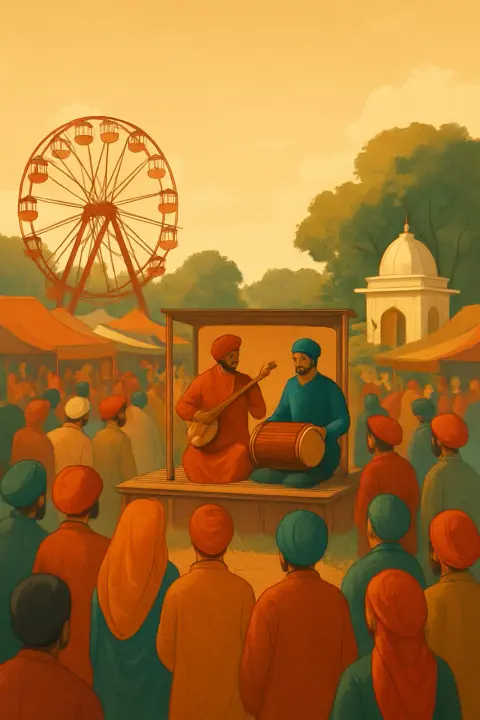
Chhapar Mela is a village fair at Chhapar in Ludhiana district, Punjab, held in memory of Gugga Veer, a folk hero venerated as a protector against snakes. It opens on Anant Chaturdashi, the fourteenth lunar day of the bright half of Bhadon, and lasts a few days: 14–17 September 2027 (expected). It is one of the best-loved fairs of Punjab's Malwa belt, with worship at the Gugge di Marhi shrine by day and folk song and dance around it.
The dates follow the lunar calendar; the mela committee and the Ludhiana district administration announce the programme in August.
What happens at the fair
The centre of the fair is Gugge di Marhi, a large shrine built in Gugga's memory and known locally for protection against snakebite. Here people mainly worship Gugga in his snake form. The central act of devotion is simple: worshippers scoop up a handful of earth seven times, asking Gugga Veer to keep them and their families safe from snakes.
Around the shrine the mela is a Punjabi village fair on a large scale, with folk singers and dancers. Farmers of the Malwa belt know the dates well enough to plan farm work around them. The crowds have grown over the past decades, and accounts of recent fairs speak of very large numbers of visitors.
The mela has a public side too. Political parties have regularly held conferences here, and rival party conferences at the mela have made the news. A second, smaller fair, the Minor Chhapar Mela, is held at the same place, and the seven scoops of earth are made there as well.
Gugga Veer and the legends of Chhapar
Gugga Veer, also known as Gugga Pir, is honoured across north India; at Chhapar the fair marks his descent into the bosom of Mother Earth together with his horse. In the legend he was a Chauhan Rajput with power over all snakes.
The village has its own story. A boy and a snake were born together in a farming family in Chhapar and were so close that when one was hurt, the other cried. One day the snake spread its hood over the sleeping child to shade him from the sun; a passer-by took it for an attack and killed it, and the child died at the same moment. The elders told the family to worship Gugga and Siddha, and a goat set free marked the spot where the shrine now stands.
Another story explains the Minor Mela: early in the 20th century a Maharaja banned the fair after complaints from farmers, his horses began to die, and the deaths stopped only when he allowed a second fair after the main one. The fair itself is believed to have begun about 150 years ago with a small group of devotees. These are legends as the village tells them.
Facts checked: 21 October 2026. Prices and hours are approximate; check locally.
 India GO