 India GO
Bonalu: Telangana’s month of offerings to the goddess
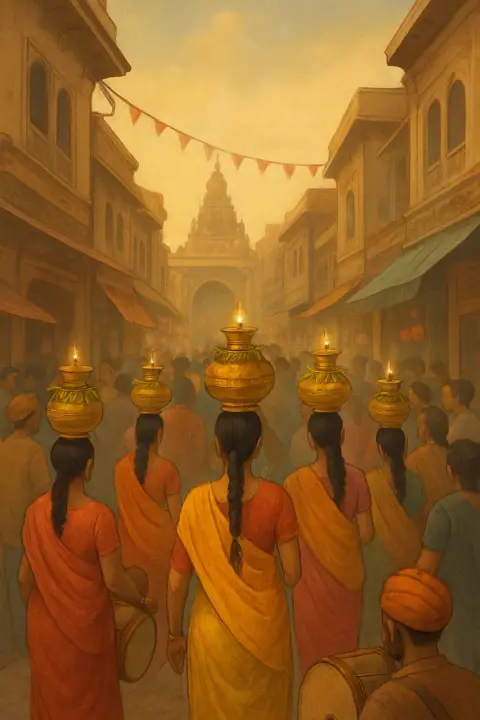
Pots of sweet rice crowned with lamps, carried on women's heads to the goddess
Bonalu is Telangana’s festival of the goddess Mahakali, celebrated through the lunar month of Ashadha, usually from late June or July into August, above all in Hyderabad and Secunderabad. Women carry the bonam, a pot of rice cooked with milk and jaggery, on their heads to her temples, and the festival moves from temple to temple week by week. Dates: 8 July – 1 August 2027 (expected); the main day, the Secunderabad Sunday, is 25 July 2027 (expected). It is Telangana’s state festival.
The Telangana endowments department releases the temple-by-temple schedule about eight weeks ahead; the Bonalu holiday is in the state list issued in early December.
The legend
Tradition says cholera struck Hyderabad in 1813. Soldiers of a Hyderabad battalion posted in Ujjain made a vow to the goddess Mahakali at the temple there.

When the epidemic passed, the soldiers returned to Secunderabad and installed a wooden image of the goddess. That became the Ujjaini Mahankali temple.

The custom itself is older: a text on the Kakatiya age has Queen Rudrama Devi offering a bonam, and an inscription of 1516 exempts Bonalu rites from tax.

It is said that in the month of Ashadha the goddess comes home to her parents, and she is welcomed like a married daughter visiting: with food, bangles and saris.

So women carry her the bonam on their heads: a pot of rice cooked in milk and jaggery, dressed with neem sprigs and topped with a small lamp.
Meaning
Hyderabad
The festival moves through the city temple by temple: it opens at Golconda's Jagadamba, then Secunderabad and Balkampet, and the Old City at Lal Darwaza comes last.
State festival
Soon after Telangana was formed in 2014, Bonalu was declared a state festival and a public holiday. Telugu communities abroad celebrate it too.
Customs
The bonam
The pot is new, of clay or brass, smeared outside with turmeric and vermilion, dressed with neem and topped with an oil lamp, then carried on the head to the temple.
Pothuraju
Pothuraju, the goddess's brother, dances to the drums at the head of the procession: red dhoti, ankle bells, body in turmeric, vermilion on his forehead.
Rangam
The morning after the main day a woman believed to be possessed by the goddess stands on a clay pot and foretells the year: rains, harvest, health.
Thottela
Each group of devotees offers the goddess a thottela, a small colourful frame of paper and sticks.
Neem in the streets
Doors and streets are hung with neem branches for the festival: the leaves are believed to keep away the illnesses of the rainy season.
Ghatam
A priest smeared with turmeric carries the ghatam, a copper pot dressed as the goddess. At the season's end the ghatams go to the Musi at Nayapul to be immersed.
Words of the festival
బోనం
bonam
from bhojanam, a meal: the pot of food for the goddess; Bonalu is the plural
పోతురాజు
Pothuraju
the goddess's brother and guardian, played by the dancer who leads the procession
రంగం
Rangam
the oracle on the morning after the main day, when the goddess is believed to foretell the year
ఘటం
ghatam
a copper pot dressed as the goddess and carried in procession
True or myth
❌ Myth. It fills the whole month of Ashadha, moving week by week from temple to temple, from Golconda to the Old City.
✅ True. An inscription of 1516, from the reign of Krishnadevaraya, already exempts Bonalu rites and the Rangam oracle from tax.
✅ True. He is Mahakali's guardian and brother, so he goes first and by custom opens the festivities.
Where to celebrate
What Bonalu means
Bonam is the Telugu word for a meal, from bhojanam, and Bonalu is its plural: the festival is, quite literally, food brought to the goddess. It is a thanksgiving, made for vows that have been fulfilled. The goddess receives it under many local names, among them Mysamma, Pochamma, Yellamma, Pedamma, Poleramma, Ankalamma and Maremma, all regarded as forms of Kali.
Believers say that in Ashadha the goddess comes home to her parents, so she is welcomed the way a married daughter is welcomed on a visit: with a home-cooked meal, bangles and a sari. That is why the bonam is carried by women and why it is cooked at home rather than bought. Ashadha also falls in the early monsoon, and neem branches hung over doors and streets are believed to keep away the illnesses of the rainy season.
How the festival began
The story told in Hyderabad goes back to 1813, when an epidemic (official accounts call it plague) killed thousands in the twin cities. A battalion of the Hyderabad army posted in Ujjain prayed to Mahakali at her temple there and vowed to install her image at home if the disease ended. When it passed, the soldiers returned and set up the goddess in Secunderabad with a bonam offering. That shrine is today’s Ujjaini Mahankali temple, and its Sunday is still one of the two biggest days of the festival.
The custom of carrying a bonam is older than that vow. A text of the Kakatiya period, the Siddeshwara Charithra, has Queen Rudrama Devi offering a bonam, and an inscription of 1516, from the reign of Krishnadevaraya, already exempts Bonalu rites from tax. After Telangana became a state in 2014, Bonalu was made the state festival with a public holiday, and Telugu communities abroad now keep it too.
How a Bonalu day unfolds
Each temple has its own day, but the shape is the same: offerings from before dawn, a procession, and a ritual the next morning.
- The pot is prepared at home
A new clay or brass pot is filled with rice cooked in milk and jaggery, smeared outside with turmeric and vermilion, dressed with neem sprigs and topped with a small oil lamp.
- The walk to the temple
Women in festive saris carry the bonam on their heads, with drummers and family around them. Women carrying a bonam are believed to hold the goddess’s spirit, so people sprinkle water on their feet to calm it.
- Pothuraju leads
Pothuraju, held to be the goddess’s brother and guardian, dances at the head of the procession: bare-chested, in a short red dhoti with ankle bells, turmeric on his body and vermilion on his forehead. Groups of devotees also bring a thottela, a small colourful frame of paper and sticks.
- Rangam, the next morning
A woman believed to be possessed by the goddess stands on a clay pot and foretells the year ahead: rains, harvest, health. Her words are widely reported in the press.
- The ghatam goes to the river
A priest smeared with turmeric carries the ghatam, a copper pot dressed as the goddess, in procession. At the end of the season the ghatams are taken to the Musi river at Nayapul and immersed.
Where to see Bonalu
Bonalu is kept across Telangana, but Hyderabad and Secunderabad are where it is largest and where a visitor can follow it from temple to temple. The season opens at the Jagadamba Mahankali temple inside Golconda Fort, moves to the Ujjaini Mahankali temple in Secunderabad and the Balkampet Yellamma temple, and ends in the Old City at Lal Darwaza, near Charminar, with the biggest crowd of the month. Warangal also celebrates.
The two weekends worth planning around are the Secunderabad Sunday with the Rangam the next morning, and the Old City Sunday a week later. Temple order, timings and where to stand are on the Bonalu in Hyderabad page.
Etiquette for visitors
Bonalu is worship, open to anyone who comes respectfully.
- Leave the women’s line alone — Big temples run separate queues for women carrying a bonam. Do not join or cut across them, and step aside for a woman with a pot on her head.
- Dress for a temple — Cover shoulders and knees and expect to leave your shoes at the door. The temple dress code page has the details for Hyderabad.
- Photos with care — Processions in the street are photographed constantly, but a woman possessed during Rangam or at the temple door is in the middle of a rite. Do not use flash in her face or block her path.
- Crowds — The UK government notes that stampedes have occurred at large religious gatherings in India and advises particular care on such days. Agree a meeting point and follow police barricades.
FAQ
When is Bonalu?
Bonalu runs through the lunar month of Ashadha, usually from late June or July into August: 8 July – 1 August 2027 (expected). The main Secunderabad day is 25 July 2027 (expected). The Telangana endowments department publishes the temple-by-temple schedule about eight weeks ahead.
What is special about Bonalu?
It is a festival of home-cooked offerings: women carry pots of sweet rice to the goddess on their heads, led by the dancing Pothuraju, and on the morning after the main day a woman believed to be possessed by the goddess foretells the year in the Rangam.
Which goddess is worshipped at Bonalu?
Mahakali, in her many local forms such as Yellamma, Pochamma, Mysamma and Pedamma, all regarded as forms of Kali.
Is Bonalu a holiday in Telangana?
Yes. Bonalu is Telangana’s state festival and has a public holiday; its date is in the state holiday list, published in early December for the following year.
What is a bonam?
A new clay or brass pot of rice cooked with milk and jaggery, decorated with turmeric, vermilion and neem and topped with a lamp, carried on the head to the goddess’s temple.
Sources (4)
Facts checked: 21 October 2026. Prices and hours are approximate; check locally.