 India GO
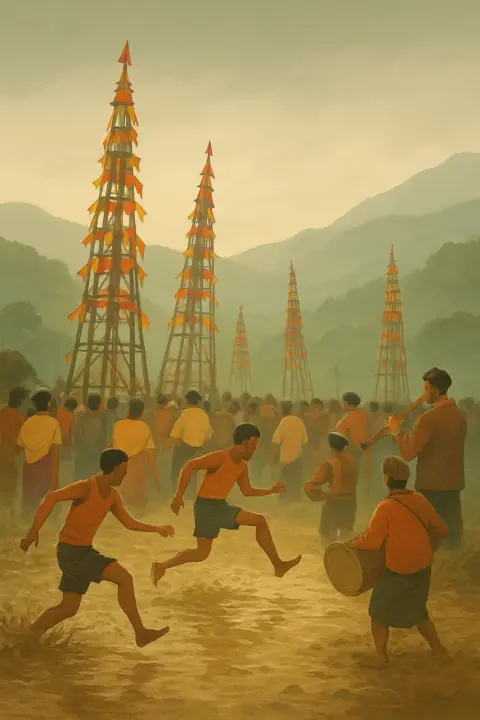
Behdienkhlam: Jowai's festival for driving out sickness
Bamboo towers plunged into a mud pool to drive sickness out of town
Behdienkhlam is the largest festival of the Niamtre faith of the Pnar (Jaintia) people, held every year in Jowai, West Jaintia Hills, Meghalaya. It comes in July after the sowing: the Meghalaya government explains the name as chasing away the demon of cholera, and the festival also asks for a good harvest. The Meghalaya government describes three days of rites; the programme in Jowai usually runs four days, between late June and mid-July. The Daloi, the Pnar religious heads, fix the dates by their ritual calendar, the state lists the main day in its holiday notification, and the full programme is announced in Jowai one to three weeks ahead.
Meghalaya lists the main day in its holiday notification each October for the following year; the Seinraij Jowai announces the four-day programme one to three weeks before.
The legend
In the Pnar language the name means "to drive away plague". By tradition the festival began as the chasing-out of the cholera demon.
It is the largest festival of the Niamtre faith of the Pnar. Held in July after the sowing, it asks for sickness to be kept away and for a good harvest.

It is kept on the largest scale in Jowai, where the Daloi priests lead the rites and the women offer food to the spirits of the forefathers.
Customs
Beating the roofs
Men go round the houses beating the roofs with bamboo poles, a gesture of driving out evil spirits and disease.
Rots in the Aitnar
On the last day tall decorated rots and polished logs are carried through the town and plunged into the Aitnar mud pool, with drums and dancing.
Dad-lawakor
The upper and lower valley play a kind of football with a wooden ball; the winners are promised the better harvest.
Where to celebrate
Jowai
Jowai's four-day Pnar festival for driving out sickness ends at the Aitnar pool: the rots and the sacred Khnong logs go into the water, then the two valleys play Dad-lawakor with a wooden ball.
What happens, day by day
Through the festival the Daloi lead a series of rites, and the women offer food to the spirits of the forefathers; by custom the women do not take part in the dancing.
In the first days young men go round Jowai beating the roof of every house with bamboo poles, a gesture that drives evil spirits, plague and disease out of the home. Around the old market ground of Iawmusiang the dienkhlam, trees brought in from the forest, are danced and then carried out to the neighbourhoods on the third day, and that evening each locality's rot stands in its own street. A rot is a tall decorated tower that the locality builds for the festival.
The last day is the climax. From about midday the rots and the sacred wooden posts called khnong are carried through town to Aitnar, the sacred mud pool of Jowai, and plunged into it while people dance to pipes and drums. Two sides also struggle to push a large undressed beam across a muddy ditch called Wah-eit-nar. Rain on the day is welcome. In the evening at Mynthong comes dad-lawakor, a football-like game played with a wooden ball between the northern and southern sides: tradition says the winners' side will have the better harvest.
Where to watch
Everything is free and in the open, in the streets and fields of Jowai.
Aitnar pool
The rots and the khnong on the final day, from about midday. The whole area is closed to vehicles that day.
Iawmusiang
The old market ground, for the dances and processions on the second and third days.
Mynthong
The field where dad-lawakor is played in the evening of the final day.
The localities
Each neighbourhood's rot, standing in its street on the evening of the third day.
Etiquette
Behdienkhlam is a religious festival of the Niamtre faith that happens to be loud and physical. Treat it as worship first.
- Stay out of the pool — The pool at Aitnar is for the men carrying the rots and the khnong. Watch from the banks.
- Give the processions room — Rots are tall and heavy and move through narrow streets. Step aside when one comes through.
- Ask before close-up photos — Especially of the Daloi and of women making offerings.
- Expect mud and rain — It is the monsoon, and rain on the final day is welcomed. Bring clothes and shoes you do not mind ruining.
How to plan the trip
Jowai is a small hill town, and the dates are known only a few weeks ahead.
- Book Jowai as soon as dates are out
Jowai has only a few modest hotels and they fill; book about six weeks ahead, or as soon as the dates are announced. Shillong, about 60 km away, is the fallback with an early start.
- Getting there
Flights and trains go to Guwahati, about 190 km from Jowai. In the July monsoon a month's notice is usually enough. Shared taxis run to Jowai from Shillong.
- Arrive the day before the final day
One night in Jowai covers the rots and the match. Two let you see the third-day processions at Iawmusiang as well.
- Check the traffic notice
The district announces traffic restrictions in Jowai for the festival days.
Other festivals of Meghalaya
Meghalaya's other great community festivals belong to the Khasi: Shad Suk Mynsiem in Shillong in spring and the Nongkrem Dance at Smit in autumn.
FAQ
When is Behdienkhlam celebrated?
Every year in July, after the sowing, usually between late June and mid-July. The dates are set by the Daloi and announced in Jowai one to three weeks ahead.
Which tribe celebrates Behdienkhlam?
The Pnar, also known as the Jaintia, and above all the followers of the Niamtre faith.
In which state is Behdienkhlam celebrated?
In Meghalaya. The biggest celebration is in Jowai, West Jaintia Hills, about 60 km from Shillong; Tuber Kmaishnong also keeps it.
What does Behdienkhlam mean?
In Pnar it means driving away plague. The Meghalaya government describes it as chasing away the demon of cholera.
What is dad-lawakor?
A football-like game played with a wooden ball at Mynthong on the last evening, northern side against southern. By tradition the winners' side will have the better harvest.
Sources (3)
Facts checked: 21 October 2026. Prices and hours are approximate; check locally.