 India GO
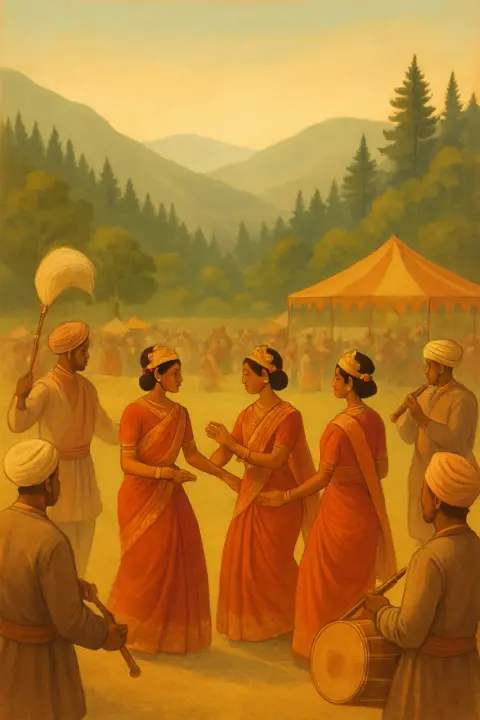
Shad Suk Mynsiem: the Khasi dance of thanksgiving in Shillong
Spring drums and a circle of silk dancers in the heart of Shillong
Shad Suk Mynsiem, usually translated as the dance of the joyful (or peaceful) heart, is the spring thanksgiving of the indigenous Khasi faith. Over three days in the first half of April, at the Weiking ground in the middle of Shillong, unmarried women in silk and gold dance in slow circles while men move around them with sword and whisk, to drums and the tangmuri pipe. It is organised by Seng Khasi, and the dates are announced each year shortly before.
Seng Khasi Kmie announces the dates in the days before; the state declares a local holiday for East Khasi Hills.
The legend

Shad Suk Mynsiem, the dance of the joyful heart, is the Khasi spring thanksgiving: as nature wakes, people thank the Creator and hope for a good harvest.
It was first held on 14–15 April 1911 at the Weiking ground in Mawkhar, Shillong, and has been kept every year since.

It is organised by Seng Khasi, keeper of the indigenous Khasi faith. It is a shad ainguh, a dance of gratitude, not a show.
Customs
The women's circle
Unmarried women in silk jainsem, gold and coral move in slow circles at the centre of the ground.
Sword and whisk
Around them men dance with a sword in one hand and a white yak-hair whisk in the other.
Drums and tangmuri
Until sunset the ksing and nakra drums and the tangmuri pipe play as the dances follow one another: Shad Nalai, Dum Dum, Klang, Mastieh.
Where to celebrate
Shillong
Seng Khasi's spring thanksgiving at the Weiking ground in Jaiaw: three April afternoons when well over a thousand dancers circle to drums and tangmuri pipes in the middle of Shillong.
A dance of gratitude, not a show
Shad Suk Mynsiem marks the arrival of spring. As nature wakes, people thank the Creator, U Blei Trai Kynrad, for blessings and protection and hope for a good harvest. Seng Khasi calls it a shad ainguh, a dance of gratitude, and treats it as worship rather than performance: it is held after rituals seeking blessings.
Seng Khasi was founded on 23 November 1899 in Mawkhar, Shillong, by sixteen young Khasi men guided by the educationist U Babu Jeebon Roy, to protect Khasi culture and Niam Khasi, the indigenous Khasi religion, at a time when colonial rule and Christian missions were changing the hills. The first recorded Shad Suk Mynsiem was held on 14–15 April 1911 at the Weiking ground, and it has been kept every year since. It began with only ten or twenty dancers; recent festivals have counted well over a thousand. Seng Khasi branches also hold the dance in other places, on weekends from February to late June.
What you see on the ground
On the first day a procession sets out from the Seng Khasi Hall in Mawkhar with drums and a prayer, and the dancing opens on the ground with the Ngi Nohkjat rite. Then, for three afternoons until sunset, the dances follow one another: Shad Nalai, Dum Dum, Klang, Padiah, Pyllun and Mastieh.
At the centre are the unmarried women, in silk jainsem, jainpien and mukmor, with gold, silver and coral ornaments, moving in slow circles. Around them the men dance in a wider circle, a sword in one hand and a white yak-hair whisk in the other. The music comes from the ksing and nakra drums and the tangmuri pipe. Seng Khasi keeps seven rhythmic patterns (skit) for the dance, tied to the Hynniewtrep, the seven huts from which the Khasi trace their origin.
The second day is usually the fullest. Among the musicians on the ksing and tangmuri are now teenagers trained at dedicated cultural schools.
Etiquette for visitors
There is no ticket, and visitors are welcome at the edge of the ground. Remember that you are watching worship.
- Stay off the dance ground — Watch from the edge and follow the marshals. Do not walk across the circle, even between dances.
- Photograph with restraint — Use no flash, keep a distance from the dancers, and ask before taking close portraits of anyone in traditional dress.
- The opening procession — On the first day the procession from Seng Khasi Hall in Mawkhar can be watched from the roadside; let it pass rather than walking with it.
- Official advice for the region — The UK Foreign Office (FCDO) notes that protests and blockades are common in north-eastern states and can start without warning, and that sudden flare-ups and skirmishes may happen along inter-state borders, including Assam-Meghalaya. Avoid protests and follow local authorities; see Is India safe? and emergency numbers.
Getting there and timing your stay
The ground is inside Shillong, so once you are in the city there is no separate transport problem.
- Via Guwahati
Flights and long-distance trains go to Guwahati, about three hours from Shillong by road. Shared taxis and buses run up to Shillong all day.
- Watch for the announcement
Seng Khasi announces the dates only shortly before, and the state declares a local holiday in East Khasi Hills district. Book a room as soon as the dates are out, and arrive the day before the festival opens.
FAQ
What is the Shad Suk Mynsiem festival in Meghalaya?
The spring thanksgiving dance of the Khasi indigenous faith, organised by Seng Khasi at the Weiking ground in Shillong: three days of dancing to thank the Creator and pray for a good harvest.
When is Shad Suk Mynsiem held?
Over three days in the first half of April in Shillong. Seng Khasi announces the exact dates each year shortly before the festival.
Who celebrates Shad Suk Mynsiem?
Followers of Niam Khasi, the indigenous religion of the Khasi people, through Seng Khasi, the organisation founded in 1899 to preserve it.
Is it free to watch Shad Suk Mynsiem?
Yes. There is no ticket; visitors watch from the edge of the Weiking ground and must keep off the dance ground.
How is it different from the Nongkrem dance?
Both are Khasi religious dances. Shad Suk Mynsiem is Seng Khasi's spring thanksgiving in Shillong, danced to seven rhythmic patterns; the Nongkrem dance uses up to 23.
Sources (5)
Facts checked: 21 October 2026. Prices and hours are approximate; check locally.