 India GO
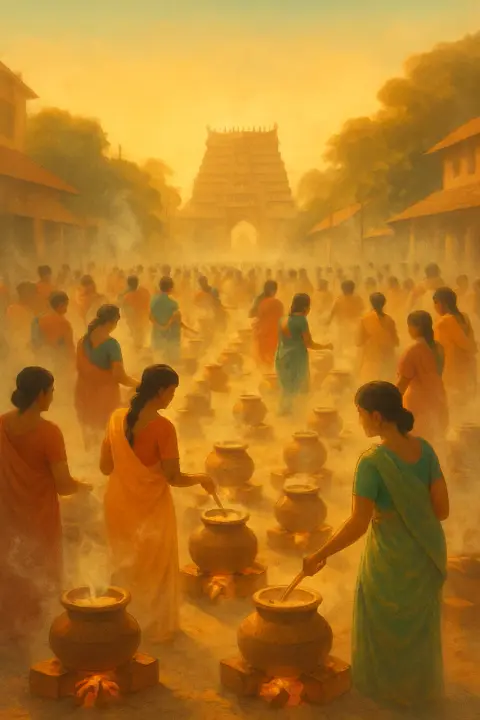
Attukal Pongala: the morning Thiruvananthapuram becomes one kitchen
Clay pots boil over for the goddess on every pavement in the city
Attukal Pongala is the ten-day festival of the Attukal Bhagavathy temple in Thiruvananthapuram, and on its ninth day, the Pooram star near the full moon, millions of women cook pongala, rice offered to the goddess, in clay pots on brick hearths along the city's streets. Guinness World Records lists it as the largest annual gathering of women. Festival: 14–23 February 2027; Pongala day: 22 February 2027.
The temple trust announces the next festival about seven months ahead, and the detailed programme follows one to three weeks before; the Thiruvananthapuram collector declares a local holiday for the Pongala day.
The legend

Legend says a radiant young girl appeared to the head of the Mulluveettil family at the Killi river, asked to be helped across, then vanished.

In a dream the goddess asked for a home in a sacred grove, and there the Attukal Bhagavathy temple stands; she is called Attukal Amma.
Another tradition sees her as Kannagi, heroine of a Tamil epic, who rested at Attukal on her way west. The pongala is cooked for her.
Customs
Fire from the temple
In the morning the priest lights the temple's main hearth, the Pandara Aduppu, and its fire passes from hearth to hearth along every street.
A pot on three bricks
Millions of women set clay pots on the city's streets and cook rice for the goddess.
The vow before
Before the day the women keep a vow of one meal a day without non-vegetarian food or alcohol, and break the fast with coconut water.
What people eat
Sharkkara pongala
Rice cooked with jaggery, coconut and cardamom.
Words of the festival
പൊങ്കാല
pongala
"To boil over": sweet rice cooked as an offering to the goddess.
Where to celebrate
Thiruvananthapuram
For one morning the streets of Thiruvananthapuram fill with women cooking pongala on brick hearths, all lit from the temple's fire: the largest annual gathering of women on record.
How the festival runs
The festival begins on the Karthika star of the Malayalam month of Kumbham, in February or March, with the Kappukettu ceremony, when the goddess is adorned with bangles. For the next nine days the temple sings the Kannaki Charitam, the story of Kannagi, the heroine of the Tamil epic Silappathikaram, whom one tradition identifies with the goddess of Attukal.
Before Pongala day the women who will cook keep a vow: one meal a day, without meat or alcohol. They take their places along the roads from the night before, each with a hearth of three bricks and a clay pot. On the ninth morning, at an auspicious time fixed in advance, the chief priest lights the Pandara Aduppu, the main hearth by the temple, and the fire is passed from hearth to hearth down the lines. For about 7 km around the temple, roads, pavements, car parks and compounds turn into one open-air kitchen, through East Fort and Thampanoor into the centre.
The most common offering is sharkkara pongala, rice cooked with jaggery, coconut and cardamom; others make vella pongala with milk and banana, therali appam or mandaputtu. In the afternoon priests walk the lines sprinkling holy water on the offerings, and flowers are showered from the air. Then the women break their fast, often with coconut water or milk.
The goddess and the numbers
The temple stands about 2 km from the Padmanabhaswamy temple and East Fort. Its goddess, Attukal Amma, is identified with Bhadrakali and also with Kannagi; she is often worshipped as all three goddesses together, Saraswati, Lakshmi and Parvati. On Pongala day she is believed to join the women as one of them, and the only men allowed near the temple are security staff, temple officials and priests. Kerala Tourism notes that women of all castes, creeds and religions take part.
The festival entered the Guinness World Records in 1997 with 1.5 million women, and set a new record in 2009 with 2.5 million. The temple has reported around four million in recent years.
Watching as a visitor
The streets are open to everyone, and nothing costs money to watch. What to see: the hearth lines in East Fort and around the temple from dawn, the fire travelling down the lines in the morning, and the priests sprinkling the offerings in the afternoon.
- Keep to the edges — Stay out of the lines of hearths: they are fires, and each one is someone's offering. Walk along the edges of the street.
- Ask before photographing — Ask before photographing the women at their pots.
- The temple is for Hindus — The Attukal Bhagavathy temple admits Hindus only; the streets around it are open to all.
Roads, trains and where to stay
Roads around the temple close for Pongala, so plan the day on foot, without a car.
- Book a room you can walk out of
Book about three months ahead, in East Fort, Thampanoor or near Attukal. Anything that needs a car on Pongala morning will not work.
- Take trains early
Book as soon as the 60-day window opens. Southern Railway adds unreserved specials and extra halts for Pongala, and KSRTC runs special buses.
- Arrive the day before
Traffic restrictions run from the afternoon before until the evening of Pongala day. Be in the city the night before and on the street by 5 am. If you fly that day, leave early by the coastal road to the airport.
FAQ
When is Attukal Pongala?
The festival runs ten days in the Malayalam month of Kumbham, in February or March: next, 14–23 February 2027. The Pongala offering is on the ninth day, 22 February 2027.
What is the purpose of Attukal Pongala?
It is an offering to Attukal Amma: women cook pongala, rice with jaggery, coconut and cardamom, in clay pots for the goddess, asking for prosperity; another kind, vella pongala, is a votive offering for a prayer answered.
Is Attukal Bhagavathy Kannagi?
One tradition identifies her with Kannagi, heroine of the Tamil epic Silappathikaram, who is said to have rested at Attukal on her way west, and the temple sings Kannagi's story during the festival. She is also identified with Bhadrakali.
What is special about the Attukal Bhagavathy temple?
Its Pongala is recognised by Guinness World Records as the largest annual gathering of women, with 2.5 million in the 2009 record and around four million reported recently.
Can men take part in Attukal Pongala?
The offering is made by women. Men can watch from the streets, but near the temple only security staff, temple officials and priests are allowed on the day.
Sources (5)
Facts checked: 21 October 2026. Prices and hours are approximate; check locally.