 India GO
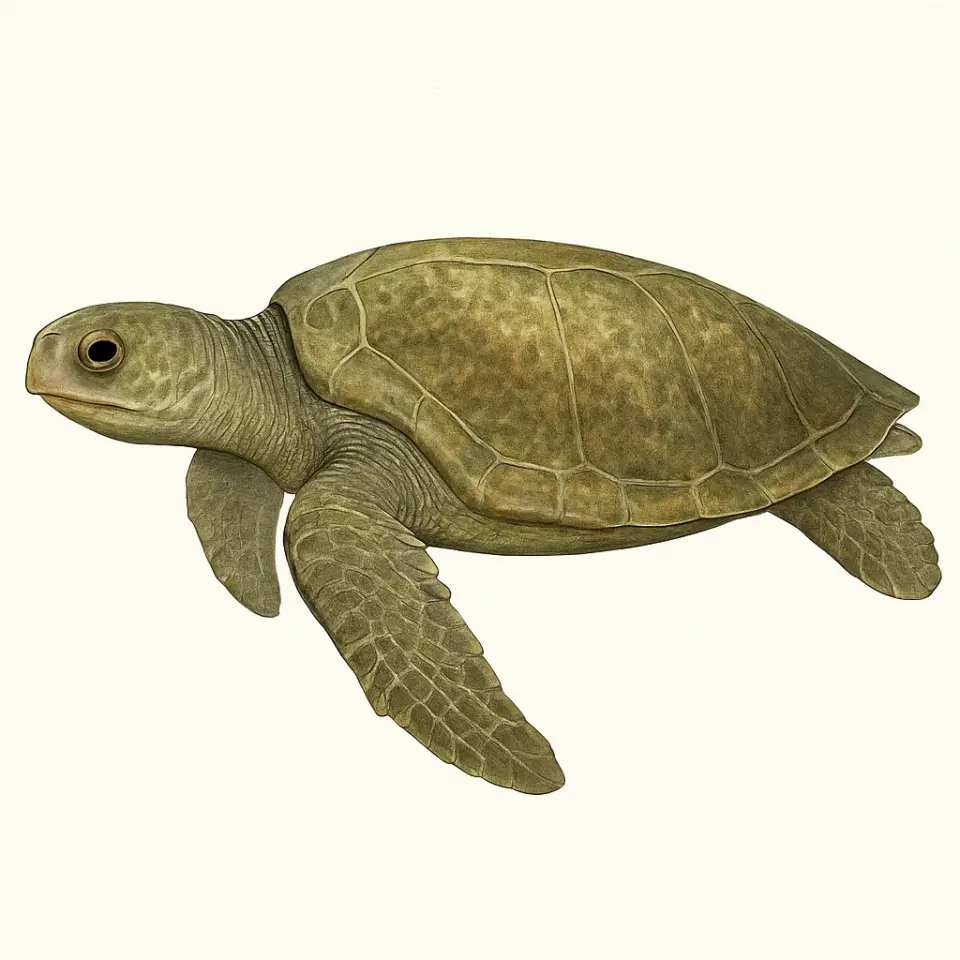
Olive ridley turtle: when and where it nests in India
समुद्री कछुआ (samudri kachhua)
The olive ridley (Lepidochelys olivacea) is the most numerous sea turtle in the world and the second smallest, and India holds some of its most important nesting beaches. In winter females come ashore at night to lay eggs in the sand: in their hundreds of thousands on a few beaches in Odisha, one by one on the coasts of Goa, Karnataka and Puducherry, where forest departments fence and guard the nests. It is protected under Schedule I of the Wild Life (Protection) Act and listed as Vulnerable by the IUCN.
A small olive-green sea turtle that comes ashore at night to lay its eggs on sandy beaches.
How to recognise it
What you realistically see is a nest enclosure fenced off by the forest department above the tideline, and, on some nights, a hatchling release.
Protection
Schedule I of the Wildlife (Protection) Act, 1972.
Where to see it
Goa
Olive ridleys nest on a handful of Goan beaches between November and April. Goa's forest department guards nests on four main turtle beaches: Morjim and Mandrem in the north, Agonda and Galgibaga in the south. Nests are fenced above the tideline and watched by department staff, and beach lighting rules change for the season.
 Galgibaga (in season) · Morjim (in season) · Agonda (in season)
Murudeshwar
One of Karnataka's first turtle hatcheries was started on this coast, and the local fishing community took on the protection of the nests. Port construction at Kasarkod Tonka has since been reported to disrupt nesting there, so check locally before planning a visit around it.
Kasarkod (Eco) Beach, Honnavar (in season) · Apsarakonda Falls & Beach
Udupi
Only about 12 km of Karnataka's coastline is suitable for nesting, spread across roughly forty low-density sites, which is why each protected beach here counts for a lot.
Padubidri Beach (in season) · Mattu Beach (in season) · Kaup Beach & Lighthouse (in season) · Delta Beach, Kodi Bengre (in season)
A small sea turtle
An adult olive ridley has a rounded, heart-shaped shell about 60 cm long, grey-green to olive on top and creamy yellow beneath, and weighs 25–46 kg, rarely more than 50. The head is broad and triangular seen from above; the front flippers carry two claws each. Hatchlings are dark grey, 4–5 cm long and about 12–23 g, and look completely black when wet.
Two ways of nesting
Olive ridleys are famous for the arribada (Spanish for “arrival”), when thousands of females come ashore on the same beach over a few nights. India has one of the largest: the Gahirmatha coast in Odisha, with further mass nesting at the mouths of the Rushikulya and Devi rivers. In 1991 more than 600,000 turtles nested along the Odisha coast in a single week.
Everywhere else nesting is solitary: one female, one night, one nest. She digs a conical hole about 45 cm deep with her hind flippers, lays her eggs and covers them. The eggs hatch after about 45–51 days, longer in poor weather, and the sand temperature decides the sex of the young: warm nests produce females, cooler ones males.
Where and when on the west coast and in Puducherry
Goa: olive ridleys nest on a handful of beaches from about November to April, and hatchlings emerge from January to April. The forest department runs three designated turtle beaches: Morjim in the north, Agonda and Galgibaga in the south. Nests are fenced above the tideline and watched by department staff, beach lighting rules change for the season, and the northern end of Galgibaga closes during hatching.
Karnataka: olive ridleys nest at about forty sites along the coast, each with few nests. Near Udupi the forest department sets up hatchery plots at Padubidri in the season (nesting November–April, peak December–February, releases roughly January–May). Kasarkod beach near Honnavar had a hatchery run with the local fishing community, but port construction at Kasarkod Tonka has been reported to have halted nesting there; check locally before you plan around it.
Puducherry: the forest department runs temporary hatcheries with local volunteers on the main nesting stretch south of town. Most nests are laid January–March and hatchlings are released roughly March–May. In 2017–18 the department and volunteers collected about 11,500 eggs and released some 7,000 hatchlings, but fishers report that nesting on some local beaches has fallen sharply.
What you can realistically see, and how to behave
- Expect a fenced nest, not a turtle — On the west coast nesting is scattered and happens at night, so most visitors see a fenced hatchery above the tideline. On some evenings staff release hatchlings, and that is the moment worth waiting for.
- Follow the staff — The species is under Schedule I. Stay outside fences, do not dig, touch or pick up eggs or hatchlings, and do what the forest guards ask.
- Keep the beach dark — Artificial light draws hatchlings away from the sea; studies at Rushikulya in Odisha looked at exactly this problem, and Goa changes its beach lighting rules for the nesting season. Leave torches and phone lights off near nests.
FAQ
When is turtle nesting season in Goa?
Olive ridleys nest on Goa's beaches from about November to April, and hatchlings emerge from January to April. The designated nesting beaches are Morjim, Agonda and Galgibaga.
Where is the largest olive ridley nesting site in India?
The Gahirmatha coast in Odisha, one of the largest mass nesting sites in the world; mass nesting also happens at the Rushikulya and Devi river mouths.
Is the olive ridley turtle endangered?
The IUCN lists it as Vulnerable: it is still the most numerous sea turtle, but the global population has fallen by more than 30% from historic levels. In India it is protected under Schedule I.
Can I see turtles hatch in Goa?
Sometimes. Hatching runs from January to April, and on some evenings forest staff release hatchlings from the fenced nests. Nothing is scheduled for visitors, so ask the staff at the beach.
Why is it called olive ridley?
“Olive” is for the colour of its shell. Where “ridley” comes from is not known.
Sources (6)
- Olive ridley sea turtle (Wikipedia)
- The Wild Life (Protection) Amendment Act, 2022, Schedule I, Part C (Gazette of India)
- Deccan Herald, 10 January 2026
- Sea turtles of India: Karnataka
- Conservation of sea turtles along the Puducherry coast of India (Indian Ocean Turtle Newsletter 36)
- Karnad et al. (2009), Lighting the way: towards reducing misorientation of olive ridley hatchlings due to artificial lighting at Rushikulya, India. Biological Conservation 142(10)
Facts checked: 8 October 2026. Prices and hours are approximate; check locally.