 India GO
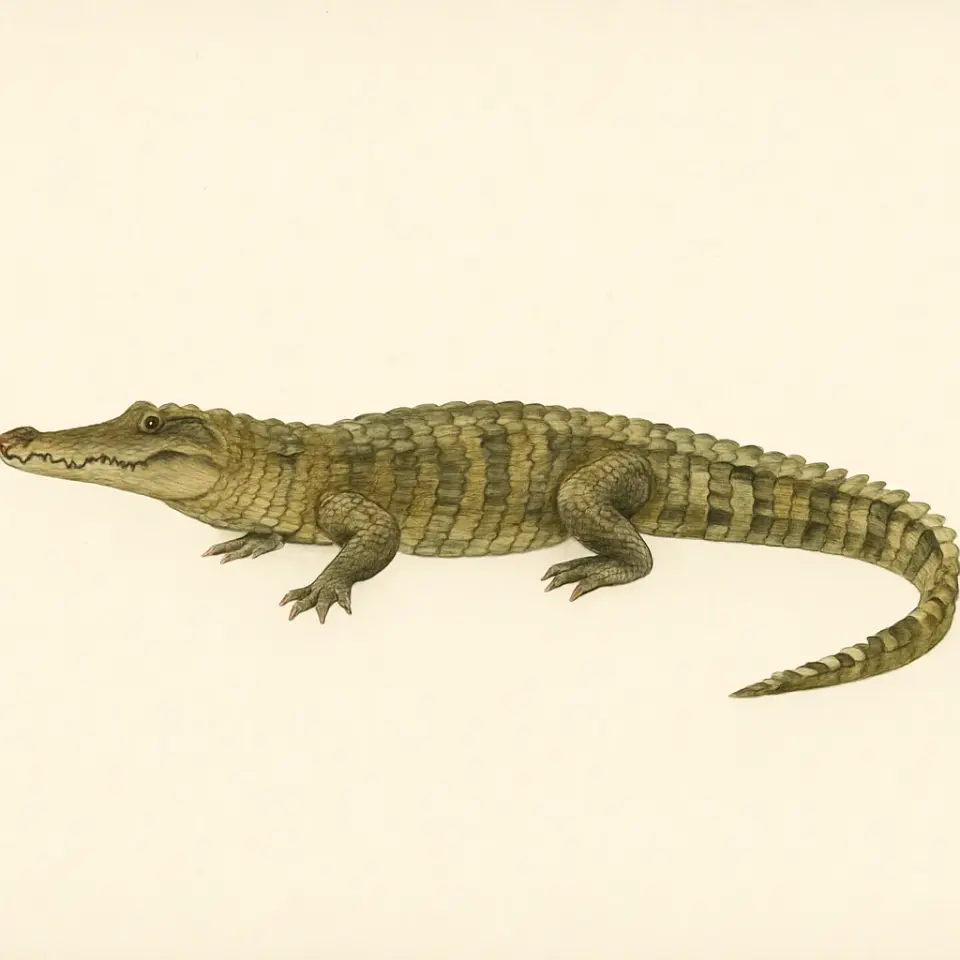
Mugger crocodile: the broad-snouted marsh crocodile of India
The mugger (Crocodylus palustris), also called the marsh crocodile, is a broad-snouted freshwater crocodile that lives in rivers, lakes, marshes and reservoirs from Iran to Sri Lanka. Females average 2 to 2.5 metres and males 3 to 3.5, rarely up to 5. It is listed as Vulnerable by the IUCN and has been protected in India under Schedule I since 1972.
The broad-snouted freshwater crocodile of the Indian subcontinent, up to about four metres.
How to recognise it
Look along the rock edges and reed banks for what seems to be a log with a line of teeth showing along the jaw. They bask in the morning and slide off as the day heats.
Protection
Schedule I, Wildlife (Protection) Act 1972
Where to see it
Mysore
Ranganathittu holds one of the largest mugger concentrations in Karnataka. Mugger and the fish-eating gharial are different animals: the gharial has a long thin snout and does not occur here. Boatmen keep the correct distance for a reason, and standing up in the boat is not allowed.
 Ranganathittu Bird Sanctuary
How to recognise a mugger
The mugger has the broadest snout of any living crocodile: only slightly longer than it is wide, with 19 teeth on each side of the upper jaw. Adults are dark olive, grey or brown; hatchlings are pale olive with black spots. The head is rough but has no ridges, and large bony plates sit on the neck, set apart from those on the back. The tail is powerful and the feet webbed.
India has two other crocodilians:
- Gharial. A very long, thin snout built for catching fish, mainly in northern rivers. The two share some rivers, such as tributaries of the Ganges and Yamuna, but there is no gharial at Ranganathittu.
- Saltwater crocodile. Lives in coastal and brackish water. The mugger barely enters brackish water and prefers shallow, slow freshwater, so the two overlap only in a few coastal areas.
The Hindi word for crocodile is magar; in Kannada and Telugu it is mosale and mosali, in Tamil muthalai.
How muggers live
Muggers prefer slow, shallow water and do well in artificial reservoirs and irrigation canals. In the cool season they bask on banks and rocks, tolerant of one another; in the hot season they spend most of the day under water and sometimes walk overland at night in search of a better pool. To escape extreme heat or cold they dig burrows up to six metres deep.
Adults eat fish above all, but also snakes, turtles, birds and mammals up to the size of a chital deer, and they scavenge. They are among the first reptiles recorded using tools: muggers have been seen balancing sticks on their heads in the nesting season to lure birds looking for nest material.
Courtship starts in the cool season from November. Between February and June the female digs a nest hole in sand and lays up to 46 eggs; in South India the young hatch between April and June. The sex of each hatchling depends on the temperature in the nest, and both parents guard the young for up to a year.
Where to see muggers: Ranganathittu
The mugger lives across much of India, from the Chambal and Gujarat's rivers to the Kaveri and the reservoirs of the south, but the place the India GO database records is Ranganathittu Bird Sanctuary, on islets in the Kaveri near Srirangapatna, about 19 km from Mysuru. It holds one of the largest mugger concentrations in Karnataka, and from the ranger's rowing boat you see them at close range, lying out on the rocks between the nesting storks and pelicans. Muggers bask in the morning and slide into the water as the day heats up.
More of the area's wildlife is on the Mysuru animals page.
Is the mugger dangerous?
It can be. Large muggers take livestock, and fatal attacks on people have been documented in Gujarat and Maharashtra. Treat any water where muggers live accordingly: do not swim, wade or wash at the edge, stay well back from the bank, and never go near a nest or young. At Ranganathittu the boatmen keep the correct distance for a reason, and standing up in the boat is not allowed. In an emergency in India, call 112.
The mugger and the makara
The crocodile is taken to be the prototype of the makara, the mythical water creature that stands for both the life-giving and the destructive power of rivers. The makara is the mount of the Vedic god Varuna and of the river goddess Ganga, and the emblem of Kamadeva. A mugger is carved on a gateway beam of the Bharhut stupa, built around 100 BC. In the traditional life of Adi Shankara, a crocodile seizes him in the river at Kaladi and lets go only when his mother allows him to become a renunciant.
Protection status
The mugger has been listed as Vulnerable on the IUCN Red List since 1982; in 2013 fewer than 8,700 mature animals were estimated to live in the wild. In India it has been in Schedule I of the Wild Life (Protection) Act since 1972, and it remains there after the 2022 amendment; it is also on CITES Appendix I.
FAQ
Is the mugger crocodile dangerous to humans?
It can be: fatal attacks have been documented in Gujarat and Maharashtra. Stay away from the water's edge where muggers live and follow boatmen's instructions.
Where can I see mugger crocodiles near Mysuru?
At Ranganathittu Bird Sanctuary on the Kaveri near Srirangapatna, where they bask on the rocks and are seen at close range from the boat.
Sources (3)
Facts checked: 8 October 2026. Prices and hours are approximate; check locally.