 India GO
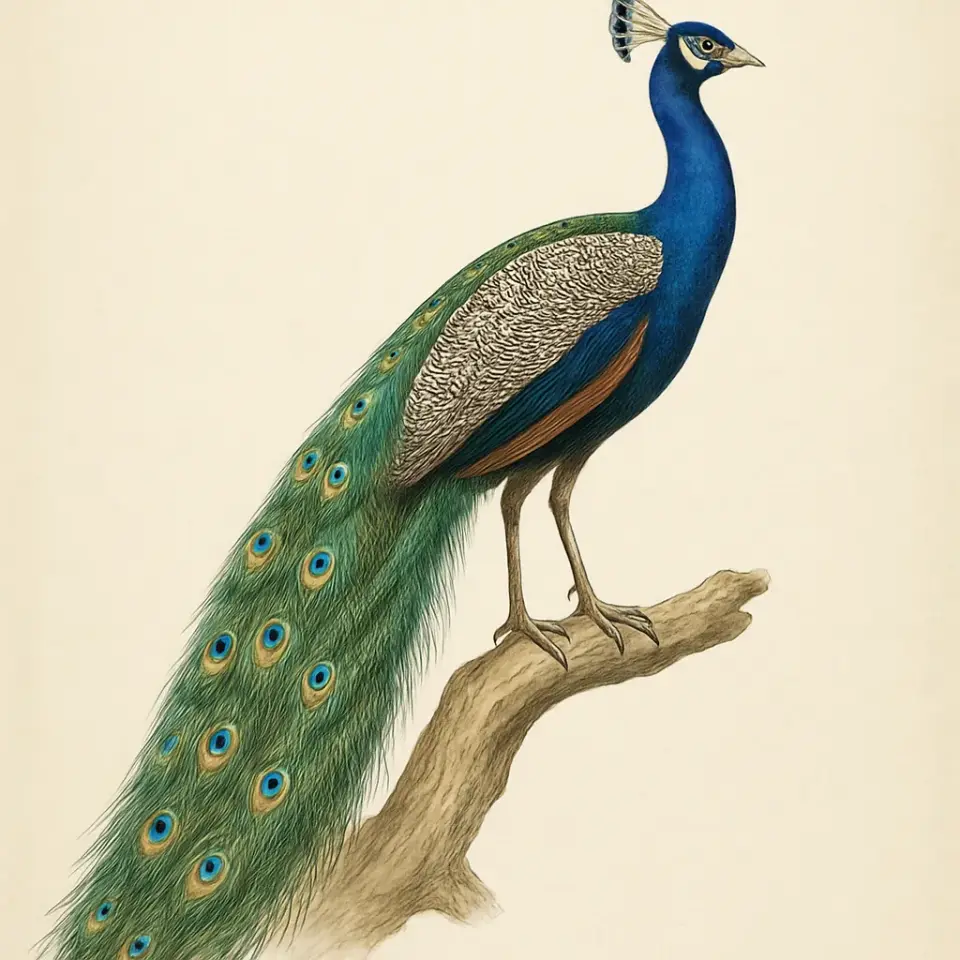
Indian peafowl (mor): India's national bird, how to see it and what it means
मोर
The national bird of India is the Indian peafowl (Pavo cristatus), mor in Hindi, so designated in 1963 and protected under Schedule I of the Wild Life (Protection) Act. It lives wild across almost the whole country, from the Indus valley to Assam and from the Himalayas to the southern tip, and in much of north and west India it is a common sight in villages and temple towns. The bird is linked with Krishna, who wears its feather in his crown, and is the mount of Kartikeya (Murugan).
India's national bird. Males carry the train from late winter into the rains and drop it afterwards.
How to recognise it
You hear one first: a loud rising «may-awe» from a roof or a tree, most often before rain. The birds feed on open ground in the morning and climb into big trees to roost at dusk.
Protection
National bird of India; protected under the Wild Life (Protection) Act, 1972.
Where to see it
Delhi
The peacock feather is Krishna's own emblem, worn in his crown; the bird also carries Kartikeya and appears on temple carving across north India. It was declared India's national bird in 1963.
 Sanjay Van · Aravalli Biodiversity Park · Asola Bhatti Wildlife Sanctuary (Neeli Jheel)
Govardhan
Braj tradition has peacocks dancing to Krishna's flute at Govardhan and then offering their tail feathers to him, which is the story behind the feather in his crown. The hill's dry scrub and the fields below it are genuinely good peafowl ground.
Govardhan Hill & Parikrama Marg · Kusum Sarovar
Hampi
The peacock is the mount of Murugan and appears throughout Vijayanagara's carved friezes; the birds walking under those same reliefs are the same species the sculptors watched.
Daroji Sloth Bear Sanctuary · Pampa Sarovar (often) · Sanapur Lake (often)
Hyderabad
The forest department counts the peafowl of KBR National Park every November, and the number holds at about 550: 550 in 2021, 544 in 2022 and 565 in 2023, all in 390 acres in the middle of Hyderabad.
KBR National Park · Mahavir Harina Vanasthali National Park · Ananthagiri Hills (often)
Jaipur
The peacock rides with Kartikeya, sits in Krishna's crown as a single feather, and is painted on half the doorways of the old city. Rajasthan's dry-country villages have protected it for centuries because its call is read as a promise of rain.
Jhalana Leopard Reserve · Nahargarh Biological Park · Kanak Vrindavan Garden (often)
Mathura
Mahavan and Gokul, where Krishna is said to have spent his infancy, hold the densest peafowl records in the district: the sandy groves, the old orchards and the grain fields suit the bird exactly, and it is nowhere hunted here.
Raman Reti, Gokul · Brahmand Ghat, Mahavan · Pavan Sarovar (often)
Pushkar
The peacock is Kartikeya's mount and Krishna's crown feather, and in dry-country Rajasthan its call is taken as a sign of coming rain, which is why villages protected it long before any law did.
Pushkar Sand Dunes · Naga Pahar (Snake Mountain) (often) · Budha Pushkar Lake (Old Pushkar) (often)
Tirumala
The peacock is the mount of Murugan and the feather worn by Krishna, so a wild peafowl in temple forest sits at the exact point where the sacred landscape and the biological one coincide.
Kalyani Dam (often) · Sri Venkateswara Zoological Park · Talakona Waterfall (often)
Vrindavan
The mor-pankh, a single peacock tail feather, is Krishna's emblem and one of the most-sold objects in the Vrindavan bazaars. The birds themselves are ordinary residents here, in groves, on garden walls and on temple roofs.
Gahvar Van · Bhandirvan (Bhandir Vat) · Vrindavan Parikrama Marg (often)
Peacock and peahen
The male, the peacock, measures 100–120 cm from bill to tail and 200–230 cm with a full train, and weighs 4–5 kg, one of the heaviest birds in the pheasant family. He has a metallic blue neck, a fan-shaped crest and white patches of bare skin above and below the eye. The train is not the tail: it is made of greatly lengthened upper tail coverts ending in eyespots. Its colours come from the structure of the feathers, not from pigment.
The female, the peahen, is about 97 cm long and mostly brown, with a white face, a crest of her own and a metallic green lower neck. Young males look like females for their first year; the train starts growing in the second year and reaches full length at about four.
The train is moulted every year. Males drop it from the end of the monsoon, around August and September, and grow it back by February or March, which is why the full display season runs from late winter into the rains.
The dance and the call
Breeding starts with the monsoon. Several males gather at a display ground (a lek) and show off from open, raised spots: a fallen tree, a large rock, a rooftop. The train goes up in an arched fan and is quivered. Peahens usually keep on feeding and seem to show no interest. In the south the displays run mainly from June to September; around Mathura and Vrindavan males are in full train from February to August.
The call is a loud “may-awe”, heard more often before the monsoon and at dusk, when the birds fly up into tall trees to roost. Peafowl also give alarm calls when a predator is near, and in forest they give away a tiger. They feed on the ground in small groups, on seeds, grain, shoots, insects, small lizards and snakes.
Where to see wild peafowl
Braj, the Krishna country around Mathura, is one of the easiest places to see peafowl. In Vrindavan they call from the wooded slope of Gahvar Van and cross the Parikrama Marg, most reliably in the first and last hour of light. At Govardhan they call from the hill through the morning and feed in the fields beside the circuit and around Kusum Sarovar. Near Mathura look in the sandy groves of Raman Reti in Gokul and on the field edges above Brahmand Ghat in Mahavan.
In Delhi look in Sanjay Van, the Aravalli Biodiversity Park and Asola Bhatti. Elsewhere: Jhalana Leopard Reserve in Jaipur, the dunes and fields of Pushkar, the fields and banana groves around Anegundi near Hampi, and KBR National Park in Hyderabad, where a forest department census in November 2023 counted 565 peafowl. The birds are resident and can be seen in any month.
Krishna's feather and Kartikeya's mount
The mor-pankh, a single peacock tail feather, is Krishna's emblem, worn in his crown, and is sold in the bazaars of Vrindavan. Kartikeya, the war god known in the south as Murugan or Skanda, is shown riding a peacock as his vahana (mount). The bird appears throughout Indian temple art, poetry and folk tradition, including the carved friezes of Vijayanagara at Hampi.
In the Ramayana, Indra, unable to defeat Ravana, sheltered under a peacock's wing and blessed it with a “thousand eyes”, the eyespots of its train.
FAQ
What is the national bird of India?
The Indian peafowl (Pavo cristatus), designated the national bird in 1963. It is protected under Schedule I of the Wild Life (Protection) Act.
Can peacocks fly?
Yes. Despite the train, they fly well enough to reach treetops to roost at dusk, but on the ground they prefer to run into cover rather than take off.
When do peacocks dance in India?
The display is tied to the breeding season, which starts with the monsoon; in the south it runs mainly from June to September. Males carry the full train from about February until they moult it after the rains.
Why do peacocks lose their tail feathers?
The train is moulted every year, starting at the end of the monsoon in August or September. It grows back by February or March.
What is a peacock called in Hindi?
Mor (मोर). In Tamil it is mayil, in Kannada navilu, in Telugu nemali.
Sources (4)
Facts checked: 8 October 2026. Prices and hours are approximate; check locally.