 India GO
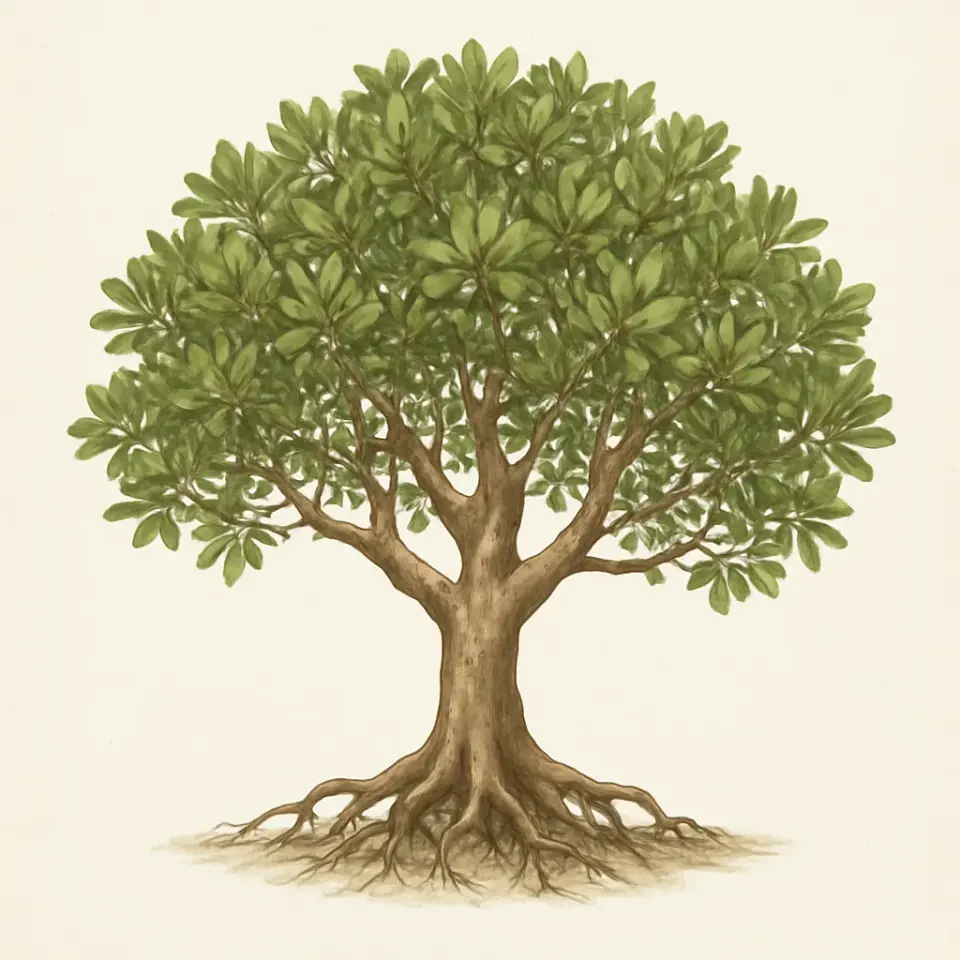
Grey mangrove: the tree with breathing roots on Mumbai's and Goa's creeks
तिवर (tivar)
The grey mangrove (Avicennia marina), tivar in Marathi, is the low grey-green tree standing on tidal mud with thousands of pencil-like roots poking up around it. It is a hardy pioneer of bare tidal mud that gets rid of excess salt through its leaves, and in India it is the mangrove that lines the creeks of Mumbai and dominates the mangroves of Goa's Chorao island.
A mangrove of the creeks, low and grey-green, standing on mud among thousands of pencil-thin breathing roots.
How to recognise it
At low tide the mud around each tree bristles with vertical roots a hand's length high. Leaves are grey-white underneath and often crusted with salt.
Where to see it
Goa
The Salim Ali sanctuary on Chorao was once paddy land behind earthen bunds; when the tides broke them and farming stopped, mangroves took over the fields, and grey mangrove is now the dominant species there, especially in the upper tidal zone.
 Dr. Salim Ali Bird Sanctuary (Chorao) · Campal Gardens & the Riverfront (often)
Mumbai
Mumbai's mangroves are protected as forest by court order, and they are the reason the flamingo flocks have shallow, food-rich mud to feed on at all. The city's wetland and its best-known wildlife spectacle are the same system. This is the mangrove that builds Mumbai's creeks.
Thane Creek Flamingo Sanctuary · Malabar Hill Elevated Nature Trail (in season)
How to recognise it
Grey mangrove grows as a shrub or tree of 3–10 m with a gnarled tangle of branches. The bark is smooth, light grey and flaky, sometimes almost white, which gives the tree its common names of grey or white mangrove. The leaves are thick, 5–8 cm long, glossy green above and silvery-grey beneath; the underside is often crusted with salt that the tree pushes out through its leaves.
The surest sign is underfoot. Around each tree the mud is studded with pneumatophores, breathing roots about 20 cm high and a centimetre thick, which take in air the waterlogged mud cannot give. The flowers are tiny, under a centimetre, white to golden-yellow, in clusters of three to five, and the seed often starts to sprout while still on the tree.
A pioneer of bare mud
Grey mangrove is often the first tree to take hold on fresh tidal mud. It is reported to tolerate extreme weather and high winds, but not shade. Its range is huge, from East Africa and the Red Sea through South and Southeast Asia to Australia and northern New Zealand.
In Goa, the Dr. Salim Ali Bird Sanctuary on Chorao was once paddy land behind earthen bunds; when tides broke the bunds and farming stopped, mangroves took over the fields, and grey mangrove is now the dominant species there, especially in the upper tidal zone. In Mumbai the mangrove belts are protected as forest by court order, and the shallow mud they hold is what feeds the city's flamingo flocks.
Where and when to look
Mangroves are there all year, but the breathing roots show only when the water is out, so plan a visit around low tide. In Goa the ferry from Ribandar crosses to Chorao and the Dr. Salim Ali Bird Sanctuary, where fourteen mangrove species are recorded and grey mangrove is the commonest; the Campal riverfront in Panaji also has stands along the Mandovi. In Mumbai the roots are exposed at low tide in the Thane Creek Flamingo Sanctuary, and the Malabar Hill Elevated Nature Trail looks down on creek-side stands from above.
FAQ
Why do grey mangroves have roots sticking out of the mud?
They are pneumatophores, breathing roots about 20 cm high. The tidal mud holds almost no oxygen, so the tree takes in air through these roots, which also help anchor it in soft silt.
Why is it called grey or white mangrove?
For its pale grey, sometimes whitish bark and the silvery-grey undersides of its leaves.
Where can I see grey mangroves in Goa?
At the Dr. Salim Ali Bird Sanctuary on Chorao island, reached by ferry from Ribandar near Panaji, where it is the dominant mangrove, and along the Campal riverfront in Panaji. Go at low tide to see the roots.
How does the grey mangrove survive in salt water?
It gets rid of excess salt through its leaves, which is why their undersides are often crusted white.
Facts checked: 8 October 2026. Prices and hours are approximate; check locally.