 India GO
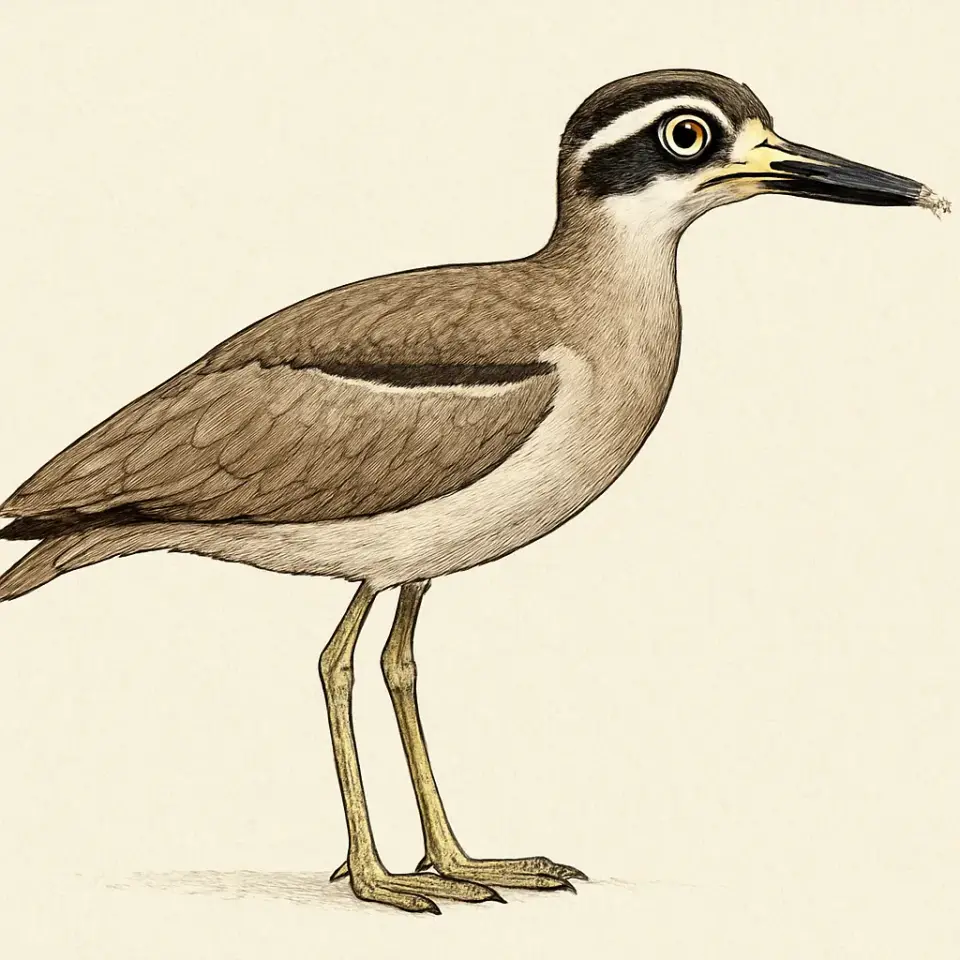
Great thick-knee (great stone-curlew)
The great thick-knee, also called the great stone-curlew, is a big, pale wader of river shingle with a heavy upturned bill and a staring yellow eye. It lives in India all year, but it is hard to see because it trusts stillness: on a gravel bar it looks like a rounded stone. In the India GO guide its place is Ranganathittu, the bird sanctuary on the Kaveri near Mysuru.
A large, pale, long-legged wader of riverbanks with a heavy upturned black-and-yellow bill and a startling yellow eye. It nests directly on open shingle.
How to recognise it
It relies on stillness, so scan the sandbars slowly for a bird that looks like a rounded stone until it walks. Largely crepuscular - best at the first and last boat of the day.
Where to see it
Mysore
Ranganathittu's islets formed after the Mysore king Kanteerava Narasimharaja Wadiyar built an embankment across the Kaveri in 1645–1648, and the great thick-knee is one of the birds that nest on them.
 Ranganathittu Bird Sanctuary (often)
What to look for
It is 49–55 cm long and stands on long legs. The bill is the thing to fix on: about 7 cm, black with a yellow base, with the lower edge angled so sharply that the whole bill seems to curve up. The face has a bold black-and-white pattern around a bright yellow eye; the back and breast are plain grey-brown, the belly whitish, the legs a dull greenish-yellow. Males and females look alike.
In flight it shows a striking black-and-white pattern on the upper wing and a mostly white underwing, with powerful, rather stiff wingbeats. It is wary and tends to fly off well ahead of a boat, so the best view is often the first one, before it decides to leave.
Where and when: Ranganathittu
The species lives along gravel banks of rivers and large lakes, and on some beaches, from India and Sri Lanka into Southeast Asia. It is mainly active at dusk and at night, though it does feed by day, walking slowly and deliberately with short runs. That is why the first and last boats of the day are the ones to take.
At Ranganathittu Bird Sanctuary it is seen frequently on the rock and shingle islets in the Kaveri. It is there all year, and between February and May it nests on the exposed rock. A nest is no more than a bare scrape on open stone with a single egg, so the less a boat crowds the islets in those months, the better. More species are on the birds of Mysuru page.
A night voice on the river
Like the other stone-curlews, it calls mostly after dark: a wailing whistle, often heard before the bird is seen. It eats crabs, large insects and other small animals. The "thick knees" of the name are the prominent leg joints shared by the whole family, and strictly speaking they are heels, not knees.
Status and protection
The IUCN lists the great thick-knee as Near Threatened. In India it is in Schedule II of the Wild Life (Protection) Act as amended in 2022.
FAQ
Where can I see a great thick-knee in India?
On river shingle and rocky islets. Ranganathittu Bird Sanctuary near Mysuru is a frequent site, on the islets in the Kaveri, all year.
Is the great thick-knee endangered?
It is listed as Near Threatened by the IUCN. In India it is protected under Schedule II of the Wild Life (Protection) Act.
When is the best time to see it?
Early morning or late afternoon, as it is most active at dusk and at night. At Ranganathittu that means the first or last boat of the day.
Is the great thick-knee the same as the beach thick-knee?
No. They are the two species of the genus Esacus; the beach thick-knee lives mainly on coasts of island Southeast Asia and Australasia.
Sources (4)
Facts checked: 8 October 2026. Prices and hours are approximate; check locally.