 India GO
Crimson rose: the slow, poisonous swallowtail of South India
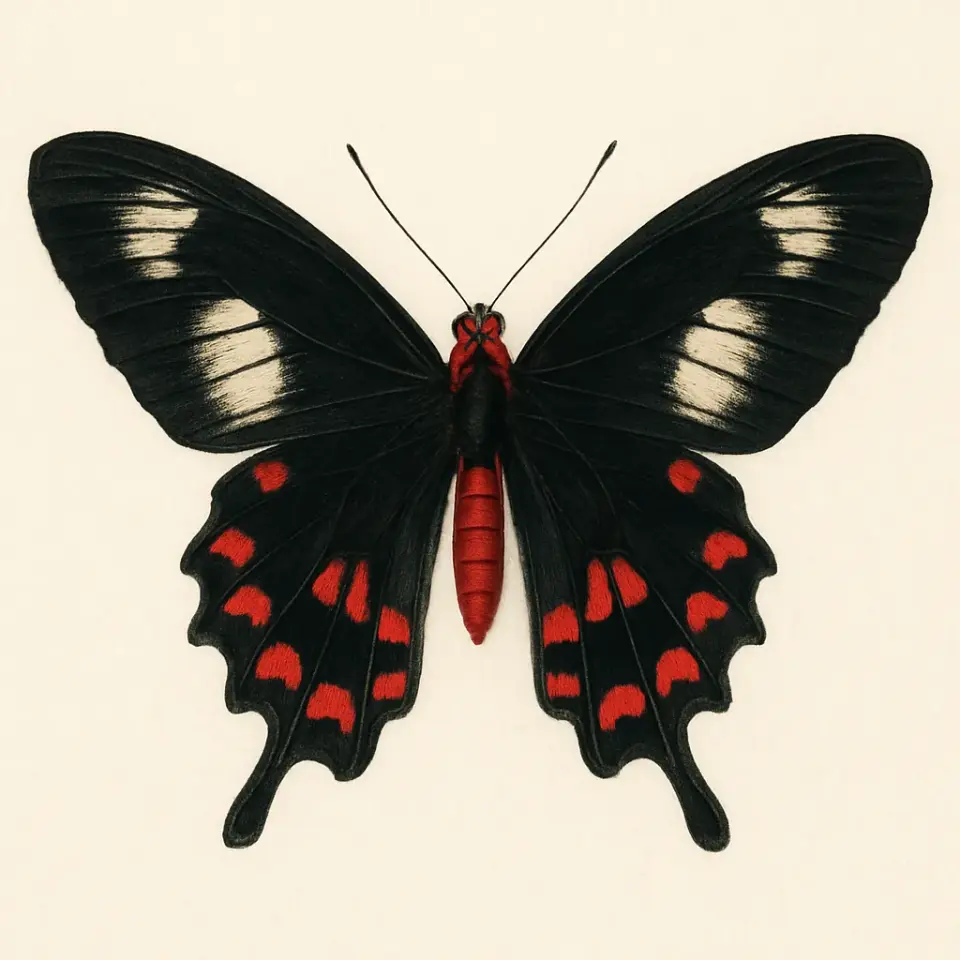
The crimson rose (Pachliopta hector) is a large black swallowtail with white bands on the forewings, rows of crimson spots on the hindwings and a bright crimson head and body. It flies slowly and in the open because it is poisonous: its caterpillars feed on Aristolochia vines and store the plant's toxins. It lives in the Western Ghats, South and East India and Sri Lanka, and in India it is a protected species.
A large black swallowtail with broken white bands and a row of crimson spots along the hindwing, plus a red body. It flies slowly and openly, because it is poisonous and does not need to hurry.
How to recognise it
Unhurried, fluttering flight at flower height, often at lantana and ixora. The red body and red spots are the warning signal - several harmless butterflies copy this pattern.
Where to see it
Auroville
Its caterpillars eat only Aristolochia vines and store the plant's toxins. Butterfly diversity is one of the measures the Auroville forest group uses to track how the restored forest is maturing.
 Auroville Botanical Gardens (often) · Pitchandikulam Forest (often)
Mysore
Its caterpillars feed only on Aristolochia vines and store the plant's toxins, which is why the adult can afford to advertise itself.
Karanji Lake Nature Park (often) · Kukkarahalli Lake (often)
How to recognise the crimson rose
On the upperside the male is black. The forewing carries a broad white band made of separate streaks, running at a slant towards the rear edge, and a second short white band near the tip. The hindwing has a curved row of seven crimson spots and, closer to the edge, a row of crimson crescents. The give-away is the body: the head and most of the abdomen are bright crimson, and so are the sides of the thorax and the underside of the body.
The female looks much the same, but her hindwing spots are duller and sprinkled with black scales; in some females the front spots are nearly white.
The butterfly most often mistaken for it is the common Mormon. One form of its female, called romulus, copies the crimson rose's wing pattern. Its flight and behaviour are also much like the crimson rose's. The check is the body: the romulus Mormon does not have the crimson head and abdomen.
Why it flies so slowly
The caterpillars feed only on Aristolochia vines, among them Aristolochia indica and Aristolochia bracteolata, and store the plant's aristolochic acid. The adult carries the same poison, and its red body, bright pattern and unhurried flight warn birds that it is not worth eating. Close to the ground it flutters slowly and steadily; higher up it flies faster.
Adults depend on nectar, and lantana is a favourite; the butterfly also visits hibiscus, periwinkle, duranta and many other garden flowers. In the evening crimson roses often roost together on the twigs of trees and shrubs, sometimes with a few common Mormons among them. The species is a strong migrant: at the peak of its season thousands can gather before moving on. It breeds several times a year, and egg to adult takes only 39 to 47 days. In the dry season it is found up to 2,400 metres in South India.
Where to see the crimson rose
In India the crimson rose is found along the Western Ghats, in Tamil Nadu and Kerala, and in West Bengal and Odisha in the east. It is common along the Ghats north to Maharashtra and rare in Gujarat. The India GO database records it as frequent in two places you can easily visit:
- Mysuru. Around the flower beds and the butterfly park of Karanji Lake Nature Park, and at Kukkarahalli Lake on the university campus. More of the city's wildlife is on the Mysuru animals page.
- Auroville. In the Botanical Gardens and in Pitchandikulam Forest. The Auroville forest group uses butterfly diversity as one of its measures of how the restored forest is maturing.
Look at flowering beds, especially lantana and ixora, at about flower height.
Protection status
Globally the crimson rose is not at risk: the IUCN assessed it as Least Concern in 2019. In India it is protected by law. Under the Wild Life (Protection) Act as amended in 2022, it is listed in Schedule II among the swallowtail butterflies, which means it may not be caught, collected or traded. Photographing it is fine; netting it is not.
FAQ
Is the crimson rose butterfly poisonous?
Yes, to its predators. The caterpillars feed on Aristolochia vines and store aristolochic acid, and the adult stays distasteful, which is why it can fly slowly in the open.
How do I tell the crimson rose from the common Mormon?
Look at the body. The crimson rose has a bright crimson head and abdomen; the romulus form of the female common Mormon copies its wing pattern but not the red body.
Is the crimson rose protected in India?
Yes. Since the 2022 amendment it is in Schedule II of the Wild Life (Protection) Act, so catching, collecting and trading it are offences.
Where can I see the crimson rose in Mysuru?
At the flower beds and butterfly park of Karanji Lake Nature Park, and at Kukkarahalli Lake, where the database records it as frequent.
What does the crimson rose caterpillar eat?
Only Aristolochia vines, such as Aristolochia indica and Aristolochia bracteolata, and the related Thottea siliquosa.
Sources (3)
Facts checked: 8 October 2026. Prices and hours are approximate; check locally.