 India GO
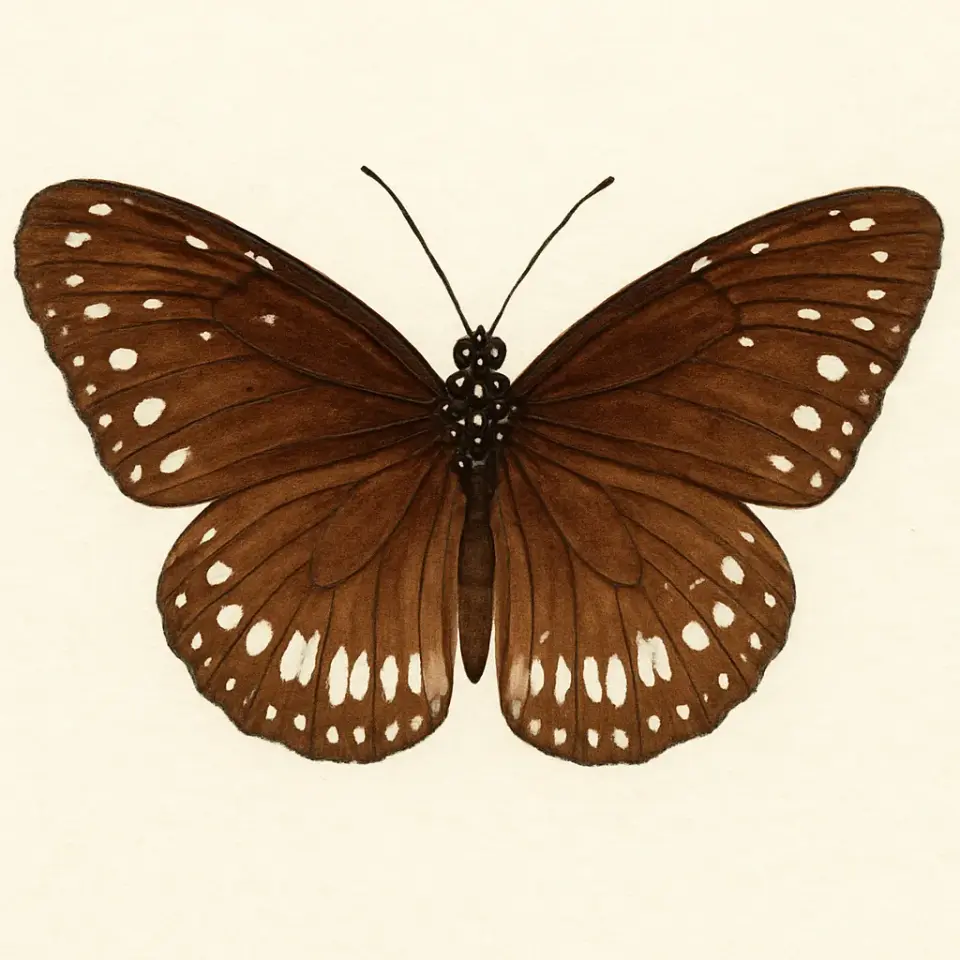
Common crow: the slow black butterfly of Indian gardens
The common crow (Euploea core) is a dark brown, almost black butterfly with rows of white spots along the wing edges, and a common butterfly across South Asia. It flies slowly and makes no effort to hide, because it does not need to: its caterpillars eat poisonous plants and the adult carries the toxins, so birds learn to leave it alone.
A dark brown butterfly with a rim of white spots, drifting slowly through gardens and gathering in dozens to roost in the dry season.
How to recognise it
Almost black in shade, with a chocolate sheen and white dots around the edge. It flies unhurriedly, like the plain tiger, and for the same reason.
Where to see it
Goa
Its caterpillars feed on oleander and other poisonous plants, and the adults carry the toxins on, which is why so many other butterflies imitate it.
 Campal Gardens & the Riverfront · Garcia de Orta Garden (Panjim Municipal Garden) · Sahakari Spice Farm
How to recognise it
The wingspan is about 8–9 cm. In shade the butterfly looks black; in sun the upperside shows as a glossy chocolate brown, paler towards the edges, with two rows of white dots along the margin of each wing. The underside is brown with the same white markings, and the body itself is spotted white.
The flight is the best clue. A common crow glides with its wings held just above horizontal, flapping only now and then, and it feeds on a bunch of flowers for a long time without being easily disturbed. The plain tiger, another poisonous butterfly, flies in the same unhurried way for the same reason.
Several edible butterflies imitate the common crow to borrow its protection, among them the female great eggfly and one form of the common mime. Telling them apart in the field takes practice; the relaxed, gliding flight is more typical of the real crow.
Why birds leave it alone
The caterpillar feeds on oleander and other plants with poisonous milky latex. It first chews through the leaf's midrib to cut off the latex flow, then eats the leaf, storing the plant toxins in its fat. The toxins pass to the pupa and on to the adult, which tastes bad and can make a predator vomit. A young bird that tries one remembers the lesson.
When caught, the butterfly plays dead and oozes a foul liquid, then flies off once released. Its wings are tough and leathery.
The pupa is worth a look if you find one: compact and shiny gold, like a small metal ornament.
On hot days common crows gather on wet sand to drink (mud-puddling), often in mixed groups with other butterflies. In the dry season they also gather in dozens to roost together.
Where to see it in Goa and across India
The common crow lives from sea level up to about 2,400 m, in every kind of country from dry land to forest, gardens included, across India and from Pakistan and Sri Lanka to Australia. In practice, any garden with flowering shrubs is worth watching.
In Goa the guide marks it as common in the public gardens of Panjim, including the Garcia de Orta garden, and at Sahakari Spice Farm. Look along hedges and flowering bushes, where it moves slowly from one cluster of flowers to the next.
FAQ
Is the common crow butterfly poisonous?
To predators, yes: it stores toxins from its caterpillar food plants, such as oleander, and tastes bad enough to make a bird vomit. It does not sting or bite, so watching it is harmless.
Why is it called the common crow?
It belongs to the genus Euploea, whose dark butterflies are known in English as crows, and it is the most common member of that genus.
What does the common crow caterpillar eat?
Oleander and other plants with poisonous milky latex. It cuts the leaf's midrib first to stop the latex, then feeds.
Is the common crow rare?
No. The IUCN Red List rates it Least Concern, and it is a common butterfly across South Asia. It is not among the species listed in the schedules of India's Wild Life (Protection) Act as amended in 2022.
Sources (2)
Facts checked: 8 October 2026. Prices and hours are approximate; check locally.