 India GO
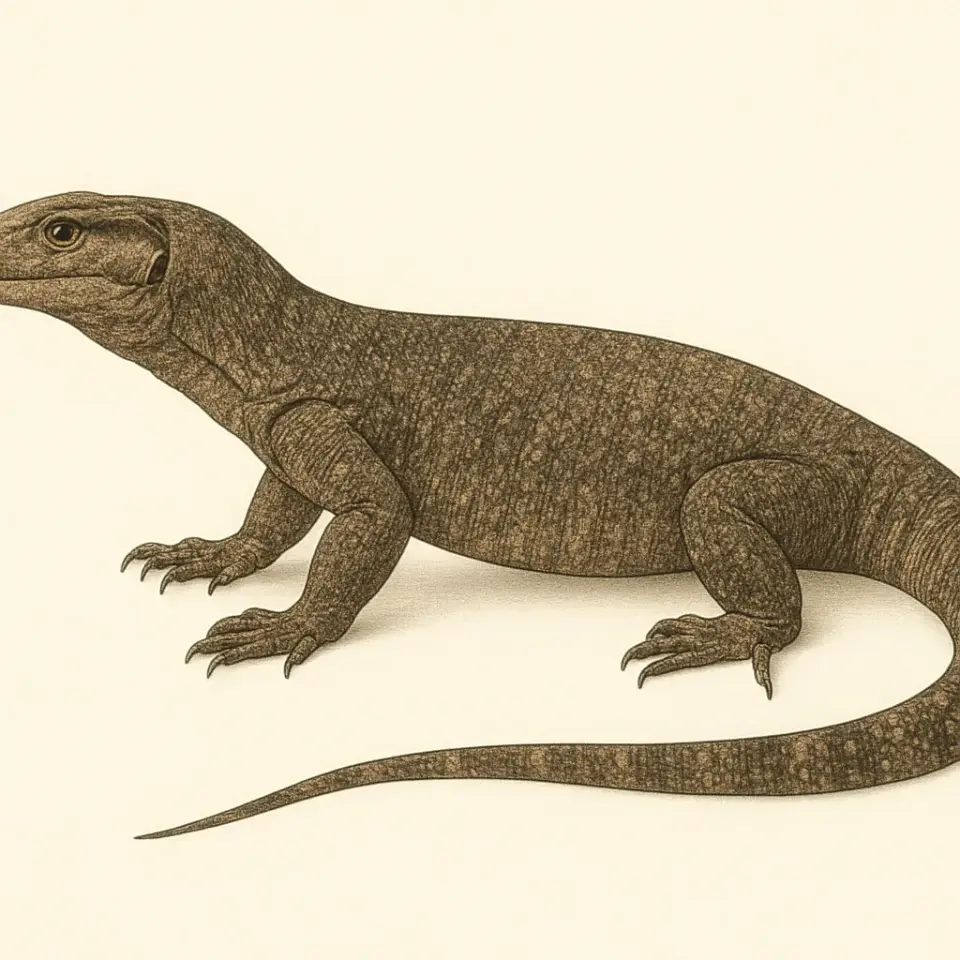
Bengal monitor lizard (goh): how to recognise it and where it lives in India
गोह (goh)
The Bengal monitor (Varanus bengalensis), goh in Hindi, is the big land lizard of the Indian plains and hills: grey-brown, heavy-bodied, more than half of its length in tail. It lives almost everywhere below about 1,500 m, from dry scrub to forest edge and farmland, including the green belts of Delhi, Bengaluru, Hyderabad, Mumbai and Pune. It is shy, rarely bites and is protected under Schedule I of the Wild Life (Protection) Act.
A heavy grey-brown lizard up to a metre and a half long, basking on rocks and ruins and vanishing into a burrow when approached.
How to recognise it
A long forked tongue flicking, a laterally flattened tail and a slow, deliberate walk. Easiest to see basking on warm mornings in the dry months; it breeds in the monsoon.
Protection
Schedule I of the Wildlife (Protection) Act, 1972.
Where to see it
Auroville
A restored dry forest is a reptile habitat first and foremost, which is one reason the planted areas feel busier at ground level than they look.
 Pitchandikulam Forest (in season) · Auroville Botanical Gardens (in season)
Bengaluru
The name udumbu attaches to the old stories of forts climbed by rope tied to a monitor lizard: a legend, not a technique, but one every fort guide in the Deccan tells.
Savandurga (in season) · Turahalli Forest
Delhi
It basks on rocks, old walls and ruins and climbs them with ease: the lizard's claws really do hold rock.
Aravalli Biodiversity Park (in season) · Sanjay Van (in season) · Okhla Bird Sanctuary
Hyderabad
It basks on rocks, old walls and ruins and climbs them with ease: the lizard's claws really do hold rock.
KBR National Park (in season) · Khajaguda Hills (Fakhruddingutta) (in season) · Mahavir Harina Vanasthali National Park (in season)
Mumbai
The goh appears in Maratha fort legend as the animal whose grip on a wall let climbers scale it; the story is folklore, but the lizard's claws really do hold rock.
Sanjay Gandhi National Park (in season) · Elephanta Caves (in season)
Pune
The goh appears in Maratha fort legend as the animal whose grip on a wall let climbers scale it; the story is folklore, but the lizard's claws really do hold rock.
Vetal Tekdi (in season) · Bedse Caves (in season)
What it looks like up close
The biggest Bengal monitors reach about 175 cm, of which about a metre is tail, and weigh up to about 7 kg; males are usually larger than females. Adults are plain grey or light brown with fine dark speckling. Young ones look like a different animal: dark crossbars on the neck and back, rows of yellow spots, a barred white belly.
Two details settle any doubt: slit-like nostrils set halfway between the eye and the tip of the snout, and a long forked tongue that flicks in and out like a snake's.
Where and when to look
Monitors become active around 6 am and bask in the morning sun, so scan warm rock, ledges and old masonry in the first sunny hours. In Delhi look in the Aravalli Biodiversity Park and Sanjay Van; near Bengaluru, the granite of Savandurga and the scrub of Turahalli Forest. In Mumbai and Pune it basks on the rock around the Elephanta and Bedse caves, in Hyderabad on the granite of the Khajaguda hills.
It is resident all year; in Delhi, Mumbai, Pune and Hyderabad it is hardest to find in December and January; around Bengaluru it is busiest on warm mornings from February to May. It can detect a moving person nearly 250 m away, so walk slowly and stop often.
How it lives
Bengal monitors live alone and mostly on the ground, sheltering in burrows they dig, rock crevices, old buildings and abandoned termite mounds. Young ones are often seen in trees; big adults prefer to escape on the ground, though they climb well and can stay underwater for at least 17 minutes.
They eat mostly beetles and other invertebrates; larger ones also take frogs, snakes, rats and birds, and scavenge carcasses. The main breeding season runs from June to September; a female lays a single clutch of about 20 eggs in a hole she digs and packs shut, and the eggs hatch after roughly 170 to 250 days.
Is it dangerous?
No, as long as it is left alone. The Bengal monitor avoids people and runs at the first sign of them; when caught, a few may bite, but they rarely do. The old belief that the goh is venomous (it is called bis-cobra in western India, and in Rajasthan some say it turns venomous in the rains) is folklore. Monitors do have venom glands, but only one disputed case of serious harm is on record.
Keep your distance, never corner or handle one, and keep dogs away. If someone is bitten or hurt, call 112.
Protection and the “hatha jodi” trade
The Bengal monitor stayed in Schedule I, the highest level of protection, when the Wild Life (Protection) Act was amended in 2022, and it is on Appendix I of CITES. Its numbers are falling: it is hunted for meat, skin and folk medicine.
Two products sold in markets and online come from it. “Hatha jodi”, offered as a lucky Himalayan root, is the dried and dyed reproductive organs of male monitors; monitor “oil” for rheumatism is boiled-down body fat. Both are illegal wildlife products.
Names and the fort legend
Almost every Indian language has its own word for it: goh in Hindi and Punjabi, ghorpad in Marathi, uda in Kannada, udumu in Telugu, udumbu in Tamil and Malayalam.
The Ghorpade clan of Maharashtra traces its name to a legend in which Tanaji Malusare climbed a fort wall on a rope tied to a monitor lizard clinging to the stone. It is a legend, not history. In the south the animal reached music too: the head of the kanjira, a small frame drum, was traditionally made from monitor belly skin.
FAQ
Is the Bengal monitor lizard venomous?
It has venom glands, but it is not considered dangerous: only one disputed case of serious harm is on record. It is shy and rarely bites unless caught, so keep your distance and do not handle it.
What is the Bengal monitor called in Hindi?
Goh (गोह). In Marathi it is ghorpad, in Kannada uda, in Telugu udumu, and in Tamil and Malayalam udumbu.
Can I keep a Bengal monitor as a pet in India?
No. It is listed in Schedule I of the Wild Life (Protection) Act, so catching, keeping or trading one is illegal in India.
Where can I see a Bengal monitor in Delhi?
On warm rock in the Aravalli Biodiversity Park and Sanjay Van, best on sunny mornings after the monsoon; it is hardest to find in December and January. Okhla Bird Sanctuary sometimes turns one up.
Sources (2)
Facts checked: 8 October 2026. Prices and hours are approximate; check locally.