 India GO
Banyan (bargad): India's national tree and where to see the great ones
बरगद (bargad)
In Hindi the banyan is बरगद (bargad); in towns of the north you will also hear वट (vat) or बड़ (bad). It is Ficus benghalensis, the national tree of India: a fig that drops roots from its branches, lets them thicken into new trunks and, given a few centuries, turns from one tree into a small wood.
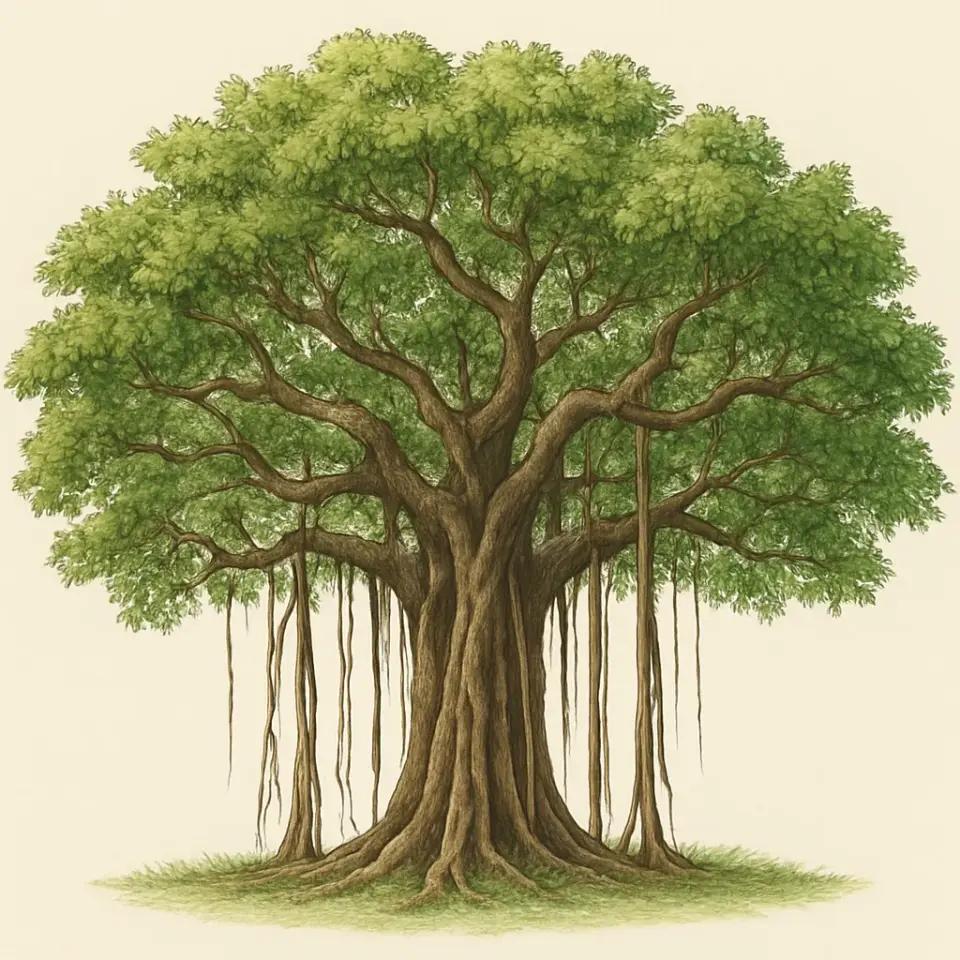
India's national tree. Supported by its own prop roots, a single old banyan can keep spreading until it becomes a wood.
How to recognise it
Curtains of hanging roots and a crown wider than it is tall. The leaves are thick, oval and blunt — no drip-tip, which separates it from the peepal.
Where to see it
Agra
The banyan is worshipped on Vat Savitri, when married women tie thread around the trunk. Village assemblies and markets traditionally met under one.
 Ram Bagh (Aram Bagh) · Keoladeo Ghana National Park (Bharatpur)
Ajmer
On the shore of Sambhar Lake, one large banyan has held a breeding colony of cattle egrets for more than fifteen years: a fair measure of what a single old tree does in a dry landscape.
Daulat Bagh (Subhash Udyan) (often) · Ana Sagar Lake (often)
Bengaluru
The village banyan is the meeting tree and the tree of Shiva as teacher. At Dodda Alada Mara the original main root died of disease in the 2000s, so the tree that stands now is made entirely of its own descendants.
Dodda Alada Mara (Big Banyan Tree) · Lalbagh Botanical Garden
Hampi
The banyan is the tree under which Shiva teaches in silence, and village banyans are still the place where meetings are held; at Pampa Sarovar it shades a tank the Ramayana names directly.
Pampa Sarovar · Onake Kindi Prehistoric Rock Art (often)
Hyderabad
The banyan is worshipped on Vat Savitri, when married women tie thread around the trunk. Village assemblies and markets traditionally met under one.
Ananthagiri Hills · Hyderabad Botanical Garden (Kotla Vijayabhaskara Reddy) · KBR National Park
Kolkata
The Great Banyan sits inside the Acharya Jagadish Chandra Bose Indian Botanic Garden, run by the Botanical Survey of India. Its original trunk, damaged by cyclones and then by fungus, was removed in 1925, so what stands is held up entirely by its own prop roots. The tree is over 270 years old, and its crown now measures roughly 486 metres around.
AJC Bose Indian Botanic Garden & the Great Banyan
Mumbai
Mumbai's stock market began under a banyan: in the 1850s a handful of brokers traded beneath one in front of the Town Hall, where Horniman Circle now is, two decades before the BSE was founded in 1875.
Rani Baug · Sanjay Gandhi National Park
Pune
The banyan is worshipped on Vat Savitri, when married women tie thread around the trunk. Village assemblies and markets traditionally met under one.
Parvati Hill · Bedse Caves · Empress Botanical Garden
Ujjain
The state tree of Madhya Pradesh. Old banyans on the Shipra bank carry platforms and shrines built into their roots, which is the usual reason such trees survive in a town centre.
Naulakhi Eco Tourism Park · Shipra River and Shri Ram Ghat · Dewas Tekri (Mata Tekri)
Varanasi
The banyan is worshipped on Vat Savitri, when married women tie thread around the trunk. Village assemblies and markets traditionally met under one.
Sarnath Deer Park · Chandraprabha Wildlife Sanctuary
Vrindavan
Bhandir Vat, the old banyan that gives Bhandirvan its name, is one of Braj's named trees and the place where the Radha-Krishna marriage story is set. Banyans are not felled here, which is why the oldest trees in the region stand in temple courtyards and at the ponds.
Bhandirvan (Bhandir Vat) · Gahvar Van (often)
Names across India
Hindi: बरगद (bargad), with वट (vat) also used around Agra, Vrindavan, Varanasi and Ujjain, and बड़ (bad) around Vrindavan and Ajmer. Vat comes from the Sanskrit vata, which is why the festival is Vat Savitri and the famous trees are called Bhandir Vat or Akshayavat.
South India: ஆல மரம் (ala maram) in Tamil, మర్రి (marri) in Telugu, ಆಲದ ಮರ (alada mara) in Kannada and പേരാൽ (peral) in Malayalam. Bengaluru's best-known tree, Dodda Alada Mara, simply means «the big banyan».
The English word has a trading history. Early European travellers saw that the shade of these trees was frequented by banias, a community of Indian traders, and named the tree after them.
How one tree becomes a wood
A banyan often starts life up in another tree. A bird drops a fig seed in a fork of branches, the seedling sends roots down to the soil, and over the years those roots wrap the host and replace it. Ficus benghalensis is classed as a strangler fig for this reason, and it can reach up to 30 m.
The roots that hang from the branches are the second trick. Each one that touches the ground thickens into a woody pillar and carries the crown further out, so an old banyan has no obvious centre. Mynas, coppersmith barbets and many other birds feed on the small red figs, and seeds that pass through a bird germinate more readily than those that simply fall.
It is easy to confuse with the peepal, the other great sacred fig; the leaf tip tells them apart (see «How to recognise it» above).
The giant trees
A few banyans are famous for size alone. Canopy area is the usual measure, because a tree that has lost its first trunk can still keep spreading.
Thimmamma Marrimanu, Andhra Pradesh
The largest known tree in the world by canopy area, about 19,107 m².
The Great Banyan, Howrah (Kolkata)
About 18,918 m² of canopy and roughly 250 years old, in the Indian Botanic Garden.
Kabirvad, Gujarat
About 17,520 m² of canopy, on a river island in the Narmada in Bharuch district; the place is linked with the poet Kabir.
Dodda Alada Mara, Bengaluru
About 12,000 m² and some 400 years old; the page on the tree covers the visit.
In worship and village life
On Vat Purnima, also called Vat Savitri, married women fast, wind thread around a banyan trunk and pray for their husbands' wellbeing. In Shaiva imagery Shiva as Dakshinamurti, the teacher, is shown seated under a banyan, and in Braj, Bhandir Vat is the tree where tradition sets the marriage of Radha and Krishna.
The tree matters beyond Hinduism too. In Pali texts the banyan (nigrodha) is a common image, its way of overgrowing a host compared to the way desire overtakes a person, and in Jain tradition Adinath, the first Tirthankara, attained enlightenment under one.
There is a practical side too: village assemblies and markets traditionally met in a banyan's shade. Threads, small shrines and stone platforms built into the roots are a sign the tree is in use; leave them as they are.
FAQ
What is banyan called in Hindi?
बरगद (bargad). Around Agra, Vrindavan, Varanasi and Ujjain you will also hear वट (vat), from Sanskrit, and around Vrindavan and Ajmer बड़ (bad).
Is the banyan the national tree of India?
Yes. Ficus benghalensis is India's national tree; it is also the state tree of Madhya Pradesh.
Where is the biggest banyan tree in India?
By canopy area the record holder is Thimmamma Marrimanu in Andhra Pradesh, about 19,107 m². The Great Banyan in Howrah is close behind at about 18,918 m².
What is the difference between a banyan and a peepal?
Both are sacred figs, but the banyan drops pillar roots from its branches and has thick blunt leaves, while the peepal has heart-shaped leaves with a long drawn-out tip.
Where can I see a big banyan near Bengaluru?
Dodda Alada Mara, the Big Banyan Tree west of the city. Its original main root died of disease, so what stands today is made of the tree's own descendants.
Sources (8)
Facts checked: 8 October 2026. Prices and hours are approximate; check locally.