 India GO
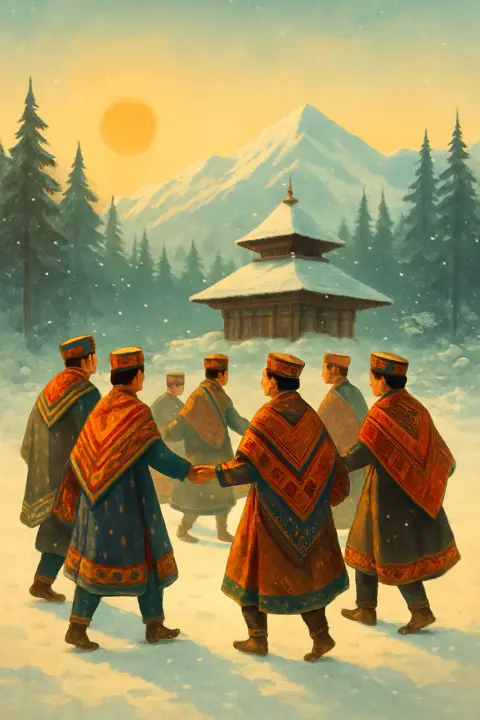
Winter Carnival, Manali: Kullu nati in the snow
Kullu caps and linked hands circling slowly through the snow
The Winter Carnival is Manali's January festival: about five days of Kullu folk dance, parades, contests and stalls on the Mall Road, with skiing and snowboarding competitions at Solang in the same days. Its centre is the Mahanati, a huge shared round of the Kullu nati danced by women of the local village groups. There is no fixed calendar date: the Kullu district administration announces the days each year, usually in December or early January.
The Kullu district administration, whose head chairs the carnival committee, fixes the dates in December or early January.
The legend
The carnival was started in 1977 to bring Manali to life in the winter off-season and draw visitors for winter sports.
In 1999 it was made a state-level event, and in 2011 it became a national one.

Every year the carnival begins with prayers at the temple of Hidimba, the presiding goddess of Manali.
In the Mahabharata, Hidimba becomes the wife of Bhima, one of the Pandava brothers; legend says she stayed in the hills and through penance became a goddess.
From her temple in the cedar forest the parade goes down to the Mall Road, and for five days the whole town becomes a stage.
Customs
Mahanati
On the Mall Road women of the local mahila mandals dance the Mahanati, a huge shared round of nati.
Village tableaux
In the parade women re-create old village life in the Kullu valley and the old ways of farming.
Winter Queen
The main contests are Winter Queen and Voice of the Carnival, a stage for young Himachali women and singers.
Home cooking
Women's groups set up stalls near the Mall Road with local dishes that no restaurant cooks.
Snow at Solang
In the same days skiing and snowboarding competitions run at Solang.
Words of the festival
नाटी
nati
Himachal's round dance: a line moves with hands linked criss-cross
टोपी
topi
"cap"; the round woollen Himachali cap, a mark of hill pride
pattu
a one-piece drape worn by Kullu women over a shirt
mahila mandal
a village women's group; they dance the Mahanati and run stalls
tuni
the hill word for the musicians who play for the nati
True or myth
✅ True. As the largest folk dance: 9,892 women danced it at the Kullu Dussehra in 2015.
❌ Myth. Men used to dance it in the past, but today it is mostly women who carry the tradition forward.
❌ Myth. It has run since 1977; it became a state event in 1999 and a national one in 2011.
What happens at the carnival
Every year the carnival begins with prayers at the temple of Hidimba, the presiding goddess of Manali. From her temple in the cedar forest the parade goes down to the Mall Road, and for the next days the town centre becomes a stage.
- The Mahanati
On the Mall Road women of the local mahila mandals, village women's groups, dance the Mahanati: a long line moving slowly with hands linked criss-cross, in Kullu caps and pattu, the one-piece drape worn by Kullu women over a shirt. The musicians who play for the nati are the tuni.
- The parade and village tableaux
In the parade women re-create old village life in the Kullu valley and the old ways of farming. Cultural teams from other states perform folk dances as well.
- Contests
The main contests are Winter Queen and Voice of the Carnival, a stage for young Himachali women and singers; there are also solo and group dance competitions and musical performances.
- Home cooking
Women's groups set up stalls near the Mall Road with local dishes that no restaurant cooks.
- Snow at Solang
In the same days skiing and snowboarding competitions run at Solang.
History and the nati
The carnival was started in 1977 to bring Manali to life in the winter off-season and to draw visitors for winter sports. It was made a state-level event in 1999 and a national one in 2011.
The nati is Himachal's round dance. Men used to dance it, but today it is mostly women who carry the tradition forward, and it holds a Guinness World Record for the largest Nati dance: 9,892 dancers, most of them women, at the Kullu Dussehra in 2015. The round woollen Himachali topi, or cap, worn in the dance is a mark of hill pride.
Hidimba, whose temple opens the carnival, appears in the Mahabharata as the wife of Bhima, one of the Pandava brothers; legend says she stayed in the hills and through penance became a goddess.
When it is held
Himachal Tourism describes the carnival as a week-long festival in the first week of January; recent editions have run for five days in the second half of January. The Kullu district administration, whose head chairs the carnival committee, fixes the dates in December or early January, so check its announcements before booking. The day to aim for is the one with the mass Nati on the Mall Road. The carnival falls in the quiet weeks after the New Year rush and pairs well with Naggar castle and the Roerich estate, the Hidimba Devi temple, and Fagli in February.
FAQ
When is the Manali Winter Carnival?
In January, for about five days. The Kullu district administration sets the dates each year, usually in December or early January; recent editions ran in the second half of January.
What is the Mahanati?
A huge shared round of the Kullu nati folk dance, danced on the Mall Road by women of the local mahila mandals during the carnival.
Is there skiing during the carnival?
Yes. Skiing and snowboarding competitions run at Solang in the same days.
When did the Manali Winter Carnival begin?
In 1977. It became a state-level event in 1999 and a national one in 2011.
Where does the carnival take place?
It opens with prayers at the Hidimba temple, then moves to the Mall Road in Manali, with winter sports at Solang.
Sources (3)
Facts checked: 21 October 2026. Prices and hours are approximate; check locally.