 India GO
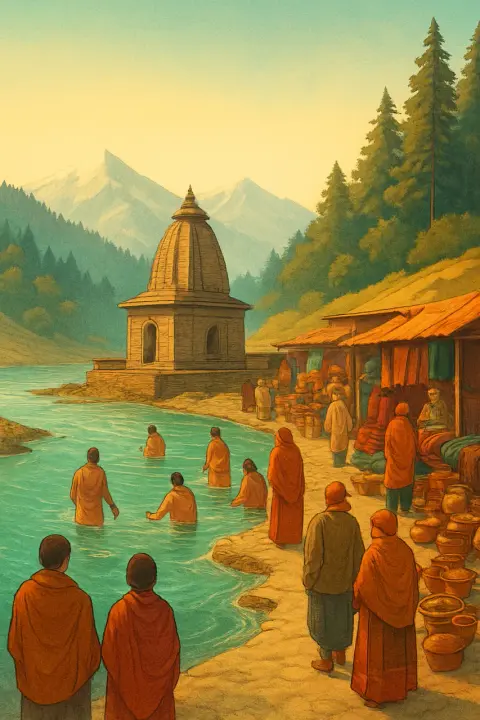
Uttarayani Fair in Bageshwar: Kumaon's winter fair at the confluence
Blankets, copper pots and mountain herbs traded where two rivers meet in January
The Uttarayani Fair is Kumaon's best-known winter fair, held in Bageshwar, Uttarakhand, where the Saryu and Gomti rivers meet. It opens around Makar Sankranti, called Uttarayani in Kumaon, with a holy bath at the confluence and a visit to the Bagnath temple of Shiva, then runs for about a week as a market and cultural fair. Next: 14–21 January 2027 (expected). The Bageshwar district administration notifies the programme in early January.
The Bageshwar district administration notifies the mela programme in early January.
The legend
Bageshwar, where the Saryu meets the Gomti, was long a mart between Tibet and Kumaon. At Uttarayani, Bhotia traders brought wool, salt and Tibetan goods.
In the early 20th century it was Kumaon's largest fair, with woollens carried down by Sauka makers from Munsiyari. The Tibet routes closed after 1962.

On 14 January 1921, the fair day, a non-violent movement against forced porterage began at the confluence. Village heads threw its registers into the river.
Customs
Bath at the confluence
On Makar Sankranti people bathe where the Saryu and Gomti meet and visit the Bagnath temple of Shiva, which gave the town its name.
Mountain market
On sale are iron and copper pots, baskets and bamboo goods, mats, herbs and spices, carpets and blankets.
The bath, the temple and the market
The religious core is Makar Sankranti, the day the Sun enters Capricorn and begins its northward course (uttarayan). In Kumaon the day is also kept as Ghughutia. On it people bathe at the sangam, the meeting of the Saryu and Gomti, and visit the Bagnath temple, the temple of Shiva that gave Bageshwar its name. Wikipedia attributes the present temple to the Chand king Laxmi Chand.
After the bath the fair turns to trade. The Kumaon Division administration lists what is sold: iron and copper pots, baskets and bamboo goods, mats, herbs and spices, mattresses, carpets and blankets. It also notes that the fair at Bageshwar draws the most people of all the Uttarayani fairs in Kumaon, and that its commercial, cultural and political importance is still high. The local press describes seven or eight days of worship, song and music in the town, and the Kumaoni folk singing forms jhora-chanchari, bair and bhagnaul have long been part of it.
Smaller Uttarayani fairs are held on the same day elsewhere in Kumaon, including Chitrashila (Ranibagh), Rameshwar, Sult Mahadev and Hanseshwar, and Haldwani holds a large procession.
A trade fair on the Tibet road, and the 1921 movement
Bageshwar was long a market between Tibet and Kumaon. When snow closed the high valleys, traders came down to the Uttarayani fair: Bhotia traders with wool, salt and Tibetan goods, and Saukas from Munsiyari with woollen clothing. Wikipedia says that in the early 20th century about 15,000 people visited, making it the largest fair in Kumaon. The Tibet routes closed after the India–China war of 1962, and the barter trade with them.
The fair also has a place in the freedom movement. Coolie begar was the law that forced hill villagers to carry the luggage of travelling British officials without pay, by turns recorded in village registers. In January 1921, at the Uttarayani fair, a non-violent movement against it led by Badri Datt Pandey and Hargovind Pant came to a head at the confluence, and village heads threw the registers into the river. Mahatma Gandhi called it a 'bloodless revolution'.
Getting there and planning
Bageshwar is a hill town in the Kumaon division of Uttarakhand, reached only by road. Distances below are from the Bageshwar district administration.
- By rail — The nearest railway station is Kathgodam, about 180 km away; from there take a bus or a taxi.
- By air — The nearest airport is Pantnagar, about 210 km by road.
- By road — Delhi is about 470 km away, Almora about 90 km and Kausani about 40 km. Buses and private taxis run to Bageshwar.
- Pick the day — Come for Makar Sankranti if you want the bath at the confluence and the temple; the days after it are for the market and the cultural programme. The fair follows the Kumaoni almanac, so Sankranti may be kept on the 14th or 15th of January.
FAQ
When is the Uttarayani Fair in Bageshwar?
Next: 14–21 January 2027 (expected). The fair opens around Makar Sankranti in mid-January and lasts about a week; the district administration notifies the programme in early January.
In which state is the Uttarayani Mela celebrated?
In Uttarakhand, across the Kumaon region. The largest Uttarayani fair is at Bageshwar; others are held at Ranibagh, Rameshwar, Sult Mahadev and Hanseshwar.
What is the Uttarayani Fair related to?
To Makar Sankranti, the Sun's northward turn, marked by a bath at the Saryu–Gomti confluence. Historically it was a Tibet–Kumaon trade fair, and in 1921 it was the scene of the Coolie Begar movement.
What is sold at the Uttarayani Fair?
Iron and copper pots, baskets and bamboo goods, mats, herbs and spices, mattresses, carpets and blankets, according to the Kumaon Division administration.
How do I reach Bageshwar?
By road only: the nearest railway station is Kathgodam (about 180 km) and the nearest airport Pantnagar (about 210 km), then bus or taxi.
Sources (6)
Facts checked: 22 October 2026. Prices and hours are approximate; check locally.