 India GO
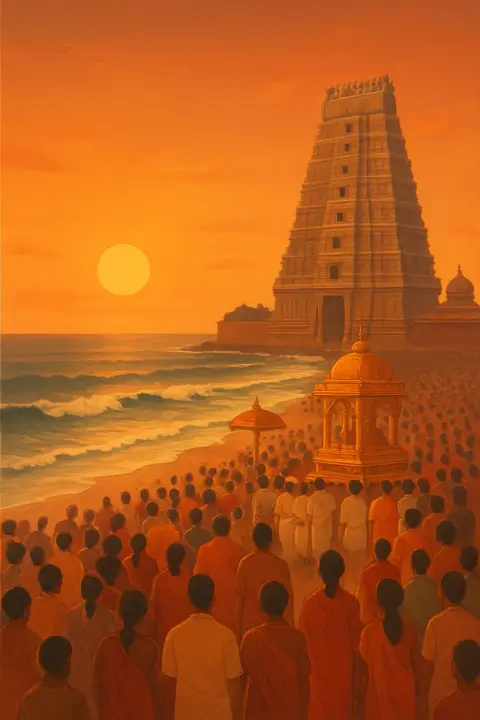
Skanda Sashti and Soorasamharam in Tiruchendur: Murugan's victory on the beach
On the beach in the evening light, a god defeats a demon who becomes his peacock
Skanda Sashti, or Kanda Sashti in Tamil, is a six-day festival of Murugan that begins just after the new moon of the Tamil month of Aippasi and ends on the sixth lunar day, sashti, with the Soorasamharam: the enactment of the god's victory over the demon Surapadman. The best-known Soorasamharam is at Tiruchendur, Murugan's temple on the seashore in Thoothukudi district, Tamil Nadu, where it is performed on the sand before lakhs of people. Dates: 10–16 November 2026 (expected), with the Soorasamharam on 15 November 2026 (expected) and the divine wedding the next day.
The temple and the Thoothukudi district administration publish the schedule about ten days before the first day.
The legend

In the Kanda Puranam the asuras Surapadman, Simhamukhan and Tarakasura won a boon from Shiva: only a son of Shiva could kill them.
That son was Murugan. His mother Parvati gave him the vel, the divine spear, and with it he overcame Surapadman, who had taken the form of a tree.

The two halves of the tree became a peacock and a rooster. The peacock became Murugan's mount and the rooster his banner.
Customs
Five days of fasting
For the first five days many fast, and evening processions circle the temple as the story of Murugan's war is told in stages.
Soorasamharam
On the sixth day the battle is enacted on the sand in front of the temple: Murugan meets the asura in several forms and prevails.
The wedding
On the seventh day the Thirukalyanam, the wedding of Murugan and Deivanai, closes the festival.
Where to celebrate
Tiruchendur
Six days of Kanda Sashti at Murugan's seashore temple end with the Soorasamharam, the god's battle with the demon enacted on the beach before lakhs of people; the divine wedding follows the next day.
The story behind Skanda Sashti
The festival follows the Kanda Puranam, the Tamil telling of Murugan's story. The asuras Surapadman, Simhamukhan and Tarakasura won a boon from Shiva: only a son of Shiva could kill them. That son was Murugan. His mother Parvati gave him the vel, the divine spear, and with it he overcame Surapadman, who at the end had taken the form of a tree. The vel split the tree in two, and the two halves became a peacock and a rooster: the peacock became Murugan's mount and the rooster the emblem on his banner. In the temple's tradition Murugan then worshipped Shiva at Tiruchendur in thanks.
Sashti simply means the sixth lunar day. Many devotees keep a fast through the six days, the Sashti viratham, and recite the Kanda Shasti Kavasam, a Tamil hymn of protection to Murugan composed in the 19th century by Devaraya Swamigal at the Chennimalai temple.
How the six days run in Tiruchendur
The temple and the Thoothukudi district administration publish the detailed schedule about ten days before the first day.
- Days 1–5: fasting and processions
Many pilgrims fast, and each evening a procession circles the temple as the story of Murugan's war is told in stages. On the first day the temple opens at 1 am instead of the usual 4 am.
- Day 6: Soorasamharam
The temple again opens at 1 am. From late afternoon the battle is enacted on the beach in front of the temple: with the sea behind, Murugan meets Surapadman in several forms and defeats him; the demon ends as his peacock and rooster. The beach is full by noon.
- Day 7: Thirukalyanam
The festival closes with the wedding of Murugan and Deivanai.
The temple by the sea
The Arulmigu Subramaniya Swamy temple at Tiruchendur is one of the Arupadai Veedu, the six abodes of Murugan; the temple counts itself the second. It is the only one of the six on a beach. It is mentioned in early Tamil literature, and its tower rises 157 feet in nine storeys. About 100 m south of the temple is the Nazhi Kinaru, a well fed by a freshwater spring, where pilgrims bathe after their dip in the sea.
Etiquette and safety
Tiruchendur is a working temple at its busiest week of the year.
- Inside the temple — The sanctum is open to Hindus only. Men often enter bare-chested in a veshti, a wrap worn like a sarong; dress modestly in any case. Paid darshan queues run alongside the free ones, and the free queue normally closes at 7:30 pm.
- On the beach — The Soorasamharam is outdoors and free. Claim a spot by noon, bring water and sun cover, and stay with your group until the crowd thins.
- Crowd sense — The UK Foreign Office notes that stampedes have occurred at religious gatherings with large crowds in India. Agree a meeting point away from the beach and follow police instructions on entry and exit.
How to get there and where to stay
Prices in Tiruchendur rise steeply in Sashti week, and transport fills early.
- Book rooms about six weeks ahead
Tiruchendur has only basic lodges, and they fill for Sashti week. The alternative is to stay in Thoothukudi, about 40 km away, or Tirunelveli, about 60 km, and come in early on the day.
- Trains: book when sales open
Train tickets go on sale 60 days ahead and sell out quickly. Southern Railway has run festival specials to Tiruchendur in past years.
- Buses
The state bus company TNSTC has run special buses from Chennai, Coimbatore, Bengaluru and other cities, bookable on tnstc.in.
- Arrive the day before
On Soorasamharam day vehicles have been stopped at the edge of town, leaving about 3 km to walk. Arrive the previous day; a second night lets you stay for the wedding.
FAQ
When is Skanda Sashti in Tiruchendur?
Next: 10–16 November 2026 (expected), with the Soorasamharam on 15 November 2026 (expected). The dates follow the lunar calendar; the temple publishes the schedule about ten days before.
What is meant by Sashti?
Sashti is the sixth lunar day. Skanda Sashti ends on the sixth day after the new moon of Aippasi, the day of Murugan's victory.
What is Soorasamharam?
The enactment of Murugan's defeat of the demon Surapadman, performed on the sixth day. In Tiruchendur it takes place on the beach in front of the temple from late afternoon.
What is the history of the Kanda Shasti Kavasam?
It is a Tamil hymn to Murugan composed in the 19th century by Devaraya Swamigal at the Chennimalai temple. Devotees recite it during the six-day Sashti fast.
Can non-Hindus attend the Soorasamharam?
Yes. The enactment is on the open beach and free to watch. The temple sanctum itself is open to Hindus only.
Why is Tiruchendur special for Skanda Sashti?
It is one of Murugan's six abodes and the only one on a beach, so the battle is enacted on the sand with the sea behind it.
Sources (5)
Facts checked: 21 October 2026. Prices and hours are approximate; check locally.