 India GO
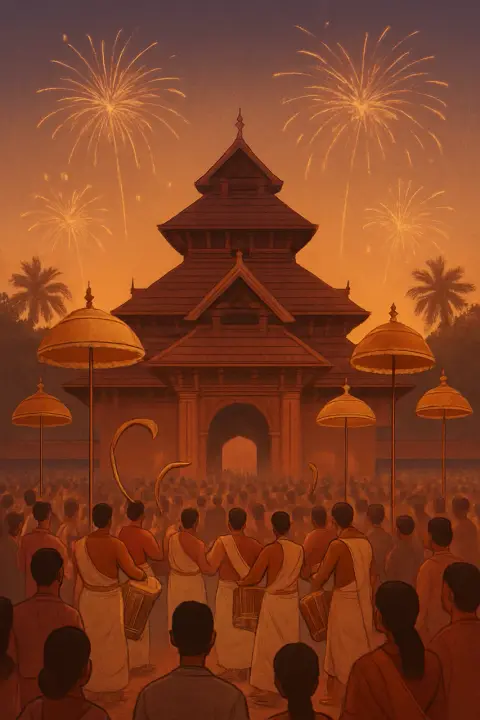
Thrissur Pooram: Kerala's great contest of drums, parasols and elephants
Hundreds of drummers under a single temple tree, building the beat for four hours
Thrissur Pooram is Kerala's best-known pooram, a temple festival held around the Vadakkunnathan temple and the Thekkinkadu Maidan in the centre of Thrissur. It falls on the day of the Pooram star in the Malayalam month of Medam, between mid-April and early May: 11–18 April 2027. The flags go up six days ahead, and the Pooram itself lasts about 36 hours, through a night, as two sides, Paramekkavu and Thiruvambady, compete in temple percussion, parasols on elephant-back and fireworks. In a usual year more than a million people come.
The two temple boards (Devaswoms) announce the next year's date at the close of each Pooram; the detailed programme follows about five weeks ahead.
The legend

Until the late 18th century Kerala's greatest temple festival was the pooram at Arattupuzha, where all the gods were believed to gather.
In 1796 incessant rain made the Thrissur temples late for Arattupuzha, and they were refused a place in the procession.
The Maharaja of Cochin, Sakthan Thampuran, replied with a pooram of his own, inviting the temples and their deities to Thrissur to honour Shiva.
He also split the temples into two sides, Paramekkavu and Thiruvambady, and is believed to have drawn up the festival's programme himself.
Ever since, the two sides have competed in drums, parasols and fireworks, and at parting the goddesses tell each other: see you at the next pooram.
Meaning
For everyone
The festival is Hindu, yet all of Kerala society comes, and the Pooram itself is called a meeting of the gods, deva sangamam.
The sound
Oscar-winning sound editor Resul Pookutty recorded all 36 hours of the festival and made a film of it, The Sound Story.
Customs
Ilanjithara Melam
After midday, under the ilanji tree in the Vadakkunnathan temple yard, a canonical 222 musicians play pandi melam for hours: a hundred chenda drums, cymbals, horns.
Madathil Varavu
In the morning the Thiruvambady side sets out from the old Vedic school, Madham, with a panchavadyam: by canon 17 timilas, horns and cymbals, nine maddalams, four idakkas.
Kudamattam
At dusk the two sides face each other and, to the drums, race to raise silk parasols; new parasols are made every year, some of them in several tiers.
Vedikettu
The main fireworks begin around three in the morning on Thekkinkadu Maidan; a few days earlier comes a trial run, the sample vedikettu.
Pandals, no ads
Only the two main sides may put up the festival pandals, and these carry no banners, no advertising, not even the temple's name.
Pakal Pooram
Next morning comes the daytime pooram, the one for Thrissur's own people, and the farewell, Upacharam Cholli Piriyal, ends with a last volley of fireworks.
Words of the festival
പൂരം
pooram
a temple festival on the day of the Pooram star in the month of Medam
മേളം
melam
an ensemble of temple chenda drums with cymbals and wind instruments
പഞ്ചവാദ്യം
panchavadyam
"five instruments": timila, maddalam, idakka, horn and cymbals
കുടമാറ്റം
kudamattam
"changing of parasols", the two sides' contest of ornate umbrellas
വെടിക്കെട്ട്
vedikettu
fireworks; at the Pooram only the two main sides have the right to them
ഇലഞ്ഞി
ilanji
the bullet wood tree under which the Pooram's great melam is played
True or myth
✅ True. It counts as the asuras' melam, and temples keep panchari melam inside. Vadakkunnathan is the exception, said to be Sakthan Thampuran's rule.
❌ Myth. The old tree fell from age in 2001, and the present ilanji was planted on 11 September that same year.
❌ Myth. Sakthan Thampuran started it in 1796, after the Thrissur temples were shut out of the pooram at Arattupuzha.
The Pooram day, hour by hour
Ten temples take part, split into two sides. Paramekkavu Bhagavathy leads the eastern side and Thiruvambady the western one; each brings smaller temples with it, and all come to pay respects to Shiva at Vadakkunnathan.
- Early morning: Kanimangalam Sastha
The arrival of the deity of the Kanimangalam temple, usually between about 7:30 and 8:30, officially opens the day. The smaller temples follow through the morning.
- Late morning: Madathil Varavu
The Thiruvambady side sets out from the Brahmaswam Madham, an old Vedic school, to a panchavadyam, the five-instrument ensemble: by canon 17 timila drums, nine maddalams, four idakkas, horns and cymbals.
- From 2 pm: Ilanjithara Melam
Under the ilanji tree in the Vadakkunnathan temple yard, a canonical 222 musicians play pandi melam for about four hours: a hundred chenda drums with cymbals and horns. Pandi melam is normally not played inside temple walls; Vadakkunnathan is the exception.
- Dusk: Kudamattam
The two sides line up facing each other 15 caparisoned elephants each, and to the drums race to change the silk parasols on the elephants' backs. New parasols are made every year, some in several tiers.
- Around 3 am: vedikettu
In a usual year the main fireworks begin on Thekkinkadu Maidan in the early hours; only the two main sides have the right to them. A trial run, the sample vedikettu, comes a few days before the Pooram on Swaraj Round. In some years the fireworks have been called off, so check the announced programme.
- Next morning: Pakal Pooram and the farewell
The daytime pooram is the one for Thrissur's own people. It ends with Upacharam Cholli Piriyal, the farewell of the two goddesses before the western gate of the Vadakkunnathan temple, facing Swaraj Round, traditionally followed by a last volley of fireworks.
How Thrissur Pooram began
Until the late 18th century the great temple festival of the region was the pooram at Arattupuzha, where all the gods were believed to gather. In 1796, the story goes, incessant rain made the Thrissur temples late, and they were refused a place in the procession. The Maharaja of Cochin, Sakthan Thampuran, answered with a pooram of his own: he invited the temples and their deities to Thrissur to honour Shiva at Vadakkunnathan, divided them into the Paramekkavu and Thiruvambady sides and, by tradition, drew up the programme himself. So the festival is a little over two centuries old, not a thousand years.
The contest has run ever since: drums against drums, parasols against parasols, fireworks against fireworks. Only the two main sides may put up the festival pandals, the decorated gateways, and these carry no banners, no advertising, not even the temple's name. The Pooram is a Hindu festival, but the whole of Kerala comes to it, and it is called a meeting of the gods, deva sangamam. It has been cancelled or scaled down only in a handful of years, among them 2020 and 2021 during the pandemic, and it has also gone ahead without fireworks, after a deadly blast at a fireworks unit in the district.
Etiquette and safety
The Pooram is a working religious festival in a packed town centre. The two temple boards (Devaswoms) announce the date of the next Pooram at the close of each one, and the detailed programme follows about five weeks ahead.
- Pick your moments — You do not need to stay for all 36 hours. The Ilanjithara Melam in the afternoon and the Kudamattam at dusk are the core of the day; in years with fireworks, they mean staying up until the early hours.
- Give the elephants room — Dozens of elephants take part, thirty in the Kudamattam alone. Keep your distance, follow police and volunteers, and never stand between an elephant and the crowd barriers. The use of captive temple elephants is the subject of a long welfare debate in Kerala.
- The fireworks zone — When fireworks are held, watch only from where the police direct the crowd. They are very loud: bring earplugs, especially for children.
- Crowds and heat — April and May are hot. Carry water, agree a meeting point and keep your phone in a front pocket. The UK Foreign Office notes that stampedes have occurred at religious gatherings with large crowds in India.
Getting to Thrissur
Thrissur railway station is on the main line through central Kerala, on the Shoranur–Cochin Harbour section. The Pooram happens on and around the temple hill ringed by the Swaraj Round, so plan to move around the centre on foot. Ernakulam, in Kochi, is about 75 km south by rail; see the Kochi guide if you are combining the trip. With more than a million visitors, book trains and a room as early as you can once the date is announced.
FAQ
When is Thrissur Pooram?
Next: 11–18 April 2027, with the main Pooram day on 17 April 2027. The date is set by the Pooram star in the month of Medam and announced by the two Devaswoms at the close of the previous Pooram.
How many days is Thrissur Pooram?
The flags go up six days before the Pooram day, and the Pooram itself runs about 36 hours, ending with the farewell the next day.
What is Pooram?
A temple festival held on the day of the Pooram star in the Malayalam month of Medam. Many Kerala temples hold one; Thrissur's is the best known.
Who started Thrissur Pooram?
Sakthan Thampuran, the Maharaja of Cochin, in 1796, after the Thrissur temples were refused entry to the pooram at Arattupuzha.
Which temples take part in Thrissur Pooram?
Ten: Paramekkavu and Thiruvambady, the two main sides, and eight smaller temples, among them Kanimangalam Sastha, Laloor, Ayyanthole, Chembukkavu and Choorakkottukavu. All come to the Vadakkunnathan temple.
What is Kudamattam?
The "changing of parasols" at dusk on Pooram day, when the two sides face each other with 15 elephants each and compete with ornate silk parasols.
Sources (9)
- Thrissur Pooram
- Thrissur
- Thrissur Pooram: next year's date decided, Onmanorama
- Thrissur Pooram festivities kick off with flag hoisting, ThePrint
- FCDO: India, safety and security
- No fireworks at Thrissur Pooram after deadly explosion, Outlook
- Thrissur Pooram cancelled due to lockdown, Onmanorama
- Thrissur Pooram to be held with curbs, The News Minute
- Thrissur railway station
Facts checked: 21 October 2026. Prices and hours are approximate; check locally.