 India GO
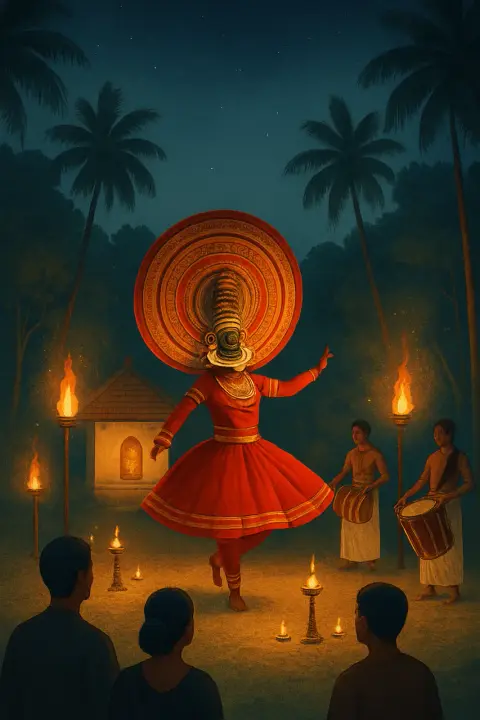
Theyyam season in north Malabar: night rituals in the sacred groves
In the grove before dawn, a man in a towering headdress becomes the village god
The theyyam season of north Malabar starts on the tenth day of the Malayalam month of Thulam, usually in mid-October, and lasts until the middle of Edavam, usually late May. Within it every grove shrine (kavu) and family house keeps its own festival nights, and around Kannur some kavu has a performance most weeks from December to March. There is no single schedule: Kerala Tourism publishes an approximate calendar, and local hosts know which shrine is performing.
There is no central announcement: each shrine or family fixes its own kaliyattam nights, many by the Malayalam calendar, and schedules circulate locally a few weeks ahead.
The legend
A legend in the Keralolpathi says Parashurama created the kaliyattam and gave the Panan, Velan and Vannan communities the right to perform theyyam.

Theyyam has over four hundred forms: mother goddesses, Vishnu as Narasimha, ancestors and heroes worshipped as gods after their death.
Pottan theyyam re-enacts a legend: Shankaracharya orders Pottan off the road, and Pottan asks: "When you are wounded, is it not blood? And when I am?"
The performer spends hours in ritual song and preparation; when the mudi, the sacred headdress, is placed on him, the deity is believed to enter him.
So in the kavu people approach the theyyam as the deity itself: it speaks with them, answers and gives its blessing.
Meaning
Parassinikadavu
At the Muthappan temple in Parassinikadavu theyyam is performed almost daily, morning and evening, and dog figures flank the gate: dogs are held sacred here.
Bhuta kola
In Tulu Nadu, next door in Karnataka, the related bhuta kola is held: family and village disputes are brought before the local deity to judge.
Opening and close
The season opens on Thulam 10, in October, and the last kaliyattam comes in Edavam at Madayi Kavu and Kalarivathukkal, shrines of the Kolathiri royal family.
Customs
Vellattam
First comes the vellattam, or thottam: with no make-up and a small red headdress, the performer and the drummers sing the legend of the deity.
Face painting
Faces are painted with rice paste, turmeric and red ink. The pattern tells one deity from another, and the craft passes down the generations.
The mirror
With the mudi on, the performer looks into a mirror and sees the deity's form. A priest throws rice, and the man begins to dance as the theyyam.
No stage
There is no stage or curtain: people stand or sit before the shrine, and one deity's performance, with breaks, lasts 12 to 24 hours.
What people eat
Tea and gram
at the Muthappan temple in Parassinikadavu everyone gets boiled gram and tea
Words of the festival
തെയ്യം
theyyam
the spoken form of daivam, "god", as Gundert explains it
കളിയാട്ടം
kaliyattam
a theyyam festival held on set days at a kavu or a family house
കാവ്
kavu
a sacred grove with a shrine, a remnant of evergreen forest
കുറി
kuri
prasad that the theyyam hands out in person as it blesses people
True or myth
❌ Myth. Devakoothu, the one women's theyyam, is performed by a woman every two years at the Thekkumbad Kulom shrine near Kannur.
✅ True. Mappila theyyams such as Ali theyyam and Ummachi theyyam are cited as an example of Malabar's social even-handedness.
✅ True. Some kavus hold it once in 10, 15 or 25 years. Such a lavish festival is called perumkaliyattam, and some feed thousands of people.
Where to celebrate
Kannur
Worth the trip
From December to March some grove shrine around Kannur holds a theyyam most weeks: all night the performer becomes the village deity, dances, speaks and blesses.
When the season runs
Kerala Tourism dates the season from Thulam 10, usually mid-October, to the middle of Edavam, typically late May. The dates of each kaliyattam (a shrine's theyyam festival) follow the Malayalam calendar, which mixes lunar and solar reckoning, so they shift from year to year. Kerala Tourism's online theyyam calendar lists shrines, dates and contact people, but the department itself calls it approximate and asks visitors to confirm with the shrine or local authorities.
For a first trip, December to March gives the best odds: that is when the most kavus around Kannur hold their nights. Some shrines keep a kaliyattam only once in many years, in some temples at intervals of 12 years or more; such a festival is called perumkaliyattam.
Where to see theyyam
Theyyam belongs to north Malabar: above all the Kannur and Kasaragod districts, with performances also in parts of Wayanad, northern Kozhikode and neighbouring Karnataka, where the related bhuta kola is held. It is performed in front of village shrines in sacred groves and in ancestral family houses (tharavads), not on a stage.
One place breaks the seasonal rule. At the Parassinikadavu Sree Muthappan temple, on the Valapattanam river about 10 km from Thaliparamba, theyyam is the daily form of worship, early in the morning and in the evening, and the temple is open to people of every faith and caste. The Muthappan theyyam is performed by the Vannan community, and offerings of fish and toddy are shared with those present. The India GO base notes a pause in the daily theyyam from mid-October to the end of November.
Short theyyams staged for hotel guests are shows, not the ritual.
What a theyyam night looks like
Kerala Tourism describes theyyam as a sacred ritual rather than a performance. Performers come mainly from the Malayan and Vannan communities and inherit the craft within their families. Before each performance they keep vrutham, a period of fasting, prayer and disciplined living, so that they can become the deity. In the kavu people approach the theyyam as the deity itself: it speaks with them, answers and gives its blessing.
A kaliyattam usually runs through the night, so plan to reach the kavu by about 9 pm and stay until dawn. The costumes are built around the mudi, the headdress, with skirts of coconut fronds, areca leaves or bamboo, and make-up of rice flour, turmeric and charcoal, red above all. Some theyyam characters dance in burning embers.
How to watch respectfully
Visitors are welcome to watch, Kerala Tourism says, but the kavu is a place of worship and the theyyam is, for the people around you, the deity itself.
- Watch, do not take part — Active participation is reserved for the performers and the local community. Stay among the spectators and do not step into the space where the theyyam moves.
- Treat it as worship — The performers prepare with fasting and prayer. Keep your voice down, follow what local people do, including where they stand and leave their footwear, and do not treat the night as a show.
- Photographs with consent — Kerala Tourism's code for travellers warns against photographing people without their consent. Ask, and if a shrine or family does not want photos, put the camera away.
- Give fire theyyams room — Some theyyams dance in burning embers. Keep the distance the crowd keeps.
- Dress modestly — Wear modest clothes, as Kerala Tourism advises for temples.
Planning a theyyam trip
The season brings no price surge, so the planning is about finding the right night, not the room.
- Base yourself near Kannur or Payyanur
Book a homestay about two weeks ahead. The host usually knows which kavu is performing and can take you there.
- Stay at least two nights
Two nights covers the night before and the theyyam night itself; four give a chance to see two different kavus.
- Plan the transport
Kannur has its own airport and is on the main west-coast railway; in December and January, the holiday season, book trains about a month ahead. Most kavus are in villages off the main roads, so a taxi or your host's car is the practical way, and you return at dawn.
- Check the night again
Confirm the date with the shrine or your host a few days before; schedules circulate locally a few weeks ahead.
FAQ
When is the theyyam season?
From Thulam 10 in the Malayalam calendar, usually mid-October, to the middle of Edavam, typically late May. Around Kannur the most performances are from December to March.
Which district in Kerala is famous for theyyam?
Kannur, together with neighbouring Kasaragod. Theyyam is also performed in parts of Wayanad and northern Kozhikode.
How long does a theyyam last?
A kaliyattam usually runs through the night, and one deity's performance, with breaks, can last 12 to 24 hours.
Can I see theyyam outside the season?
Yes, at the Parassinikadavu Sree Muthappan temple, where theyyam is performed daily, early morning and evening, except for a break from mid-October to the end of November.
Is there an entry fee for theyyam?
No. Theyyam is a village ritual, not a ticketed show, and watching a kaliyattam is free.
Can tourists take part in theyyam?
Visitors are welcome to watch, but Kerala Tourism notes that active participation is reserved for trained performers and the local community.
Sources (9)
- Kerala Tourism: Theyyam, a ritual art popular in north Kerala
- Kerala Tourism: Theyyam calendar
- Kerala Tourism: Kannur theyyam calendar
- Kerala Tourism: Experiencing Theyyam
- Kerala Tourism: Ritual significance of Theyyam
- Kerala Tourism: Code of ethics for travellers
- Kerala Tourism: Parassinikadavu Muthappan Temple
- Theyyam
- Kerala Tourism: Dos and don'ts in Kerala temples
Facts checked: 21 October 2026. Prices and hours are approximate; check locally.