 India GO
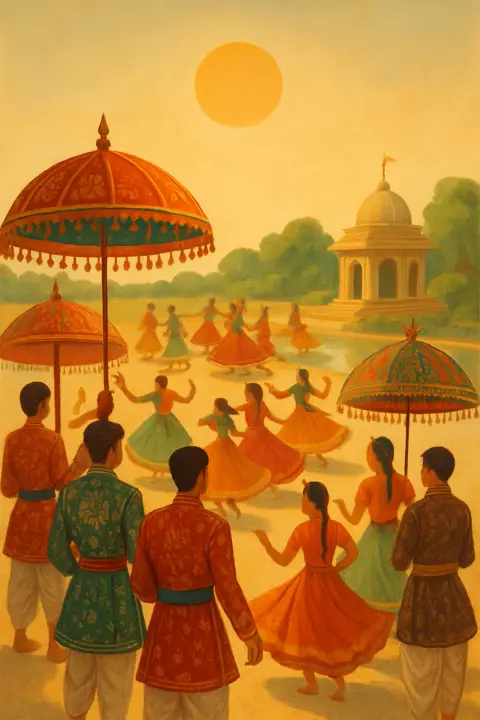
Tarnetar Fair: embroidered umbrellas over the dance circles of Saurashtra
Embroidered umbrellas twirling above the dance circles of Saurashtra's herders
The Tarnetar Fair is held at the Trinetreshwar Mahadev temple in Tarnetar village, about 8 km from Thangadh in Surendranagar district, Gujarat. Dates: 3–6 September 2027 (expected), four days from the third to the sixth lunar day of the bright half of Bhadrapada (Bhadarva Sud 3 to 6), usually late August or September. Gujarat Tourism counts more than 50,000 visitors, mostly from Saurashtra's herding and farming communities, and calls it the most important fair in Saurashtra.
The fair follows the lunar calendar, so the dates are known months ahead; the Surendranagar administration and Gujarat Tourism publish the programme.
The legend
Tradition ties the fair to Draupadi's swayamvara, where Arjuna, watching only the reflection in water, shot the eye of a spinning fish target and won his bride.
So Tarnetar became a fair where young people look for a partner: Gujarat's folk dance, music and dress all revolve around matchmaking.

The Trinetreshwar Mahadev temple is ringed by three kunds. It is believed the Ganga once flowed here, so a dip in them equals a bath in the Ganga.
Customs
Embroidered umbrellas
Would-be grooms stroll the fair under umbrellas worked with beads and patchwork; each takes over a year to make, a custom begun by the Kolis of Saurashtra.
The rahado dance
Rabari women from nearby Zalawad dance the circular rahado, and dance circles and folk-singing contests fill the whole fair.
Craft stalls
Stalls cover much of the village: local crafts, jewellery, images of deities and clothes embroidered with tiny mirrors.
Where to celebrate
Tarnetar
Around Rishi Panchami the Trinetreshwar Mahadev temple ground near Thangadh fills with Saurashtra's herding communities, young men carrying hand-embroidered umbrellas through the dance circles.
What you see at the fair
Gujarat Tourism lists the communities that come: Kolis, Rabaris, Bharwads, Khants, Kanbis, Kathis, Charans, Desh-Rabaris and others, with visitors from elsewhere in India and abroad. Tradition ties the fair to Draupadi's swayamvara, the contest for her hand, and Tarnetar has long been a fair where young people look for a partner. Gujarat Tourism dates the tradition back about 200 to 250 years.
The umbrellas are the reason most outsiders come. The custom was begun by the Kolis of Saurashtra: young men carry umbrellas worked with beadwork, patchwork and small bright handkerchiefs, each taking over a year to make, and stroll the fair under them to catch the eye of a future bride.
The dancing never really stops. The most popular is the raas, danced with clacking sticks; large circles of women dance rasada to drums and the jodia pava (double flute); Rabari women from Zalawad dance the circular rahado, and spontaneous hudo breaks out among the crowds. Bhajan mandlis (devotional singing groups) sing through the day. Among the Rabari women, a black zimi (skirt) marks a married woman and a red one an unmarried woman.
The Trinetreshwar Mahadev temple, rebuilt by the Gaekwads of Vadodara in the 19th century, is ringed by kunds (bathing tanks). It is believed the Ganga once flowed here, so a dip in them counts as a bath in the Ganga; the bathing is on the morning of Rishi Panchami. Around the temple, stalls sell local crafts, jewellery, images of deities and mirror-embroidered clothes, with rides, magic shows and tattoo artists.
Which day to go
The four days are not the same.
The second day
The busiest day for the umbrellas and the hudo dancing; if you have one day, this is it.
Rishi Panchami morning
The bathing in the temple kunds. Ganesh Chaturthi, the day before, also falls within the fair.
Two nights
A second night nearby lets you come back to the fairground for another day at the temple.
How to reach Tarnetar
- By train
Thangadh, 8 km from the fair, is the nearest station, on the Ahmedabad to Hapa line. Rajkot and Surendranagar have more trains; tickets go on sale 60 days ahead, and about a month ahead is a comfortable margin for this fair.
- By road
Tarnetar is about 59 km from Surendranagar and 75 km from Rajkot. State buses run from Rajkot, Jamnagar, Ahmedabad and Porbandar to Chotila, 25 km from Thangadh.
- By air
Rajkot airport is the nearest.
Where to stay
Tarnetar has no hotels. In some years Gujarat Tourism puts up a tented camp at the fair with special packages; otherwise stay in Rajkot or Surendranagar and drive out early, or arrive the night before in Thangadh. Book a room about six weeks ahead.
Etiquette
Entry to the fairground is free. It is a religious fair and a community gathering first.
- Ask before close-up photos — Ask before photographing anyone up close, especially women dancing in the circles.
- At the temple and kunds — Follow the temple's own rules at the shrine and keep the bathing kunds clear for those bathing.
- Crowds — In recent years the district has deployed police in large numbers. Keep to the paths between the dance circles and follow police instructions on the busiest day.
Other fairs of Gujarat
If you are planning around Gujarat's fairs, see also the Bhavnath Mahadev Fair at Junagadh and the Vautha Fair.
FAQ
When is the Tarnetar Fair?
Next: 3–6 September 2027 (expected). It runs four days, Bhadarva Sud 3 to 6 in the lunar calendar, usually in late August or September.
Where is the Tarnetar Mela held?
At the Trinetreshwar Mahadev temple in Tarnetar village, Surendranagar district, Gujarat: about 8 km from Thangadh, 59 km from Surendranagar and 75 km from Rajkot.
What is the Tarnetar Fair famous for?
For the embroidered umbrellas young men carry to attract a bride, a custom begun by the Kolis of Saurashtra, and for the raas, rahado and hudo dance circles.
Why is the Tarnetar Fair celebrated?
It is the fair of the Trinetreshwar Mahadev (Shiva) temple, tied by tradition to Draupadi's swayamvara, and it has become a gathering where young people of Saurashtra's communities look for a partner.
Who takes part in the Tarnetar Fair?
Mainly Saurashtra's communities: Kolis, Rabaris, Bharwads, Khants, Kanbis, Kathis, Charans and others, with visitors from across India and abroad.
Sources (5)
Facts checked: 21 October 2026. Prices and hours are approximate; check locally.