 India GO
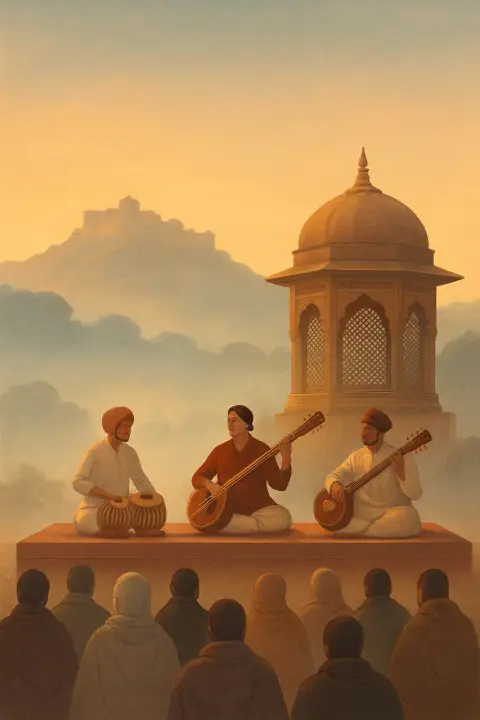
Tansen Samaroh: free classical concerts at Tansen's tomb in Gwalior
Dawn ragas at a singer's tomb, under a tamarind said to sweeten the voice
Tansen Samaroh is a festival of Hindustani classical music held every December in Gwalior, Madhya Pradesh, at the tomb of Tansen, the 16th-century singer of Akbar's court. Dates: 14–19 December 2026. For five or six days musicians from across India and abroad perform in morning and evening sessions, entry is free, and the festival closes in Behat, the village held to be Tansen's birthplace. It is organised by Madhya Pradesh's Department of Culture and the Ustad Alauddin Khan Sangeet Evam Kala Akademi.
Madhya Pradesh's Culture Department and the Ustad Alauddin Khan academy set the dates; the 2026 dates were public by late September.
The legend
Tansen was born in Gwalior and learned from Swami Haridas. In 1562 he joined Akbar's court and became one of the emperor's nine jewels.
He is remembered as a master of dhrupad, the creator of new ragas and the founder of the Gwalior gharana, the first musical lineage.
The festival at his tomb was at first a local one. B. V. Keskar, minister of information and broadcasting in 1952–1962, made it a national festival.
Customs
Dawn at the tomb
The first morning at the tomb in Hazira opens with shehnai, a Hindu Harikatha and a Muslim Milad, and a chadar is laid on the grave.
Morning and evening
Every morning and evening bring Hindustani vocal and instrumental concerts by musicians from across India, and the National Tansen Samman is presented.
Closing at Behat
The last concert is held at Behat, a village on the Jhilmil river held to be Tansen's birthplace.
Where to celebrate
Gwalior
Five December days of free Hindustani concerts at Tansen's tomb in Gwalior, opening at dawn with shehnai and the prayers of two faiths and closing at his birthplace, Behat.
How the festival runs
The main stage is at Hazira in the old city, inside the tomb complex of Muhammad Ghaus, the Sufi teacher with whom Tansen is linked; Tansen's own tomb stands in the same complex. The first morning opens here at dawn with shehnai, then a Harikatha, a sung Hindu sermon, and a Milad, a Muslim devotional recitation, and a chadar, a ceremonial cloth, is laid on Tansen's grave. This dawn session, with the prayers of two faiths at a musician's grave, is the high point of the festival.
After that, concerts of vocal and instrumental music run every morning and evening by musicians from across India. On one of the evenings, often the opening one, the state presents the National Tansen Samman, its award for Hindustani music; past winners are listed from 1985 on. In some editions concerts have also been held at the Gujari Mahal inside Gwalior Fort. The last session moves to Behat, about 45 km from Gwalior, on the bank of the Jhilmil river, where by tradition the festival closes with dhrupad.
Beside the tomb grows a tamarind tree. Singers chew its leaves in the belief that they sweeten the voice.
Who Tansen was, and how the festival began
Tansen was born in the Gwalior region at the end of the 15th or the start of the 16th century and learned music from Swami Haridas. He spent much of his life at the court of Raja Ramchandra Singh of Rewa, and in 1562 he joined the court of the Mughal emperor Akbar, who counted him among his nine jewels and gave him the title Mian. Ragas such as Miyan ki Todi and Miyan ki Malhar carry that title, and legends credit his singing with bringing rain and lighting lamps. He is remembered as a master of dhrupad, and many gharanas, the hereditary schools of Hindustani music, trace their lineage to him. He died in 1589 and was buried in Gwalior, in the complex of Muhammad Ghaus.
The festival at his tomb was at first a local gathering. B. V. Keskar, India's minister of information and broadcasting from 1952 to 1962, turned it into a national music festival, and it has since passed its hundredth edition.
Practical tips
There are no tickets: every session at Tansen's tomb and the closing session at Behat is free, according to MP Tourism.
- Choose your session — The dawn opening on the first day and the evening when the Tansen Samman is presented draw the most people. Other mornings are quieter.
- Dress for the cold — December nights in Gwalior are cold and several sessions are outdoors. Bring a warm layer and a shawl for the early morning.
- Respect the shrine — The stage is inside a Sufi tomb complex. Dress modestly, follow what people around you do at the graves, and keep phones silent during concerts.
- Check the schedule — The organisers publish the programme and the list of artists before the festival; concerts can move between Hazira and Gujari Mahal.
How to get there and where to stay
Gwalior is easy to reach and the festival does not fill the city or push up prices.
- By train
Gwalior is on the main Delhi–Agra–Jhansi line, with fast trains such as the Shatabdi from Delhi and Agra. The station is in the centre of the city. Book about a month ahead.
- By air
Gwalior airport is about 8 km from the city centre, with taxis at the terminal.
- Stay two or three nights
Arrive the day before the dawn opening and stay in Gwalior itself; a month's notice is enough for a room. A third night leaves a day for Gwalior Fort and the Sas Bahu temples, and another evening of concerts.
- Combine the trip
Agra is on the same railway line; see the Agra guide. Orchha is nearby, and the Khajuraho Dance Festival follows in February.
FAQ
When is Tansen Samaroh?
Every December, for five or six days in the middle of the month. Next: 14–19 December 2026.
Where is Tansen Samaroh organised?
At Tansen's tomb in Hazira, Gwalior, in the tomb complex of Muhammad Ghaus, with some concerts at Gujari Mahal in Gwalior Fort and the closing session at Behat.
Do you need tickets for Tansen Samaroh?
No. Entry to all sessions is free.
Was Tansen from Gwalior?
Yes. He was born in the Gwalior region, by tradition in the village of Behat, and is buried in Gwalior.
Why is Tansen so famous?
He was the leading singer at Akbar's court and one of the emperor's nine jewels, a master of dhrupad to whom many musical lineages trace themselves, and legends say his ragas could bring rain.
Which state gives the Tansen Award?
Madhya Pradesh. The National Tansen Samman is presented during the festival.
Sources (4)
Facts checked: 21 October 2026. Prices and hours are approximate; check locally.