 India GO
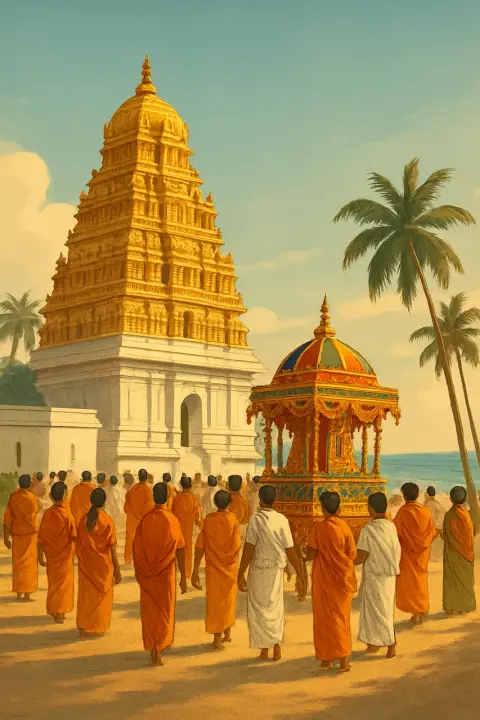
Ayya Vaikunda Avataram at Swamithope
Processions in white converge on a shrine where a mirror stands in for an idol
Ayya Vaikunda Avataram, also called Vaikunda Jayanthi, is the main festival of Ayyavazhi, a faith founded in the 19th century in the far south of Tamil Nadu. It marks the 20th day of the Tamil month of Masi, when followers believe Narayana incarnated as Vaikundar in 1833. On that day processions from Tiruchendur, Thiruvananthapuram and Nagercoil converge on Swamithope Pathi, the faith's main centre near Kanyakumari. Next date: 4 March 2027 (expected).
The date follows the Tamil solar calendar; the Kanyakumari and Thoothukudi collectors declare local holidays about two weeks ahead.
The legend

Followers of Ayyavazhi believe that on 20 Masi 1833 (1 March) Narayana incarnated as Vaikundar, rising from the sea at Tiruchendur.
His life and teaching are set out in the Akilathirattu Ammanai, a scripture Ayyavazhi ranks with the Vedas; Vaikundar taught equality.
Swamithope Pathi is the faith's main centre. Its inner shrine holds no idol: just two oil lamps and a large mirror.
Customs
The Masi procession
On 19 Masi processions leave Tiruchendur and Thiruvananthapuram and meet at Nagercoil; at dawn on the 20th all walk on to Swamithope.
Anna Dharmam
The night before, Tiruchendur hosts talks and cultural programmes until dawn, and pilgrims are fed a free meal, the Anna Dharmam.
What the festival celebrates
Ayyavazhi holds that on 20 Masi of the Kollam year 1008 (1 March 1833) Vishnu, as Narayana, incarnated as Vaikundar, rising from the sea at Tiruchendur. His life and teaching are set down in the Akilathirattu Ammanai, the faith's scripture, Followers count the festival as the anniversary of that incarnation, which is why the local press and the district notices call it Ayya Vaikundar's birthday.
Swamithope Pathi is the first of the five pathis, the faith's principal centres, and the place of Vaikundar's tavam (penance). This is the largest festival held at Swamithope Pathi.
How the procession runs
The programme follows the Tamil calendar, so the eve and the main day are counted as 19 and 20 Masi.
- 18 Masi, night: Tiruchendur
Talks, cultural programmes and Anna Dharmam, free meals for pilgrims, at Tiruchendur through the night.
- 19 Masi: two processions
Followers bathe in the sea at Tiruchendur and walk out in procession; a second procession leaves East Fort in Thiruvananthapuram and follows the highway south. Both meet at Athalavilai near Nagercoil in the evening, where the Vaikunda Jyothi, a sacred flame, is lit on the Vaikunda Malai hillock; the procession goes on to Nagercoil for a religious conference, and many followers stay the night there.
- 20 Masi: the great Masi procession
From early morning the combined procession walks from Nagercoil to Swamithope, reaching it around noon. The palm-leaf Akilathirattu is carried on a decorated vahana, with saffron flags, elephants and horses; the procession goes round the four car streets and the flags are handed over at the pathi.
What you see along the route
Lakhs of followers walk in the Masi procession, with thousands of vehicles behind. Along the way the procession is greeted by other communities: Christians at Kottar, Muslims at Edalakudi and Hindus at Suchindram come out with garlands. Dharmagharttas, the faith's officiants, mark participants' foreheads with the namam.
At Swamithope the inner shrine, the palliyarai, holds no idol: two oil lamps and a large mirror, with a cane and wooden sandals said to be Vaikundar's on a pedestal. Kodiyettru festivals of eleven days, ending with a car procession, are held here three times a year in Vaikasi, Aavani and Thai, separately from this day.
Getting to Swamithope
Swamithope lies south-east of Nagercoil, roughly halfway between Nagercoil and Kanyakumari on the Eathancaud-Manakkudi road. Nagercoil railway station is about 12 km away, and town buses run from Nagercoil and Kanyakumari. On the festival day the roads into Swamithope carry the procession and its vehicles, so allow for slow traffic.
The day is a local holiday in Kanyakumari district (since 1993) and in Tirunelveli and Thoothukudi districts, and a restricted holiday in Tamil Nadu and Kerala. The Kanyakumari collector announces the local holiday in advance.
Visiting as an outsider
This is a working religious day for a living community, not a show. Watch from the roadside, ask before photographing people, and respect local dress codes and customs at the pathi, as the UK Foreign Office advises for all religious sites. Large crowds gather at Swamithope around noon.
FAQ
When is Ayya Vaikunda Avataram?
On 20 Masi in the Tamil calendar, usually 3 or 4 March. Next: 4 March 2027 (expected).
Who was Ayya Vaikundar?
In Ayyavazhi belief, the incarnation of Narayana who rose from the sea at Tiruchendur in 1833; his life and teaching are told in the Akilathirattu Ammanai.
Where is Swamithope?
In Kanyakumari district, Tamil Nadu, between Nagercoil and Kanyakumari; Nagercoil railway station is about 12 km away.
Why is there a mirror instead of an idol?
The inner shrine at Swamithope holds two oil lamps and a large mirror, not an image of a deity; this is how the pathi is kept in Ayyavazhi tradition.
Is it a holiday?
Yes, a local holiday in Kanyakumari, Tirunelveli and Thoothukudi districts and a restricted holiday in Tamil Nadu and Kerala.
Sources (4)
Facts checked: 22 October 2026. Prices and hours are approximate; check locally.