 India GO
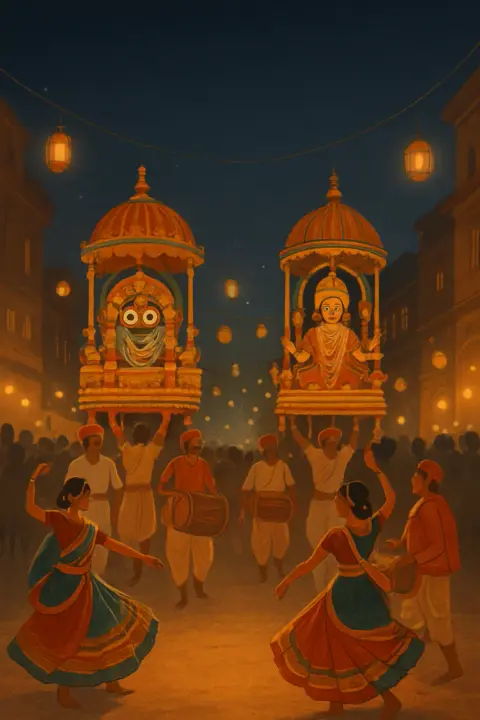
Sital Sasthi in Sambalpur: the town marries Shiva and Parvati
Shiva weds in the old town, and a whole night of drums walks the couple home
Sital Sasthi is Sambalpur's festival of the wedding of Shiva and Parvati, held around Shashthi, the sixth lunar day of the bright half of Jyeshtha, at the end of the summer heat, usually between late May and late June. A local family takes the role of the bride's parents, the wedding is solemnised at night with Vedic rites, and the couple is then carried home in a procession of folk troupes and lit floats that runs through the night into the next evening. Next: 8–10 June 2027 (expected).
The Sital Sasthi committees of Sambalpur and the district administration announce the dates of the rites and the procession a few weeks ahead, from the Odia almanac.
The legend

Sital Sasthi celebrates the wedding of Shiva and Parvati. It falls at the end of summer, on Shashthi of Jyeshtha, and asks the gods for rain after the heat.

In the Shiva Purana Shiva tested his bride: disguised as a short Brahmin, he asked why she wanted an old hermit. Parvati said she loved his wisdom.

Tradition dates it to about 400 years ago, when the raja of Sambalpur invited Vedic Brahmins from Puri; the Nandapada quarter held it first.
Customs
The invitation
It all begins with Patrapendi, the rite of the wedding invitation, just as in an ordinary Sambalpuri family.
Parents of the gods
Local families become the bride's and the groom's parents, and the wedding follows every custom; at night it is solemnised with Vedic rites.
The homecoming
After the wedding the couple are taken through town in a night procession of folk troupes, lit floats and drums that runs into the next evening.
Where to celebrate
Sambalpur
Sambalpur marries Shiva to Parvati as a real town wedding, with local families as the in-laws, then carries the couple home in an all-night street procession of folk troupes.
How the wedding runs
Sital Sasthi follows the order of a Sambalpuri family wedding, only the groom is a god. It opens with Patrapendi, a rite held a few days before the wedding night, and goes through the steps an ordinary marriage would: invitations, preparations, the arrival of the groom's party.
On the wedding night Shiva sets out from his temple as the groom, with other deities in his party and Nrusingha (Narasimha) leading the baraat, the wedding procession. The family chosen to be Parvati's parents receives it at their home or a hall the committee has prepared, performs kanyadana (the giving away of the bride), and priests solemnise the marriage with Vedic rites. No family plays Shiva's parents, because he is held to be swayambhu, self-born. For the family on the bride's side the role is real: it takes on the obligations that go with it, year after year.
The next night the newlyweds start for home. This homecoming is the part most people come to see: the couple in a decorated palanquin, followed by drummers, dancers, lit floats and folk troupes, moving slowly through the old town until the following evening, when the deities re-enter the temple.
Three quarters, three weddings
Sambalpur holds more than one wedding. Each of the three big committees runs its own rites and its own procession, and a joint coordination committee handles the overall arrangements. Watching is free, from the streets along the routes.
Nandapada
The oldest and largest committee, based at the Balunkeswar temple. The Utkal Brahmin families of this quarter began the festival, and Shiva sets out from here as the groom.
Jhaduapada
The second historic procession, started by the Aranyaka (Jhadua) Brahmins, who follow the Vaishnava tradition and founded the Loknath temple here.
Modipada
The third procession, added by the residents of Modipada in 1972 and now one of the three big committees.
The procession route
The old-town streets from Nandapada towards Municipality Chowk are where the wedding party passes. Recent festivals have announced more than 7,500 artistes from Odisha and other states, with western Odisha forms such as Dulduli, Samprada and Ghanta.
Why Sambalpur, and why in summer
The festival is about 400 years old. King Ajit Singh of the Chauhan dynasty of Sambalpur, a devout Vaishnava who spent long periods in Puri, wanted to make Sambalpur a religious centre in the Vedic tradition and invited Utkal Srotriya Vedic Brahmin families from the sasana (Brahmin) villages of Puri. They settled in Nandapada and brought with them their own festival of Shiva's wedding, which the king patronised.
The timing carries the other meaning: the festival falls at the end of summer to ask the gods for rain after the heat. The wedding story itself is told from the Shiva Purana. Sital Sasthi has since spread to other towns of western Odisha, including Bargarh, Padampur, Barpali and Jharsuguda. The Sambalpur district administration describes lakhs of people gathering for it, including pilgrims from Madhya Pradesh and Bihar.
Planning the trip
The committees and the district administration announce the days of the rites and the procession a few weeks ahead, from the Odia almanac. Wait for that before booking.
- Book about a month ahead
Sambalpur has a fair number of hotels, but they fill for the wedding and procession nights. A month is also enough for trains to Sambalpur or flights to Jharsuguda, about 60 km away.
- Arrive on the wedding day
Come on the day of the wedding night and stay for the homecoming procession. One night is the minimum; two let you see both the wedding and the procession.
- Check the venues
The wedding hall of each committee and the exact route can change from year to year; the committees publish them with the dates.
Etiquette in the crowd
For Sambalpur this is a religious wedding first and a carnival second.
- Give the palanquin room — Make way for the deities and the priests, and ask before photographing a family's rites at close range.
- Crowd basics — Agree a meeting point away from the route and keep valuables in a front pocket. The UK Foreign Office advises care with possessions in crowds; see also is India safe.
FAQ
When is Sital Sasthi?
Next: 8–10 June 2027 (expected). It falls around Shashthi of the bright half of Jyeshtha, usually between late May and late June; the Sambalpur committees confirm the days a few weeks ahead.
What is Sital Sasthi puja?
It is the celebration of the wedding of Shiva and Parvati, performed like a human wedding with a local family as the bride's parents. It also asks the gods for rain at the end of summer.
Where is Sital Sasthi celebrated?
It began in Sambalpur, Odisha, about 400 years ago, and Sambalpur is where it is best known. It is also held in other western Odisha towns such as Bargarh and Jharsuguda.
Who plays the parents in Sital Sasthi?
A chosen local family takes the role of Parvati's parents and gives her away. Nobody plays Shiva's parents, because he is held to be self-born.
Is it free to watch the Sital Sasthi procession?
Yes. The processions pass through the streets of the old town and anyone can watch from the roadside.
Sources (4)
Facts checked: 21 October 2026. Prices and hours are approximate; check locally.