 India GO
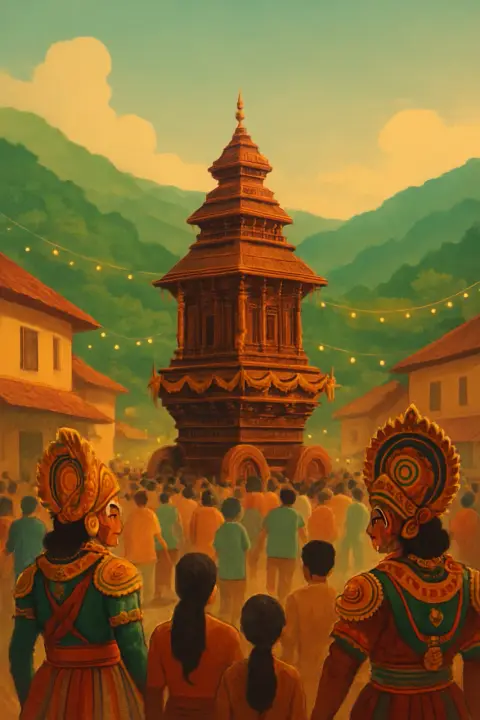
Sirsi Marikamba Jatre: the goddess's fair, held every second year
The goddess leaves her temple and a whole hill town follows her
The Sirsi Marikamba Jatre is a fair of nine days held every second year around the Marikamba temple in Sirsi, a Malnad town in the hills of Uttara Kannada, Karnataka. Next: 7–15 March 2028 (expected). It usually begins on the Tuesday before the Phalguna full moon, in late February or March, and the temple fixes the dates at a meeting in mid-January of the jatre year. The chariot day, when the goddess leaves the temple and the town follows her, is the heart of it.
The temple fixes the dates at a meeting in mid-January of the jatre year.
The legend

The Marikamba temple at Sirsi was built in 1688. The goddess is revered as the "elder sister" of all the Durgas of Karnataka.
Tradition says the seven-foot image of eight-armed Durga riding a tiger was recovered from a pond on the road to Hangal.
Customs
The goddess's chariot
Every second year the goddess leaves the temple on a chariot and the whole town follows; the chariot day is the heart of the jatre.
Yakshagana and trade
For nine days Yakshagana plays and a busy fair fill the ground around the temple.
The temple and its goddess
Marikamba is worshipped in Sirsi as a fierce form of Durga, and she is revered as the "elder sister" of all the Durgas of Karnataka; locals also call the temple Marigudi. The image in the sanctum is about seven feet tall: an eight-armed goddess riding a tiger and killing a demon. Tradition says it was found in a pond. According to the temple's own history, the goddess was installed as the village deity in the late 17th century with the permission of the ruler of Sonda, when Sirsi was still a small village; the main hall, sanctum, tower and gateway were built between 1850 and 1875. The walls carry murals in Kaavi, a red-and-white plaster technique once common on the Konkan coast.
Since 1955 the temple has been run by a board of five trustees. Buffalo sacrifice was once part of the jatre; a reform movement in Sirsi ended it after Mahatma Gandhi's visit in 1934.
How the jatre runs
The days follow the goddess's story. In the account given by Wikipedia, the first day marks the marriage of the goddess, as Parvati, to Shiva; from the second day, when she slays the demon Mahishasura as Durga, the remaining days are the Vijayotsava, the victory festival. On the chariot day (rathotsava) the goddess is drawn out of the temple to the Bidkibail ground, and crowds fill the route. On the last day she goes out towards the edge of the town in her fierce form as Kali.
Around the rituals the jatre is a fair: for nine days Yakshagana, the night-long dance-drama of coastal Karnataka, is staged near the temple, and stalls and trade fill the ground. It is one of the largest fairs in the Western Ghats interior, and the town is at its fullest on the chariot day.
Getting to Sirsi
Sirsi has no railway station of its own. It sits at about 611 m in the Western Ghats interior, and most visitors come by road.
- Nearest stations
Talaguppa (about 54 km), Kumta on the Konkan coast (about 62 km) and Haveri (about 76 km); Hubballi is the main railhead for the region.
- Nearest airports
Hubballi is the nearest airport; Belagavi is further, and Goa (Dabolim) is the nearest international airport.
- Where to stay
Book a room in Sirsi once the temple announces the dates in mid-January; the chariot day is the busiest.
Etiquette at the temple
- Footwear — The temple asks visitors to leave their footwear at the stand to the right of its administrative office, not anywhere outside the entrance.
- Chariot day — The chariot is drawn through dense crowds. Watch from the roadside, keep clear of the ropes and wheels, and follow the police and volunteers.
- Photos — Ask before photographing people at worship; inside the sanctum, follow the temple's rules.
What to combine it with
Sirsi is usually a town people drive through on the way to Jog Falls. If a Western Ghats route passes this way during the jatre, it is worth the stop, and the coast at Gokarna is within reach via Kumta. The jatre also falls in the Yakshagana season, when touring troupes play across coastal Karnataka.
FAQ
When is the Sirsi Marikamba Jatre?
Next: 7–15 March 2028 (expected). It is held every second year for nine days, usually from the Tuesday before the Phalguna full moon; the temple confirms the dates in mid-January.
How often is the Marikamba Jatre held?
Every two years. There is no jatre in the years between.
Where is the Sirsi Marikamba Jatre held?
At and around the Marikamba temple in Sirsi, Uttara Kannada district, Karnataka; on the chariot day the procession goes to the Bidkibail ground.
What is special about the Marikamba temple in Sirsi?
Its goddess is revered as the elder sister of all the Durgas of Karnataka. The seven-foot image of the eight-armed goddess on a tiger was, by tradition, found in a pond, and the walls carry rare Kaavi murals.
Sources (4)
Facts checked: 21 October 2026. Prices and hours are approximate; check locally.