 India GO
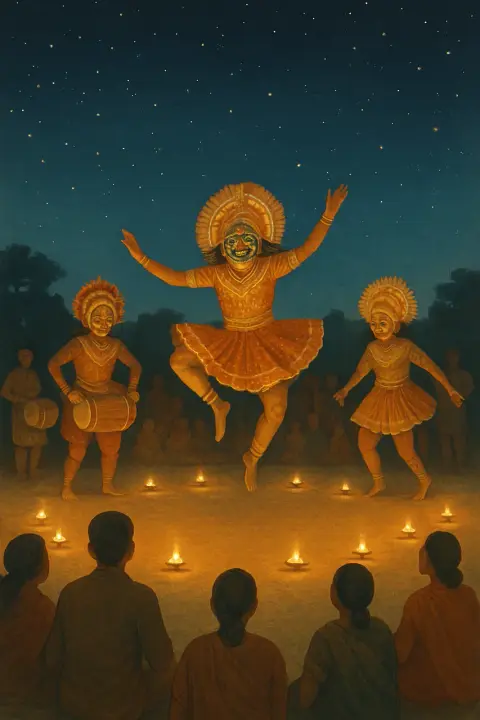
Chaitra Parva: the spring festival of Seraikela Chhau
Painted masks and warrior leaps in the open on an April night
Chaitra Parva is the spring festival of Seraikela in Jharkhand, held in honour of Shiva and Shakti in April and ending on Chaitra Sankranti, the last day of the solar month of Chaitra. It is the main season of Seraikela Chhau, the masked dance that UNESCO inscribed in 2010. Dates: 11–14 April 2027 (expected), with the state Chhau festival on the evenings just before Sankranti in recent years.
The Seraikela-Kharsawan district administration and the Jharkhand culture department set the programme; the local press reports it one to two weeks before.
The legend
In the myth Shiva lay in yogic sleep until Shakti woke him. He began to dance, and from the dance the universe and time came into being.
The word chhau may come from the Sanskrit chhaya, shadow or image. The Seraikela dancer wears a mask as the shadow of the dancing god.
At the end of Chaitra Parva a ritual pot is buried beside Shiva's linga and taken out a year later: a sign the world has lived another year.
Customs
Chhau at night
Chhau is danced at night in the open: mock combat, the gaits of birds and animals, and movements drawn from village housework.
The pot procession
By day ritual processions cross the town, a sacred pot carried at their centre, on a route that leads to the palace of Seraikela's rulers.
The stadium festival
The state holds three Chhau evenings at Birsa Munda Stadium, where winners of the village contests dance in the Seraikela, Kharsawan and Manbhum styles.
Where to celebrate
Seraikela
Seraikela's masked Chhau has two April settings: three free evenings of the state festival at Birsa Munda Stadium, and the village nights of Chaitra Parva around Chaitra Sankranti.
What Seraikela Chhau is
Chhau is a dance tradition of eastern India with three styles, named after Seraikela in Jharkhand, Purulia in West Bengal and Mayurbhanj in Odisha. Seraikela and Purulia dance in masks, Mayurbhanj does not. UNESCO describes it as performed at night in an open space, to reed pipes (mohuri and shehnai) over a heavy ensemble of drums, with movements drawn from mock combat, the gaits of birds and animals and village housework. The themes come from the Mahabharata and Ramayana, local folklore and abstract ideas.
In Seraikela the dance grew up at the court. The town on the Kharkai river was the seat of the Singh Deo rulers, and the Jharkhand culture department notes that princes and peasants danced together and that masks were made by skilled craftsmen, sometimes by princes themselves. UNESCO notes that Chhau is taught to male dancers, and the culture department writes that the Seraikela dancers of the spring festival are all men. A government Chhau dance centre was set up in Seraikela in 1960. The Seraikela mask is said to be the shadow of the dancing god, which links the dance to the festival's story of Shiva woken by Shakti.
How the festival unfolds
Chaitra Parva began as a religious festival and became an arts festival without losing its ritual core. Its four days are said to stand for the four ages of the world, from Satya to Kali Yuga, and the dances move from creation through episodes of the epics to present-day themes. A dance is not repeated within the festival. In the old form the competitions were judged by the Maharaja of Seraikela as sabhapati, who gave the winning party a flag as the year's trophy.
Today there are two settings. The state Chaitra Parva and Chhau festival fills three evenings at Birsa Munda Stadium in Seraikela, with the winners of the rural contests in the Seraikela, Kharsawan and Manbhum styles and guest artists; it is free and open to all. In Seraikela and the villages around it, Chaitra Parva is still kept as a community observance, with pot processions by day and Chhau danced at night in the open around Sankranti.
Planning a visit
- Watch for the programme — The Seraikela-Kharsawan district administration and the Jharkhand culture department set the dates; the local press reports the programme only one to two weeks ahead, so keep your days flexible.
- Base yourself in Jamshedpur — Seraikela has very little accommodation. Jamshedpur, about 40 km away, has more, and its railway station is Tatanagar.
- In the villages, be a guest — Village performances are community events: watch from the edge of the ground and ask before photographing dancers or rituals.
- Compare the styles — Chhau is also danced in spring at Kharsawan nearby, in Purulia (West Bengal) and at Baripada in Mayurbhanj (Odisha), where it is unmasked.
FAQ
When is Chaitra Parva?
Next: 11–14 April 2027 (expected). It ends on Chaitra Sankranti (13 or 14 April), and the state Chhau festival has recently been held on the three evenings before it.
Chaitra Parva is celebrated in which state?
In Seraikela, Jharkhand, where it is the festival of Seraikela Chhau. The spring Chhau season is also kept in Purulia (West Bengal) and Mayurbhanj (Odisha).
Which dance is performed at Chaitra Parva?
Chhau, a masked dance in the Seraikela style, inscribed by UNESCO as intangible cultural heritage in 2010.
Is the Chhau festival free to watch?
Yes, the state festival evenings at Birsa Munda Stadium are free and open to everyone.
What does chhau mean?
The word may come from the Sanskrit chhaya, shadow or image; the Seraikela dancer's mask is the shadow of the dancing god.
Sources (6)
Facts checked: 22 October 2026. Prices and hours are approximate; check locally.