 India GO
Rath Yatra of Puri: the month around the chariot day
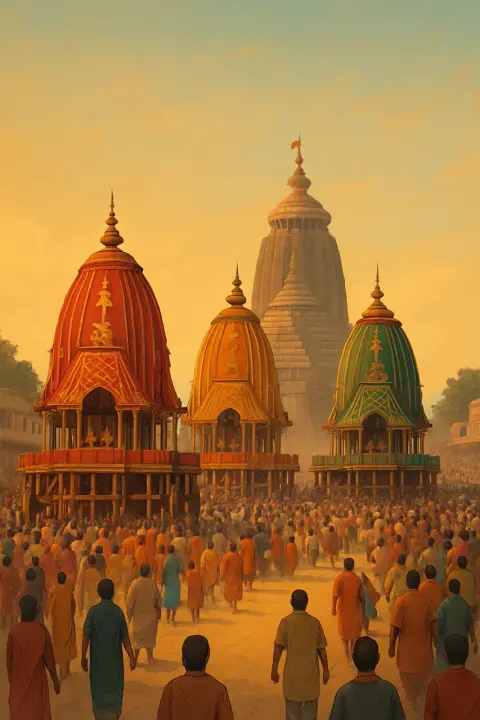
Three towering chariots hauled down the grand road by thousands of hands
Puri’s Rath Yatra is the day Jagannath, Balabhadra and Subhadra leave their temple and ride three new wooden chariots about 3 km down the Bada Danda to the Gundicha temple. The chariot day is 5 July 2027, and the whole cycle, from the public bath to the deities’ return, runs 18 June – 16 July 2027. The temple itself admits only Hindus; on the street, during these days, everyone can see the deities.
The Shree Jagannatha Temple Administration publishes its festive calendar for each Odia year around April, and the Odisha holiday list, out in November or December of the previous year, carries Rath Yatra.
The legend
Legend says Queen Gundicha, wife of King Indradyumna, secretly glimpsed the image of Jagannath being made and was struck by it.

She urged her husband to build the god a temple and to start the chariot procession, the first Rath Yatra.

In another telling, Jagannath promised to visit her. Her house is today's Gundicha temple, the god's garden house 3 km from the main temple.
Every year the promise is kept: the chariots carry Jagannath, Balabhadra and Subhadra down the Bada Danda, and the gods stay a week with Gundicha.
Meaning
Gaudiya Vaishnavas
Chaitanya Mahaprabhu spent his last years in Puri and began the custom of washing the Gundicha temple with pitchers of water before Rath Yatra.
Daitapatis
For the descendants of the hunter chief Biswabasu and the priest Vidyapati it is a birthright: they alone, almost, serve the gods through their 'illness' and Rath Yatra.
Customs
The chariot's retinue
Each chariot carries nine painted wooden deities around its sides, with a carved charioteer and four wooden horses in front.
A halt for Salabega
On the Bada Danda, Jagannath's chariot pauses by the memorial of Salabega, a 17th-century poet born a Muslim who spent his life singing of Jagannath.
Dakshina Moda
On the sixth day the chariots are turned south to face the main temple. Legend says Vibhishana saw Jagannath from far-off Lanka that day.
Gita Govinda
For the last three days at Gundicha, verses of the Gita Govinda are sung: Vaishnavas hold that the temple becomes Vrindavan for that time.
What people eat
Poda pitha
a baked cake offered at the Mausi Maa shrine on the way back
Rasagola
cheese balls in syrup, Jagannath's peace offering to Lakshmi
Words of the festival
ପହଣ୍ଡି
pahandi
the rhythmic procession carrying the swaying images from temple to chariot
ବାହୁଡ଼ା ଯାତ୍ରା
Bahuda Jatra
the chariots' return journey from Gundicha to the main temple
ଅଧର ପଣା
adhara pana
a sweet drink in pots as tall as the gods' lips, broken after the offering
ନୀଳାଦ୍ରି ବିଜେ
Niladri Bije
the gods' return into the temple, the last rite of Rath Yatra
How to greet
ଜୟ ଜଗନ୍ନାଥ
Jai Jagannath!
"Glory to Jagannath": Odisha's hello and good wish, heard most of all during Rath Yatra.
True or myth
✅ True. The gods stay there only for the nine days of Rath Yatra; the rest of the year the temple is empty.
❌ Myth. The logs are floated as rafts down the Mahanadi from the former princely state of Dasapalla, in Odisha itself.
✅ True. Tradition says King Kapilendra Deva, back victorious from war in 1460, gave gold to Jagannath.
Where to celebrate
Puri
Worth the trip
The day the Jagannath deities leave their Hindus-only temple: three chariots, built new each year, are hauled by hand down Puri's 3 km Bada Danda in full view of the street.
The cycle day by day
The rites follow lunar days. The Shree Jagannatha Temple Administration (SJTA) publishes the exact days in its festive calendar in spring; until then, plan around the chariot day.
- Full moon of Jyeshtha: Snana Yatra
The deities are bathed on the Snana Bedi, the platform on the temple’s east side, in view of the Bada Danda. It opens the cycle.
- About two weeks: Anasara
By tradition the deities fall ill after the bath. The temple states that darshan is not possible for 15 days, so a visit to Puri in this window will not include seeing them.
- 5 July 2027: Rath Yatra
After the morning rites the deities are carried to the chariots in the swaying Pahandi, usually from mid-morning. The Gajapati king of Puri then sweeps the chariot decks with a golden broom (Chhera Pahanra), and the pulling begins, usually in the late afternoon. In some years the chariots stop at nightfall and reach Gundicha the next day.
- At Gundicha: Hera Panchami and Sandhya Darshan
The deities stay at the Gundicha temple for about a week; Hera Panchami is played out here, and on the day before the return comes Sandhya Darshan, the evening viewing of the deities.
- Tenth lunar day: Bahuda Yatra
The return journey. The chariots halt at the Mausi Maa temple on the Bada Danda for an offering of poda pitha, then stand in front of the Lion’s Gate.
- The next days: Suna Besha, Adhara Pana, Niladri Bije
On the eleventh day the deities are dressed in gold on the chariots outside the Lion’s Gate, the second peak of the festival. On the twelfth comes Adhara Pana, a sweet drink offered on the chariots, and on the thirteenth Niladri Bije, the procession back inside the temple.
Temple rules and what the street offers
The Shree Jagannatha Temple Administration states plainly that only Hindus are allowed inside the temple, and the rule holds during the festival too. For everyone else the festival is the chance: the bath on the Snana Bedi, the chariot day and Suna Besha all happen in full view of the Bada Danda.
Those who do enter the temple leave shoes, leather items, cameras and mobile phones outside; the administration runs free shoe and phone stands near the Lion’s Gate barricade. More about the deity: Jagannath.
Where to watch
Watching is free, from behind the police barricades along the Bada Danda; a rooftop or balcony arranged in advance keeps you above the press.
Singhadwara (Lion’s Gate)
The temple’s east gate: the Pahandi, the Chhera Pahanra and Suna Besha.
Bada Danda (Grand Road)
About 3 km from the temple to Gundicha, closed to traffic for the procession. Come on foot through the side lanes.
Snana Bedi
The bathing platform, seen from the Bada Danda on Snana Yatra.
Gundicha temple
The chariots’ destination, where the deities spend the week and Hera Panchami takes place.
Mausi Maa temple
On the Bada Danda, where the chariots halt on the way back.
Crowds: practical advice
Press reports put the crowd on a recent chariot day at about 8–9 lakh (800,000–900,000) people. The advice below is from the UK Foreign Office and, as reported in the press, from the temple administration and Odisha Police.
- Follow the routes — According to press reports, the SJTA chief administrator has asked pilgrims to follow the guidelines, keep to the designated routes and cooperate with police and volunteers.
- Elderly people and babies — As reported in the press, before a recent festival Odisha’s police chief advised elderly and unwell people not to come to Puri and asked devotees not to bring children under two.
- Large gatherings — The FCDO notes that stampedes have occurred at events with large crowds in India, including religious gatherings. Agree a meeting point in case you are separated.
- Phones and wallets — The FCDO advises taking care of your possessions in crowds and keeping a copy of your passport separately from the original.
- Heat and rain — June and July in Odisha are hot and humid, often with monsoon showers: water, a hat and sunscreen. Emergency number: 112 (emergency numbers).
Booking and arriving
Plan three or four nights: the pull can run into the next day.
- About four months ahead: rooms
Sea-facing hotels and the guesthouses near the Bada Danda go first, and rates climb steeply for the festival week. Bhubaneswar is the fallback base.
- 60 days ahead: trains
Ticket sales open 60 days before travel and regular trains to Puri fill in the first days. In past years Indian Railways has added special trains for the festival, mostly within Odisha and from neighbouring states, according to press reports; flights into Bhubaneswar get expensive.
- Two days before: be in Puri
The town closes to vehicles around the route and fills completely; coming in from Bhubaneswar on the day is hard, because roads near the route close.
FAQ
When is Rath Yatra in Puri?
The chariot day is 5 July 2027, the second lunar day of the bright half of Ashadha. The whole cycle, from Snana Yatra to Niladri Bije, runs 18 June – 16 July 2027.
Can non-Hindus attend Rath Yatra in Puri?
Yes, the procession is on the public street and anyone can watch it. The temple itself admits only Hindus, according to the temple administration.
Why can’t you see Jagannath before Rath Yatra?
After the Snana Yatra bath the deities are held to be ill and rest out of view; the temple states darshan is not possible for 15 days.
How far is the Gundicha temple from the Jagannath temple?
About 3 km along the Bada Danda. The deities stay there about a week before the return, the Bahuda Yatra.
What happens every 12 years in Puri?
The Nabakalebara, when new wooden images of the deities are carved. The temple administration gives the interval as 8, 11, 12 or 19 years, depending on the lunar calendar.
Is Rath Yatra in Puri suitable for children?
According to press reports, Odisha’s police chief has asked devotees not to bring children under two and advised elderly and unwell people to avoid Puri during the festival because of the crowds.
Sources (11)
- FAQs (Shree Jagannatha Temple Administration)
- Ratha Yatra (SJTA)
- Calendar of festive occasions (SJTA)
- Nabakalebara (SJTA)
- India: safety and security (FCDO)
- Chariot pulling resumes on the Bada Danda (Pragativadi)
- Darsan facilities (SJTA)
- SJTA chief administrator urges devotees to follow guidelines (PTI via LatestLY)
- Odisha DGP urges caution for elderly and children during Rath Yatra (IANS via NewKerala)
- Puri Rath Yatra draws 9 lakh devotees (Pragativadi)
- ECoR to operate special trains for Rath Yatra (Prameya News)
Facts checked: 21 October 2026. Prices and hours are approximate; check locally.