 India GO
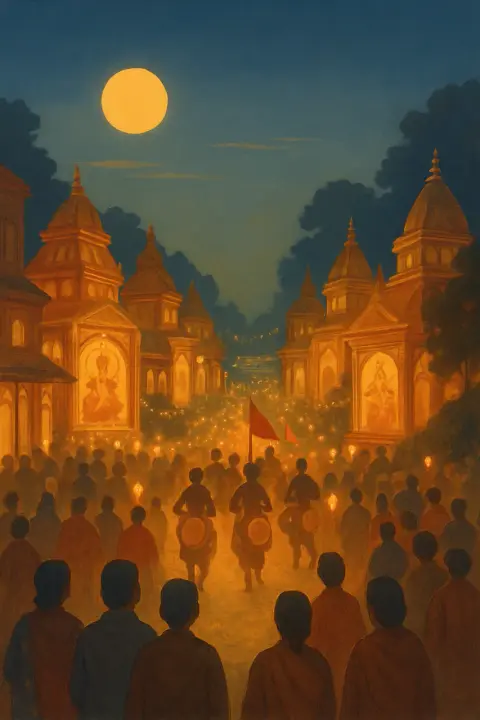
Rash Yatra in Nabadwip and Shantipur: goddesses on the full moon
Giant clay goddesses carried through the night to the river under a full moon
Nabadwip is famous as the birthplace of Chaitanya and a heart of Bengali Vaishnavism, yet its biggest festival belongs largely to the goddess. On Rash Purnima, the full moon of Kartik, neighbourhood committees across town unveil giant clay images of Kali, Durga, Jagaddhatri and other goddesses, and the next day carry them through the streets to the Bhagirathi in a procession that runs late into the night. Nearby Shantipur keeps a Vaishnava Rash of Radha and Krishna. Dates: 23–25 November 2026.
The Nabadwip municipality and the puja committees publish the schedule in the fortnight before; the Nadia district police announce the Bhanga Rash route.
The legend
In the Bhagavata Purana Krishna plays his flute in Braj, and the gopis, the cowherd girls, leave their homes to join him.
Krishna dances the rasa lila with every one of them at once, taking many forms. It is called the dance of divine love.
In Nabadwip, Chaitanya's birthplace, the Rash Yatra began in his own time as a Vaishnava festival.
Shaktas prayed that night before painted scrolls, or pot, hence Pot Purnima. Potters who settled here under Raja Krishnachandra brought in clay.
So the Shakta Rash was born: on the Kartik full moon giant clay goddesses rise across Nabadwip, and the next day they are shown to the whole town.
Meaning
Nabadwip
Here the Rash is Shakta: Kali, Durga, Jagaddhatri and Annapurna are installed, and several old Kali pujas moved here from the new moon to the full moon.
Shantipur
Across the river the Rash is Vaishnava: Radha and Krishna from the houses of the Goswamis, Advaita Acharya's descendants, go through town to drums and kirtan.
Customs
Light giants
Nabadwip's potters make huge yet balanced, light images: in the 19th century five or six people could carry a goddess on their shoulders and even dance with her.
Judging at Poramatala
The morning after the puja, committees brought their images to Poramatala, and the Maharaja of Nadia rewarded the finest image and its adornment.
Rai-Raja
In Shantipur a girl in silk and gold, the Rai-Raja, is carried through town on a throne and honoured as Radha; the custom is about 250 years old.
Candlelight thrones
Shantipur's procession thrones are still lit by old Belgian glass candleholders and chandeliers rather than electric light.
Words of the festival
শাক্তরাস
Shakta Rash
the Rash of the goddesses, Nabadwip's name for its full-moon festival
রাসযাত্রা
Rash Yatra
the festival of Krishna's rasa lila on the Kartik full moon
সাজ
saj
an image's adornment, its dress and ornaments, once judged for a prize
পোড়ামাতলা
Poramatala
the square by the shrine of Pora Ma, one of Nabadwip's chief goddesses
True or myth
✅ True. That is why Shaktas called the Rash full moon Pot Purnima, from pot, a scroll; clay came with the potters under Raja Krishnachandra.
❌ Myth. Nabadwip's Rash is Shakta, with images of Kali, Durga and other goddesses, while the Vaishnava Rash lives on in Shantipur.
✅ True. Chaitanya was born in Nabadwip in 1486; his birth name was Vishvambhara Mishra.
Where to celebrate
Nabadwip
On the Kartik full moon Nabadwip worships giant clay goddesses in its neighbourhood mandaps, then carries them through the town to the Bhagirathi in a procession that runs into the night.
How a Krishna festival became the goddess's
Rash Yatra celebrates Krishna's rasa lila, his dance with the gopis on the autumn full moon, and in Nabadwip it began as a Vaishnava festival in Chaitanya's own time. What the town celebrates now is the Shakta Rash, the Rash of the goddess (Shakti, divine feminine power).
The change has a history. Kali worship spread in Bengal after the Nabadwip Tantric scholar Krishnananda Agamavagisha composed the Brihat Tantrasara in the 17th century, and grew under the patronage of Maharaja Krishnachandra of Nadia in the 18th, who founded several Kali pujas in the town. These were first held on the new-moon night of Kali Puja; with the Shakta Rash many of them moved to the Kartik full moon. At first the goddess was worshipped before pot, painted scrolls, which is why Shaktas called the night Pot Purnima. Clay images came with the potters who settled here under royal patronage.
A police officer of the 1850s, Girish Chandra Basu, left one of the earliest descriptions: images of Durga, Kali, Jagaddhatri and Annapurna, so light that five or six people could carry one on their shoulders and even dance with it. Nabadwip's potters are still known for that balance of size and lightness. In the old days the committees brought their images to Poramatala the morning after the puja, and the Maharaja of Nadia gave a prize for the finest image and its saj (adornment).
Over the three days
Everything is in the street and free to see.
Full-moon night: the mandaps
Each neighbourhood committee shows its image in its own mandap (pavilion); the oldest pujas go back to the Nadia kings in the 18th century. The streets stay crowded until late as people walk from one to the next.
The next day: the procession to the river
In the afternoon the images leave their mandaps and move through the town to the drums, down to the Bhagirathi, where they are immersed. By custom the processions stop to worship at the Pora Ma temple, under an old banyan in the centre of town. The crowd stays out late into the night.
Shantipur
A separate three-day Rash, Vaishnava in character, though the district notes that Kali is worshipped there too. Radha and Krishna images from the houses of the Goswamis, descendants of Advaita Acharya, go through the town to drums and kirtan (devotional singing), with its own procession on the third day.
Getting there and where to stay
Nabadwip is a simple trip from Kolkata. The only real constraint is beds.
- By local train from Kolkata
Suburban trains run from Howrah via Bandel to Nabadwip Dham. They are unreserved, so tickets are bought on the day. Only the journey to Kolkata itself needs booking; a month ahead is enough in November.
- Stay in Mayapur or Krishnanagar
Nabadwip itself has few rooms. Mayapur, across the river, has guesthouses and is about ten minutes away by public boat; Krishnanagar is the other base. Book about a month ahead.
- Be there for the full moon and the day after
The mandaps are on the full-moon night and the procession the next afternoon and night. The schedule comes out about a fortnight before from the Nabadwip municipality and the puja committees, and the Nadia district police announce the procession route.
Etiquette and safety
The images are worshipped, not exhibited. A few habits help.
- At the mandaps — Follow what people around you do at each mandap, and dress modestly: UK travel advice asks visitors to respect local dress codes at religious sites.
- Plan to walk — During the procession the streets are blocked for hours, so plan to walk.
- Crowds at the ghats — UK travel advice notes that stampedes have happened at large religious gatherings in India and asks visitors to follow the advice of the local authorities.
FAQ
When is Rash Yatra in Nabadwip?
Next: 23–25 November 2026. The main night is Rash Purnima, the full moon of Kartik, usually in November, and the procession to the river follows the next day.
Why is Rash Purnima celebrated?
It marks Krishna's rasa lila, his dance with the gopis on the autumn full moon. In Nabadwip the night has also become the Shakta Rash, when goddesses such as Kali and Durga are worshipped.
What is Rash Utsav in Nabadwip?
Another name for the Shakta Rash: a festival of large clay images of the goddess, shown in neighbourhood mandaps on the Kartik full moon and immersed in the Bhagirathi the next day.
Is Rash in Nabadwip Vaishnava or Shakta?
Both, in different places. Nabadwip's Rash is mostly Shakta, with goddess images; Shantipur's is Vaishnava, with Radha and Krishna. Krishna's own story is on the Krishna page.
Can I visit from Mayapur?
Yes. Mayapur is across the river, about ten minutes by public boat, and has more guesthouses than Nabadwip.
Sources (3)
Facts checked: 21 October 2026. Prices and hours are approximate; check locally.