 India GO
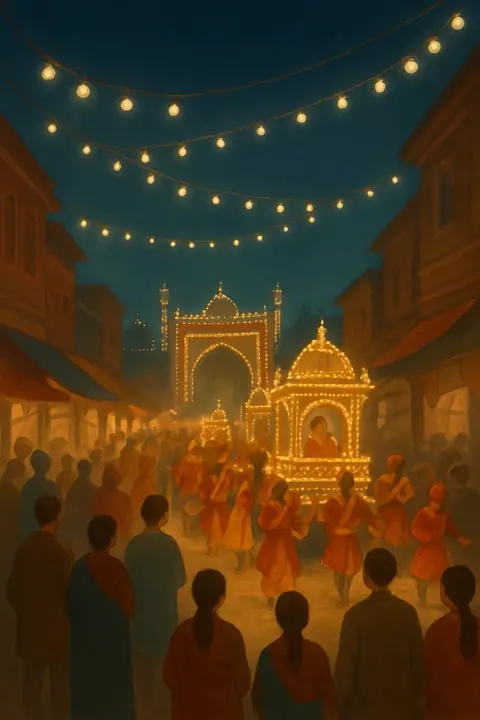
Ram Barat: Agra walks Rama to his wedding
A god's wedding party moves all night through Agra to the bride's palace
Ram Barat is Agra's biggest night of the year, and almost none of it happens near the Taj. As part of the city's Ramlila before Dussehra, a wedding procession for Rama sets out through the old city with chariots, bands and tableaux and walks all night to Janakpuri, the bride's city, built anew each year in a different neighbourhood. The date is not fixed: past editions have fallen between mid-September and mid-October, and the Shri Ramlila Committee announces the date and the host neighbourhood each year, usually in July.
The Shri Ramlila Committee in Agra sets the procession date and the host neighbourhood each year, usually in July.
The legend
In the Ramayana, King Janaka of Mithila finds a baby girl in a furrow while ploughing for a rite and raises her as his daughter, Sita.
Sita will marry only the man who can string Shiva's bow. Many princes try; Rama takes the bow and breaks it in two.
King Dasharatha comes from Ayodhya to Mithila with the wedding party, and Rama marries Sita.
Some 125 years ago, it is said, the Agra merchant Lala Kokamal began a three-day festival around this royal wedding.

Every year since, Agra sees Rama off to his bride again: the wedding party walks all night through the old city to a new Janakpuri.
Meaning
Janakpur
In Janakpur in Nepal, where the Ramayana sets the wedding, it is marked on Vivah Panchami, and a Ram Barat procession arrives there too.
Customs
A new Janakpuri
Each year Janakpuri, the bride's city, is set up in a different Agra neighbourhood, decorated like a bride's family home.
Janak Mahal
Craftsmen build a temporary palace of King Janaka for the wedding and light it up; after the procession it opens to all.
The brothers' chariots
Tableaux roll out from midday, and by evening Rama appears: in 2024 on a peacock chariot, with Lakshmana on one shaped as the serpent Shesha.
Greeting the groom
By morning the party with Dasharatha and the sages Vasishtha and Vishvamitra reaches Janakpuri, and the neighbourhood greets it as the bride's family.
Sita's mehndi
The neighbourhood women prepare Sita as a real bride: Rama's name is drawn on her hands in henna, and her dola palanquin is carried on procession day.
Words of the festival
बारात
barat
the groom's wedding procession to the bride's home
जनकपुरी
Janakpuri
"Janaka's city", the bride's home town; for the festival one Agra neighbourhood becomes it
डोला
dola
a palanquin that carries a bride; at the festival it carries Sita
झाँकी
jhanki
"a glimpse": a decorated or living tableau riding in the procession
How to greet
जय सियाराम
Jai Siya Ram!
"Glory to Sita and Rama": an old village greeting of north India; on procession night the whole street shouts it.
True or myth
❌ Myth. A new Agra neighbourhood is chosen every year, and the procession route changes with it.
❌ Myth. The procession night is followed by days of the wedding at Janakpuri, with rites, darshan and aarti at the Janak Mahal.
✅ True. The road where the barat sets out bears Lala Kokamal's name, as do the grounds where the Ramlila is staged.
Where to celebrate
What you see on procession night
The word barat means the groom's wedding procession to the bride's home, and Agra stages exactly that, for a god. The procession sets out from Lala Channomalji Ki Baradari, a pavilion in the old city, and threads through the lanes towards Janakpuri. Rama and his brothers appear on special chariots decorated with silver leaf, in jewelled headgear, and the female roles are played by local teenage boys. Behind and between them come akharas (wrestling and martial clubs), brass bands and jhankis, decorated or living tableaux: an announced edition counted more than 200.
It is slow and long. The tableaux start rolling out from midday, the main party leaves in the evening, and it reaches Janakpuri by morning. Crowds come from across Agra and from neighbouring districts of Rajasthan and Madhya Pradesh, and the reported numbers run to millions.
The procession is only the first night. For the following three days or so the wedding continues at Janakpuri, where craftsmen build a temporary, lit-up palace of King Janaka, the Janak Mahal, with rites, darshan (viewing of the deities) and aarti, and the whole neighbourhood turns into a fair.
When Ram Barat happens
Ram Barat belongs to the Ramlila of Agra, which ends on Dussehra with Rama's victory over Ravana, and the district administration lists it as held before Dussehra. Because Dussehra follows the lunar calendar, the procession moves too: past editions listed on Wikipedia fall between mid-September and mid-October. The festivities run three or four days in all.
The Shri Ramlila Committee of Agra fixes both the date and the host neighbourhood, usually in July, and local Hindi papers report it from then on. Until it is announced, any date you see online is a guess.
Where to watch
Everything is free and on the street. There are no seats and no tickets.
Along the old-city route, on the first evening
Find a place on the route in the old city in the evening and expect to stand for hours: the procession passes a given spot over a long stretch of the night.
Janakpuri and the Janak Mahal, the evenings after
The lit palace and the decorated neighbourhood are open to all on the evenings after the procession. This is the calmer way to see the festival.
Where to stay and when to arrive
The festival moves around the city, so the right hotel changes every year.
- Stay on the Janakpuri side
Once the host neighbourhood is announced, book on that side of the city about a month ahead. Recent hosts have included Kamla Nagar, Shah Ganj, Dayal Bagh and Sikandra. Taj Ganj, by the Taj Mahal, is usually far from the route.
- Arrive the day before
The procession closes roads across the host area and runs very late.
- Trains from Delhi
Agra has fast trains from Delhi, among them the Gatimaan Express, Vande Bharat and Shatabdi. Booking about a month ahead is enough.
In the crowd
This is a religious procession and a city-wide party at once. The street greeting all night is "Jai Siya Ram", glory to Sita and Rama.
- Plan to walk — Roads in the host area close for the procession, so expect to walk the last stretch and the way back.
- Crowd basics — UK travel advice notes that stampedes have happened at large religious gatherings in India and asks visitors to follow the advice of the local authorities.
- Give the procession room — It is a religious procession first. Watch from the side of the street and do not push into it for a photo.
More festivals in Agra
Agra's other two big dates are the Taj Mahotsav crafts festival in February and the Bateshwar Fair in October–November, about 70 km away. The rest of the city is on the Agra page.
FAQ
When is Ram Barat in Agra?
Before Dussehra; past editions have fallen between mid-September and mid-October. The exact date and the host neighbourhood are set each year by the Shri Ramlila Committee of Agra, usually in July; until then no date is confirmed.
What is Ram Barat?
The wedding procession (barat) of Rama, staged in Agra as part of the city's Ramlila: the groom's party walks through the old city to Janakpuri, the bride's city, built for the festival in a different neighbourhood each year.
Where does the Ram Barat procession start?
At Lala Channomalji Ki Baradari in the old city. From there it goes through the lanes to that year's Janakpuri.
How old is Ram Barat?
By tradition about 125 years: the Agra merchant Lala Kokamal is said to have started the festivities, and the road where the procession sets out is named after him.
Is it free to watch?
Yes. The procession is watched from the street, and Janakpuri and the Janak Mahal are open to all on the evenings after it.
Sources (4)
Facts checked: 21 October 2026. Prices and hours are approximate; check locally.