 India GO
Raja Parba: the days Odisha lets the earth rest
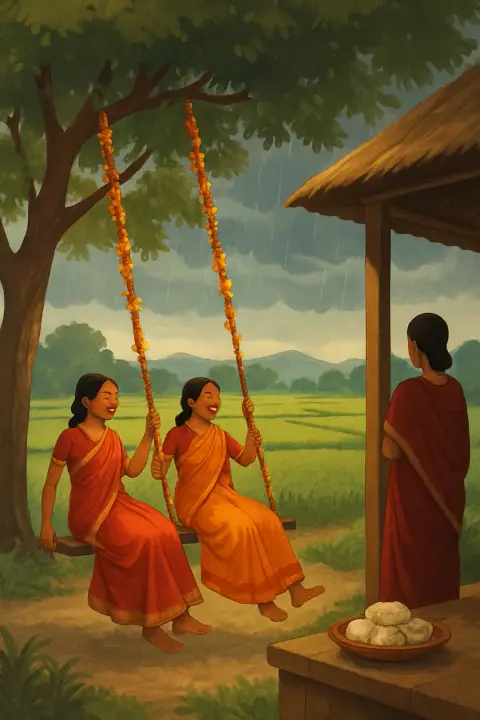
Rope swings under the first monsoon clouds while the earth is left to rest
Raja Parba is Odisha's festival of womanhood and the first monsoon. For three days in mid-June it is believed that Bhumi, Mother Earth, menstruates as a woman does, so farm work stops, girls and women rest in new clothes, rope swings go up in the trees and homes bake poda pitha. Dates: 14–17 June 2027 (expected); the main day, Raja Sankranti, is a state holiday.
The Odisha holiday list, issued in November or December of the previous year, gives Pahili Raja and Raja Sankranti.
The legend
It is believed that during the first three days Bhumi, Mother Earth and the consort of Vishnu, menstruates as a woman does.

The word raja comes from the Sanskrit rajas, menstruation. The festival falls in mid-June, as the rainy season begins.

The earth is left alone: all farm work stops, and on the fourth day, Vasumati Snana, women bathe the grinding stone as an image of Bhumi.
Customs
Banyan swings
Girls in new saris ride rope swings hung from big banyan trees, singing songs made up on the spot.
Games and shows
Young men play kabaddi, villages compete with each other, and at night there are jatra plays and gotipua dances.
What people eat
Poda pitha
A sweet rice cake with coconut, baked until lightly charred.
Words of the festival
ରଜ ପର୍ବ
Raja Parba
"Festival of rajas", from the Sanskrit for menstruation.
The days of Raja
Raja follows the solar calendar: it centres on Mithuna Sankranti, the day the Sun enters Gemini and the solar month of Mithuna begins, which is why its dates barely move from year to year. Sources count three days of Raja proper, plus a day of preparation before and the earth's bath after.
| Sajabaja | A day of preparation before the festival begins. |
| Pahili Raja | The first day of Raja, the day before the Sankranti; a state holiday in Odisha. |
| Raja Sankranti | Mithuna Sankranti itself, the main day of the festival and a state holiday. |
| Bhudaha or Basi Raja | The third day, also called Sesha Raja. |
| Vasumati Snana | The fourth day: women bathe the grinding stone as an image of Bhumi and offer it turmeric paste, flowers and seasonal fruit. Also written Basumati Snana. |
Swings, pitha and kabaddi
The word raja comes from the Sanskrit rajas, menstruation, and the festival marks it openly. The earth is left alone: no ploughing or digging, and all farm work stops. The festival centres on unmarried girls, who keep customs echoing those of menstruation: they rest from housework (the spices are ground in advance, on the preparation day), do not walk barefoot, and eat uncooked, nourishing food.
Girls and women wear new saris, alta (red dye on the feet) and jewellery. Rope swings hung from big banyan trees, among them the Ram Doli, Charki Doli and Pata Doli, are given over to them, and they sing folk songs, many made up on the spot, as they swing. Households bake poda pitha, a sweet rice cake with coconut, baked until lightly charred.
Young men play country games, kabaddi above all, with villages competing against each other, and villages that can afford it put on jatra (folk theatre) or gotipua dance at night. In the medieval period Raja also became a festival of Bhumi as the consort of Jagannath, a regional form of Vishnu: in the Puri temple a silver image of Bhumi stands beside him.
For a visitor
Raja happens in homes and villages rather than at one venue, so there is no programme or ticket. It is a pleasant thing to find if you are in Odisha in mid-June, rather than a reason for the trip.
- Where — Across Odisha, most strongly in the coastal districts: in villages, and in towns such as Puri and Cuttack.
- Holidays — Pahili Raja and Raja Sankranti are on the Odisha government's holiday list, so government offices close.
- Weather — Raja coincides with the start of the monsoon, so expect the first rains.
- Ask before photographing — The swings are a women's space during the festival. Ask before photographing girls and women on them.
- Pair it with — Sital Sasthi in Sambalpur, and Rath Yatra in Puri, also in the early monsoon.
FAQ
When is Raja Parba?
Next: 14–17 June 2027 (expected). It is held around Mithuna Sankranti in mid-June, and the Odisha holiday list confirms Pahili Raja and Raja Sankranti in advance.
What are the three days of Raja Parba?
Pahili Raja, Raja Sankranti (Mithuna Sankranti) and Bhudaha or Basi Raja. A fourth day, Vasumati Snana, follows, when the grinding stone is bathed as Mother Earth.
What does Raja mean in Odia?
It comes from the Sanskrit rajas, menstruation: the festival marks the days when Mother Earth is believed to menstruate.
What food is made for Raja?
Poda pitha, a sweet rice cake with coconut baked until lightly charred, is baked at home for the festival.
In which state is Raja Parba celebrated?
In Odisha, most strongly in its coastal districts.
Sources (4)
Facts checked: 21 October 2026. Prices and hours are approximate; check locally.