 India GO
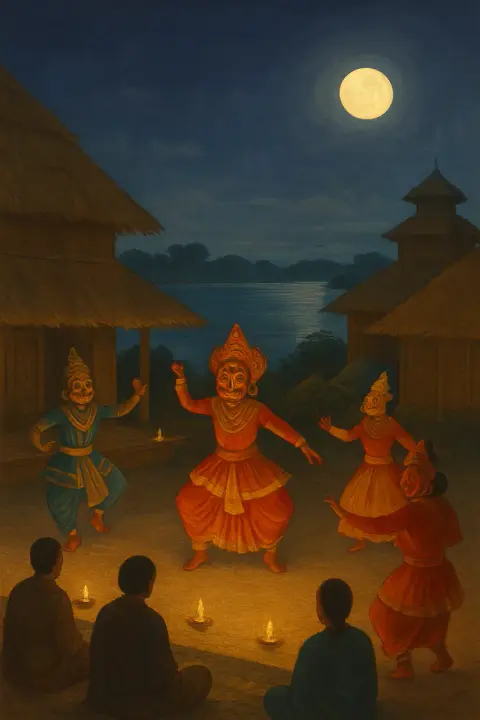
Raas Mahotsav on Majuli: Krishna's life played out until dawn
All-night Krishna plays in masks on a river island at the full moon
Raas Mahotsav is Assam's festival of Krishna's life told as theatre, and on Majuli, a river island in the Brahmaputra, it takes over the whole island for three nights around the Kartik full moon. The satras (Vaishnava monasteries) and dozens of village stages play from evening until dawn. Dates: 23–25 November 2026. The catch is the river: the ferries stop in mid-afternoon, so the Raas is something you sleep on the island for, not a day trip.
The days follow the full moon; the Majuli district administration and the satras announce the Raas programme in late October or early November.
The legend
In the Bhagavata Purana, Krishna plays his flute one night in Vrindavan. Hearing it, the gopis, the cowherd girls, slip away from home to the forest.
As the gopis draw near, Krishna playfully vanishes, then appears again.
He dances with every gopi, taking many forms, and the night, it is said, stretches to a whole kalpa, billions of years long.
Every year at the full moon, Majuli's satras stage this dance of divine love until dawn.
Meaning
Assam
Raas is one of Assam's state festivals. Besides Majuli, Nalbari and Howly are especially known for it.
Assam Vaishnavas
Sankardev, founder of Assamese Vaishnavism, began the Krishna plays himself, and since the 16th century Majuli has been the island home of his tradition.
The whole island
On Majuli the Raas draws in everyone, whatever their caste, faith or background.
Customs
Samaguri masks
Masks for the plays are made in the satras, Samaguri above all. One takes 10 to 15 days, and the largest cover the actor entirely.
The musical prelude
The play opens with gayan singers and bayan musicians: drums, big cymbals and sweeping hand movements. Only then does the sutradhar step in.
Monks on stage
In the old satras every role, from Krishna to the gopis, is played by bhakat monks sworn to celibacy.
Village stages
The Raas has long spread beyond the satras: villages, community halls and namghars across the island stage their own.
What people eat
Mah-prasad
soaked green gram with ginger and fruit, offered before a bhaona
Words of the festival
ৰাসলীলা
rasalila
from ras, nectar or feeling, and lila, play: the dance of divine love
সত্ৰ
satra
a Vaishnava monastery of Assam; Majuli once had 65
ভাওনা
bhaona
Assamese devotional drama with song, dance and masks
মুখা
mukha
a bhaona mask of bamboo, cane, clay and cloth
সূত্ৰধাৰ
sutradhar
the narrator and director, who explains each scene to the audience
True or myth
❌ Myth. Back in 1922 Pitambar Deva Goswami, head of the Garamur satra, set up a theatre with boys and girls instead of all-male casts.
✅ True. Among them is komal saul, a rice that needs no cooking: it is soaked in water and eaten with milk or curd.
✅ True. It was made a district in 2016.
Where to celebrate
Majuli
Worth the trip
Majuli's satras and villages stage the Raas on some fifty stages over three nights around the Kartik full moon, from about 8 pm until dawn; sleep on the island.
What a Raas night looks like
Despite the name, the Raas is not one dance but the whole life of Krishna in a cycle of plays. The district's description runs from his birth and childhood in the house of Nanda, through the cowherd years at Gokula and the killing of demons such as Bakasura, Putana, Kaliya and finally his uncle Kamsa, to the rasa lila, the dance with the gopis (cowherd girls). More than a hundred characters can appear on stage in a single day.
The texts are variations on plays of the Assamese Vaishnava tradition, among them Keli Gopal by Sankardev and Raas Jhumura, attributed to his disciple Madhavdev. Performances run from about 8 pm until dawn, with masks, painted backdrops and handmade props.
At Garamur, 100 to 150 volunteers put on the festival, and main rehearsals start only the day after Diwali. During the three or four days, island families receive visitors, and many put them up at home.
Where to watch: satras and village stages
About a dozen major satras stage the Raas, among them Auniati, Dakhinpat, Garamur, Natun Kamalabari, Uttar Kamalabari, Bengenaati and Samaguri, and each keeps its own style. Moving between two or three in one night is the whole idea.
Dakhinpat Satra
Where Assam's Raas began: the district dates the first performance here to 1840. The play runs for about ten hours, and as each character enters, the image of that deity is worshipped; the satra head and the audience stand when Krishna and Balarama come on stage.
Garamur Satra
The Raas as stage theatre, introduced in 1934 by Pitambar Dev Goswami, the head of the satra and a social reformer, who in 1950 also let girls take roles. Performances are in an auditorium of about 1,000 seats, ticketed; seats are usually booked about a month ahead.
Uttar Kamalabari Satra
The opposite approach: the roles are played by celibate monks of the satra, and the performances are free and open to all.
Village stages
Villages set up stages in community halls, open fields and school grounds, more than sixty venues across the island by one count. Some sell tickets to cover their costs. At Borun Chitadar Chuk the Raas is organised by the Mising community in a school.
Getting to Majuli
In practice it is one flight or train to Jorhat and one ferry, as long as you respect the ferry hours.
- To Jorhat
Fly into Jorhat (Rowriah); Lakhimpur (Lilabari) and Dibrugarh (Mohanbari) are the other airports. Train tickets to Jorhat go on sale 60 days ahead, and it is worth booking flights at the same time.
- The ferry from Nimati Ghat
Nimati Ghat is about 14 km from Jorhat. Ferries cross to Kamalabari or Aphalamukh Ghat on Majuli between 7:30 am and 3:30 pm, roughly 50–65 minutes one way and 75–90 minutes the other, depending on the current. Tickets can be booked online through Assam Inland Water Transport, which also posts service notices.
- From the Lakhimpur side
A shorter crossing leaves from Dhunaguri Ghat, about 10 km from Bihpuria: about 15 minutes over the Subansiri, between 7 am and 5 pm. A road also runs from Lakhimpur via Dhakuakhana, with buses from Lakhimpur, Dhemaji and Dibrugarh.
- Arrive on the morning of day 1
The river sets the pace. Cross in the morning, settle in, and be at the first satra by evening.
Where to sleep
Majuli's beds are satra guesthouses and small homestays, and there are few of them for the number of people who come: for one recent Raas the district expected about 50,000 visitors. Book about three months ahead, and stay on the island for the nights you want to watch. During the festival many island families also take in visitors.
Staying in Jorhat and crossing daily does not work for the evening plays: the last boats leave around 3:30 pm and the plays run from about 8 pm until dawn.
Etiquette in the satras
A satra performance is worship as much as theatre.
- Sit where you are seated — Satras seat visitors in a particular place. Take it; at Dakhinpat the audience stands when Krishna and Balarama come on stage.
- Flash off — Keep the flash off and the phone quiet.
- Leave a donation — Many satra performances are free. A donation at the satra is the polite way to say thank you.
- Dress for a religious site — UK travel advice asks visitors to respect local dress codes and customs, particularly at religious sites and in rural areas.
FAQ
When is Raas Mahotsav on Majuli?
Next: 23–25 November 2026, three nights around Kartik Purnima, the full moon of Kartik. The district administration and the satras announce the programme in late October or early November.
What is Raas Mahotsav?
A festival of Krishna's life performed as devotional theatre with song, dance and masks, from his birth to the rasa lila with the gopis. On Majuli it is staged by the satras and by villages across the island.
Why is Raas celebrated in Assam?
It grew out of Assamese Vaishnavism, whose founder Sankardev wrote plays about Krishna; Majuli's satras have kept this tradition for centuries. Raas is now one of Assam's state festivals. It is also celebrated widely beyond Majuli, notably in Nalbari and Howly.
Can I visit the Raas as a day trip from Jorhat?
Not for the performances. Ferries from Nimati Ghat run only from 7:30 am to 3:30 pm, and the plays go on from about 8 pm until dawn, so you need to sleep on the island.
Do I need tickets?
Many satra performances are free, Uttar Kamalabari's among them. The Garamur auditorium and some village stages sell tickets; Garamur seats are usually booked about a month ahead.
Do women perform in the Raas?
It depends on the satra. At Garamur girls have taken roles since 1950, and today women perform at most venues; at Uttar Kamalabari the roles are still played by celibate monks.
Sources (6)
Facts checked: 21 October 2026. Prices and hours are approximate; check locally.