 India GO
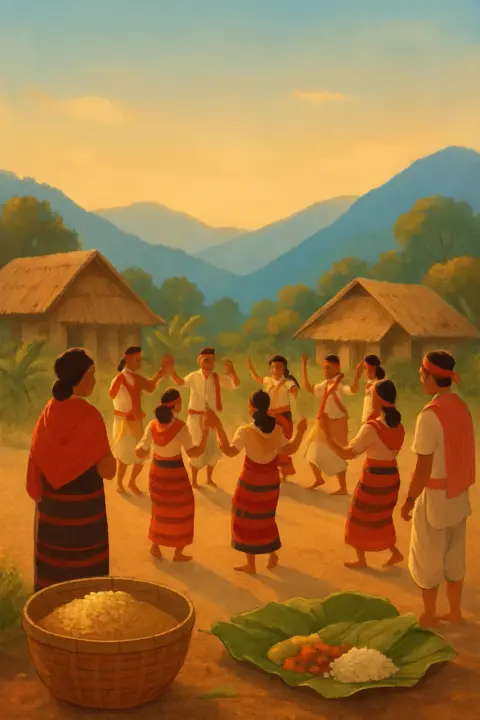
Ngada: the Rengma Naga festival that closes the farming year
Drums lead a procession from house to house, and every door opens with rice beer
Ngada is the biggest festival of the Rengma Nagas of Nagaland: a thanksgiving held at the end of November, once the harvested grain is home, when the farming year is closed with feasting, dancing and forgiveness. Nagaland Tourism lists it for Tseminyu district on two fixed days at the end of November every year. Next dates: 27–28 November 2026. In the villages the festival runs longer, seven to nine days depending on the village.
The dates are fixed in the Nagaland calendar; village programmes are announced locally.
The legend
Ngada is the greatest festival of the Rengma Naga. It is kept in late November, once the year's crop has gone from the fields into the granaries.
The Rengma hold that the souls of the dead visit their families during Ngada. The year's wrongs are forgiven and quarrels set aside before the new year.

Ngada closes the year: the day after it the new one begins, with new fields cleared for the coming harvest and rites for its protection.
Customs
Readying the village
The village priest announces the dates. Men clean the village, paths and wells, bring banana leaves and air their festive dress in the sun.
House to house
A procession with drums and song goes from house to house, each house feeds it, and the afternoons are for dancing. The festival lasts seven to nine days.
Tseminyu programme
On 27–28 November the ground at Tseminyu holds the Rengma public programme: folk songs, dances and traditional games.
Where to celebrate
Tseminyu
The Rengma close their farming year with eight days of village rites that end in a shared feast, and bring the public programme to Tseminyu on 27–28 November.
What Ngada is and what the name means
The Rengmas keep several seasonal festivals tied to their fields, and Nagaland Tourism calls Ngada the biggest, grandest, longest and most colourful of them. The department explains the name as nga, merry-making, and da, big: a festival of rejoicing. A Rengma community organisation, quoted by The Morung Express, gives a slightly different reading, nga for festival and da for a series of celebrations, which matches how the festival actually runs over several days.
It is a thanksgiving for the blessings of the year, and also a reckoning. Wrongs done in shared work, trade or hunting are meant to be forgiven and forgotten, misunderstandings between families are set aside, and new friendships begin. The Rengmas hold that the souls of the dead visit their families during Ngada, so families clean the graves and leave food and drink there as a sign of remembrance. The day after the festival is the start of the new year, when new fields are chosen and cut for the coming season.
How the festival runs
The village priest announces the dates, and the preparations are shared out:
- Readying the village
Men clean the village, the morung (the traditional youth house), footpaths and wells, bring banana leaves for serving food and air their festive dress in the sun. Women collect firewood, prepare rice beer and clean the houses.
- Feasts
Through the festival, wealthier households host feasts for the whole village, and guests sing and dance in praise of the host.
- The procession
On the second-to-last day the men, in full traditional dress and carrying weapons, go through the village with song and dance, visiting every house. What each house gives is cooked outside the morung and shared by all, a sign that no ill feeling remains in the community.
- The public programme at Tseminyu
The Rengma Hoho, the tribe's apex body, holds a two-day programme with the state tourism department at the RSA ground in Tseminyu, with folk songs, dances and the Ngada feast. Recent editions opened with a thanksgiving service or with indigenous games such as bamboo-pole climbing, stilt races and tug-of-war between teams from the seven Rengma ranges.
Permits for Nagaland
Tseminyu is in Nagaland, where visitors need a permit on top of any visa. Arrange it before you travel on from Dimapur.
- Indian nationals: Inner Line Permit — Required for all of Nagaland. Apply on the state portal, ilp.nagaland.gov.in; the domestic permit costs about ₹200 for 30 days.
- Foreign nationals: Protected Area Permit — All foreign nationals visiting Nagaland must hold a Protected Area Permit, applied for online through the e-FRRO portal, and register with the district Foreigners Registration Officer within 24 hours of arrival. The state ILP portal also lists a permit category for foreigners, about ₹500 for 30 days.
- Rules change — The UK Foreign Office (FCDO) says permit regulations can change at any time and advises applying three months before arrival. Check the portals before you book.
Where to stay and getting there
Kohima, about 48 km from Tseminyu, is the practical base: Tseminyu itself has a circuit house and very few rooms. Book about six weeks ahead. The nearest airport and railway station are at Dimapur, about 100 km from Tseminyu.
Ngada falls in the week before the Hornbill Festival at Kisama, so it combines naturally with it. If you are staying on for Hornbill, book as early as for Hornbill itself, because Kohima fills up for it.
Etiquette and safety
Ngada is a community festival, and in the villages you are a guest at someone else's celebration.
- As a guest — At the village processions and feasts, wait to be served rather than joining the line, and ask before photographing people in traditional dress.
- Alcohol law — Rice beer is part of the tradition, but the FCDO lists Nagaland among the states where the consumption, production or transport of alcohol is illegal, and warns that you could be arrested and held without bail. Do not bring alcohol in.
- Roads in the north-east — The FCDO notes that protests and blockades are common in the north-eastern states and can disrupt the highways linking them with Assam. Follow local news and the advice of the authorities; see Is India safe?.
FAQ
When is Ngada?
Nagaland Tourism fixes it on two days at the end of November every year in Tseminyu district. Next dates: 27–28 November 2026. Village celebrations last seven to nine days and are announced locally.
What festival does the Rengma tribe celebrate?
Ngada is the Rengma Nagas' biggest festival, a thanksgiving after the harvest. They also keep other seasonal festivals tied to their cultivation.
What does Ngada mean in English?
Nagaland Tourism translates it as nga, merry-making, and da, big: a festival of rejoicing. A Rengma community body reads it as a series of celebrations.
Where is Ngada celebrated?
In Rengma villages in and around Tseminyu district, Nagaland, with the public programme at the RSA ground in Tseminyu, about 48 km from Kohima.
Do I need a permit for Ngada?
Yes. Indian nationals need a Nagaland Inner Line Permit from ilp.nagaland.gov.in; foreign nationals need a Protected Area Permit through e-FRRO and must register within 24 hours of arrival.
Who are the Rengma people?
The Rengma are one of the Naga tribes of Nagaland; Tseminyu district is their home area in the state.
Sources (9)
- Nagaland Tourism: Tribes (Rengma, Ngada)
- Ngada, the festival of Rengma Nagas, The Morung Express
- Ngada-cum-Mini Hornbill Festival, The Morung Express
- Rengma's premier festival Ngada kicks off in Tseminyu, Eastern Mirror
- Nagaland Inner Line Permit portal: fees
- Mandatory Protected Area Permit for foreign visitors to Nagaland, All India Radio News
- FCDO: India entry requirements (access permits)
- FCDO: India safety and security (alcohol laws)
- FCDO: India regional risks
Facts checked: 21 October 2026. Prices and hours are approximate; check locally.