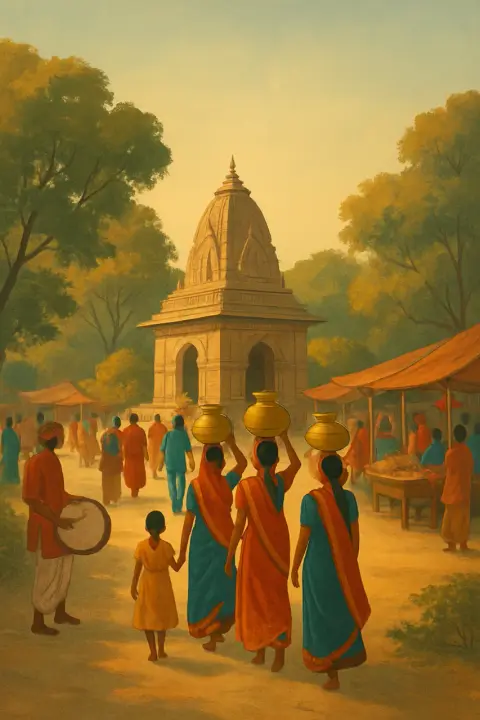
Nagoba Jatara is the festival of the Mesram clan of the Raj Gonds at Keslapur, in Indravelli mandal of Adilabad district, Telangana, built around their serpent god Nagoba. Its centre is the Mahapuja at midnight on the new moon that ends the lunar month of Pushya; the jatara around it runs several days and ends with a public durbar. Dates: 5–9 February 2027 (expected). It is described as the second-largest tribal gathering after the Sammakka Saralamma Jatara at Medaram, and draws clan members from Maharashtra, Chhattisgarh, Odisha and Madhya Pradesh as well.
The Mesram elders set the rites by the new moon; their walk to fetch Godavari water starts about two weeks earlier, and the Adilabad district fixes the Darbar day.
🐍
In Gond tradition, the serpent god Nagoba was born into the Mesram clan and later withdrew into the hills at Keslapur, where his temple now stands.
🏺
Before the jatara, clan members walk to the Godavari and carry its water back in new clay pots; at midnight on the Pushya new moon it is used to bathe Nagoba.
⚖️
The people's durbar held at the jatara was first convened in 1942 by the anthropologist Haimendorf; today the district collector presides over it.
Nagoba and the Mesram clan
In Gond tradition the serpent god Nagoba was born into the Mesram clan and later withdrew into the hills at Keslapur, where his temple now stands. The Mesram clan of the Gond and Pardhan communities keeps the rites. Worship began at the spot where the god is believed to have appeared; a thatched shrine was built there in 1956, a cement-and-brick temple in 1995, a government-assisted temple in 2000 and a stone temple in 2022. The Government of Telangana has declared the jatara a state festival.
The festival also holds something rare for a religious gathering: a people’s court. The durbar goes back to 1942, when it was first convened by the anthropologist Haimendorf, and today the district collector presides over it.
Facts checked: 21 October 2026. Prices and hours are approximate; check locally.
 India GO