 India GO
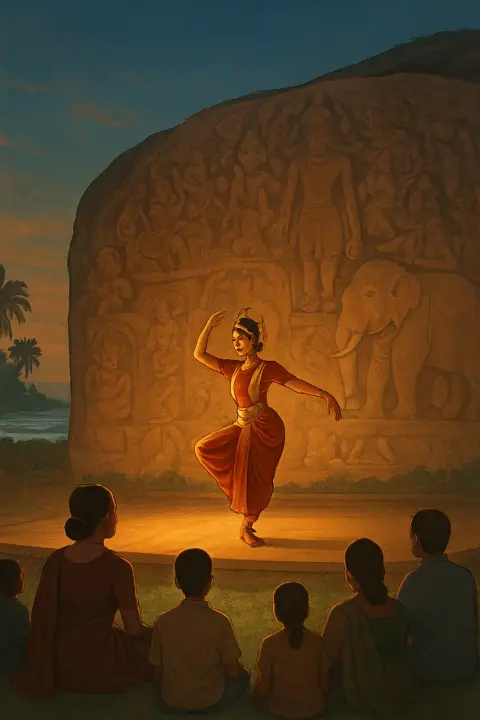
Mamallapuram Dance Festival: classical dance by the Pallava stones
Classical dance under floodlights before a seventh-century cliff of carved gods
The Mamallapuram Dance Festival, now officially the Indian Dance Festival, is a month of evening performances in Mamallapuram (Mahabalipuram), the Pallava port town about 60 km south of Chennai whose monuments are a UNESCO World Heritage Site. Tamil Nadu Tourism holds it every year from late December to mid-January, with classical and Tamil folk dance on an open-air stage at the Shore Temple complex, near the great rock relief of Arjuna's Penance.
Tamil Nadu Tourism names the season in November and confirms the exact dates a day or two before the opening in late December.
The legend
First held in 1992 as the Mamallapuram Dance Festival, it was later renamed the Indian Dance Festival.
The stage stands by Arjuna's Penance, a mid-7th-century rock relief measuring 29 by 13 metres.

The town is named after the Pallava king Narasimhavarman, known as Mamallan, "the great wrestler".
Customs
Classical evenings
Every evening noted dancers from across India take the stage: Bharatanatyam, Kuchipudi, Kathak.
Folk dances
Alongside the classics come Tamil folk forms: Mayilattam, Karagam, Kavadi, Thappattam and Oyilattam.
What is on the programme
Every evening noted dancers from across India take the stage, from 5:30 to 8:30 pm in the last edition, by Tamil Nadu Tourism's listing. The classical forms include Bharatanatyam, the dance of Tamil Nadu, Kuchipudi from Andhra Pradesh and Kathak from the north. Alongside them come Tamil folk forms: Mayilattam, Karagam, Kavadi, Thappattam and Oyilattam.
The festival was first held in 1992 as the Mamallapuram Dance Festival and was later renamed the Indian Dance Festival, though most people still call it by the old name. Tamil Nadu Tourism announces the season in November and confirms the exact dates shortly before the opening in late December.
The setting: Mamallapuram's monuments
The stage stands among Pallava monuments of the 7th and 8th centuries. The town is named after the Pallava king Narasimhavarman I, known as Mamalla, "the great wrestler", to whom scholars attribute many of its monuments of the 7th century. Arjuna's Penance, also called the Descent of the Ganges, is a mid-7th-century relief about 29 by 13 metres, a giant open-air rock relief carved with gods, people and animals. The Shore Temple stands on the beach, and the five monolithic Pancha Rathas are dated to the same century.
The Group of Monuments at Mahabalipuram was inscribed on the UNESCO World Heritage List in 1984. The monuments by day and the dance in the evening fit into one trip, and Chennai's December music season runs at the same time.
Practical tips
The festival is an add-on to a Mahabalipuram day or a Chennai winter stay rather than a reason for a trip on its own.
- Any evening works — Performances run every evening of the season, and Saturday evenings in January are the peak. Check the evening's line-up with Tamil Nadu Tourism.
- From Chennai — Mamallapuram is about 60 km south of Chennai. If you come for the evening only, plan the return before you set out, as the show ends after dark.
- Respect the monuments — The stage is inside a protected heritage site. Do not climb on the carvings, and follow the instructions of staff and security.
FAQ
When is the Mamallapuram Dance Festival?
Every year for about a month, from late December to mid-January, with performances every evening. Tamil Nadu Tourism confirms the exact dates shortly before the opening.
Why is Mahabalipuram called Mamallapuram?
After the Pallava king Narasimhavarman I, known as Mamalla, "the great wrestler". Mahabalipuram is another historical name of the town.
In which year were the Mamallapuram monuments listed by UNESCO?
In 1984, as the Group of Monuments at Mahabalipuram.
Which dances are performed at the festival?
Classical forms such as Bharatanatyam, Kuchipudi and Kathak, and Tamil folk forms: Mayilattam, Karagam, Kavadi, Thappattam and Oyilattam.
Sources (3)
Facts checked: 21 October 2026. Prices and hours are approximate; check locally.