 India GO
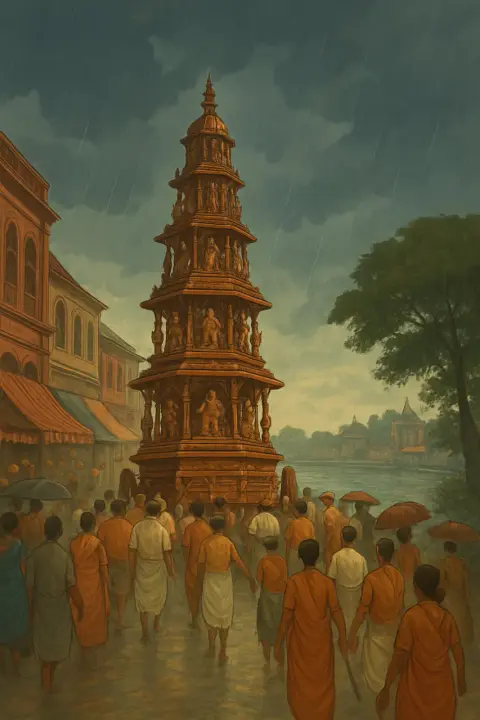
Mahesh Rath Yatra: Bengal's oldest chariot festival in Serampore
A four-tier iron chariot from 1885, hauled on two thick ropes down the Grand Trunk Road
The Rath Yatra of Mahesh, in Serampore on the Hooghly about 20 km upriver from Kolkata, is held on the same day as Puri's chariot festival and is said to have been celebrated since 1396, which makes it the oldest Rath Yatra in Bengal. Jagannath, Balarama and Subhadra ride about a kilometre down the Grand Trunk Road on a four-tier chariot of steel and iron built in 1885, and come back eight days later on the Ulto Rath. Next: 5 July 2027.
The Bengali almanac fixes the day; the Mahesh Jagannath temple trust and the Serampore municipality announce the pulling time in the week before.
The legend

In the 14th century the Bengali ascetic Dhruvananda comes to Puri hoping to offer Jagannath food with his own hands, but the temple servants refuse.
In the legend Jagannath appears to him in a dream and sends him to Mahesh on the Bhagirathi, where a neem trunk will arrive for new images.
On a stormy, rainy night the trunk arrives. Dhruvananda carves Jagannath, Balarama and Subhadra from it and builds them a temple.
Later Chaitanya visits and names Mahesh Naba Nilachal, "the new Puri". His disciple Kamalakar Piplai starts the chariot festival.
The wooden chariots burned more than once, and since 1885 Mahesh has pulled an iron one, still hauled along the Grand Trunk Road to "the aunt's house".
Meaning
The oldest
The festival has run since 1396: it is the oldest Ratha Yatra in Bengal and, by Bengali accounts, the largest in the state.
Radharani
In Bankim Chandra Chatterjee's novel Radharani, the young heroine gets lost at the Mahesh fair and is found by her future love.
Customs
The bathing festival
On the full moon before the festival the images are bathed in milk and Ganga water. The gods are then said to run a fever, and three physicians are called.
Fresh colours
Two weeks before the procession the images are repainted with herbal colours for three days behind closed doors. The painter eats once a day and takes no fee.
The rosshi ropes
The chariot is hauled on long ropes, and everyone in the crowd tries to take hold of them at least once.
At the aunt's house
The chariot travels about a kilometre to the Gundicha temple, "the aunt's house". The gods stay eight days and return on Ulto Rath.
A month-long fair
A fair of stalls and food runs beside the temple for a month, and two to three hundred thousand people come to see it.
What people eat
Papad bhaja
crisp fried papad, the signature snack of the chariot fairs
Jilipi
Bengal's syrupy jalebi, paired with papad at Rath Yatra
Words of the festival
রথযাত্রা
Rathayatra
"the chariot journey": Jagannath rides out of the temple on a ratha
উল্টোরথ
Ulto Rath
"the reverse chariot": eight days later the gods ride home
মাসীর বাড়ী
Mashir Bari
"the aunt's house", the Gundicha temple where the gods stay eight days
দারুব্রহ্ম
Daru-Brahma
the neem trunk from which Jagannath's images are carved
নবরত্ন
Nabaratna
"nine jewels", a Bengali temple style with nine towers; the chariot is built that way
True or myth
✅ True. Puri renews its images from time to time, but Mahesh is said to keep the ones made by Kamalakar Piplai himself.
❌ Myth. The Martin Burn company built it in 1885: four tiers, nine spires, twelve iron wheels and two copper horses.
✅ True. After the full-moon bath three physicians, from Arambag, Goghat and Ghatal, "treat" them until the fever passes.
Where to celebrate
Serampore
On the same day as Puri's festival, Mahesh pulls its four-tier iron chariot of 1885 about a kilometre down the Grand Trunk Road, and a fair runs beside the temple for about a month.
What you see on Rath Yatra day
The day starts at the Mahesh Jagannath temple near the river. In the early afternoon the three deities are brought out and lifted onto the chariot, and in the late afternoon the pull begins: two long, thick ropes, the rosshi, laid out ahead of the rath, and anyone in the crowd may take hold of them for a turn.
The chariot is the reason Mahesh is known beyond Bengal. Earlier wooden raths were lost to fire more than once, and in 1885 the Martin Burn company built the present one, with a steel frame and iron wheels, which is why it is known as the iron chariot. It is a nabaratna, the Bengali temple style with nine spires, in four tiers, about 50 feet tall on twelve iron wheels, with two copper horses in front. Puri builds new wooden chariots every year (see Rath Yatra); Mahesh pulls the same one.
The procession covers about a kilometre of the Grand Trunk Road to the Gundicha Bari, which Bengalis call the Mashir Bari, "the aunt's house". The deities stay there for eight days and return on the Ulto Rath, "the reverse chariot", along the same road. A fair of stalls and food sets up beside the temple; jilipi (Bengal's syrupy jalebi) and papad bhaja, crisp fried papad, are the chariot-fair snacks.
Six centuries of the Mahesh chariot
The temple's story begins with a legend. Dhruvananda (Drubananda) Brahmachari, a Bengali ascetic, went to Puri hoping to offer food to Jagannath with his own hands and was refused. In a dream Jagannath sent him to Mahesh on the Bhagirathi, where a neem log would come to him; on a stormy night it did, and he carved the three images from it. Later Chaitanya stopped at Mahesh on his way to Puri and named it Naba Nilachal, "the new Puri", and his follower Kamalakar Piplai became the temple's servitor and is credited with starting the chariot festival.
The ritual year follows Puri. On the full moon before Rath Yatra the images are bathed in milk and Ganga water and are then said to run a fever, treated by three physicians from Arambag, Goghat and Ghatal. Before the procession they are repainted with herbal colours over three days behind closed doors.
Sri Ramakrishna and Sarada Devi came to the fair, and Bankim Chandra Chatterjee's novel Radharani opens with its young heroine lost in the crowd at Mahesh.
How to get there from Kolkata
Mahesh is easiest as a day trip from Kolkata. Nothing needs booking for the day itself.
- Local train from Howrah
Take a main-line local from Howrah to Serampore, about 20 km and roughly half an hour. Local trains are unreserved, with tickets bought on the day.
- Auto or e-rickshaw to Mahesh
From Serampore station an auto-rickshaw or e-rickshaw takes you to Mahesh, which lies along the Grand Trunk Road.
- Arrive by late morning
The pulling time is announced by the temple trust and the Serampore municipality in the week before. Coming by late morning leaves time to see the temple before the deities are brought out.
- Come back for the Ulto Rath
The return eight days later is a second chance to see the chariot move. If you are travelling to Kolkata for the festival, a long-distance ticket a month ahead and a room two weeks ahead is ample: it falls in the monsoon and does not push up prices.
Etiquette and crowds
The procession is free and open to everyone, and it is a festival of the whole town: by the encyclopedia's count two to three lakh people (200,000 to 300,000) come to the fair. The UK Foreign Office (FCDO) notes that stampedes have occurred at large religious gatherings in India; at Mahesh the pressure is greatest around the ropes.
- Watch from the side of the road — Any point on the kilometre between the temple and the Gundicha Bari gives a view. Away from the ropes there is room to stand and see the whole chariot pass.
- If you take the rope — Hold on with both hands, move with the people around you and let go if the crowd surges. Keep clear of the wheels.
- At the temple — Shoes come off before the shrine; follow what the people around you do. Ask before photographing priests and rituals inside.
- Rain and basics — It is the monsoon: carry an umbrella and keep the phone and cash in a front pocket. Agree a meeting point away from the route. In an emergency call 112; see also is India safe.
FAQ
When is the Mahesh Rath Yatra?
On the second lunar day of the bright half of Ashadha, the same day as the Puri Rath Yatra, usually in late June or July: next 5 July 2027. The Ulto Rath follows eight days later.
How old is the Mahesh Rath Yatra?
It is said to have been celebrated since 1396, more than six centuries, and it is described as the oldest chariot festival in Bengal. The present chariot, of steel and iron, dates from 1885.
Where is the Mahesh Rath Yatra held?
In Mahesh, a historic part of Serampore in Hooghly district, West Bengal. The chariot runs about a kilometre along the Grand Trunk Road from the Jagannath temple to the Gundicha Bari.
What is the story behind the Mahesh Jagannath temple?
By legend, the ascetic Dhruvananda, refused at Puri, was sent by Jagannath in a dream to Mahesh, where a neem log arrived and he carved the images from it. Chaitanya later called Mahesh "the new Puri".
Is it free to watch, and can visitors pull the chariot?
Yes to both. There are no tickets, and anyone may take a turn on the ropes; it is crowded, so step back if the press gets heavy.
Sources (3)
Facts checked: 21 October 2026. Prices and hours are approximate; check locally.